
How your phone can show what stores are needed in Lexington County
Thousands of people leave Lexington County every day to spend their money somewhere else.
That’s according to data collected by the town of Lexington to track what economic development circles call “leakage” — the loss of local residents’ dollars when they go elsewhere to make their spending decisions, like cash escaping the county economy through a sieve.
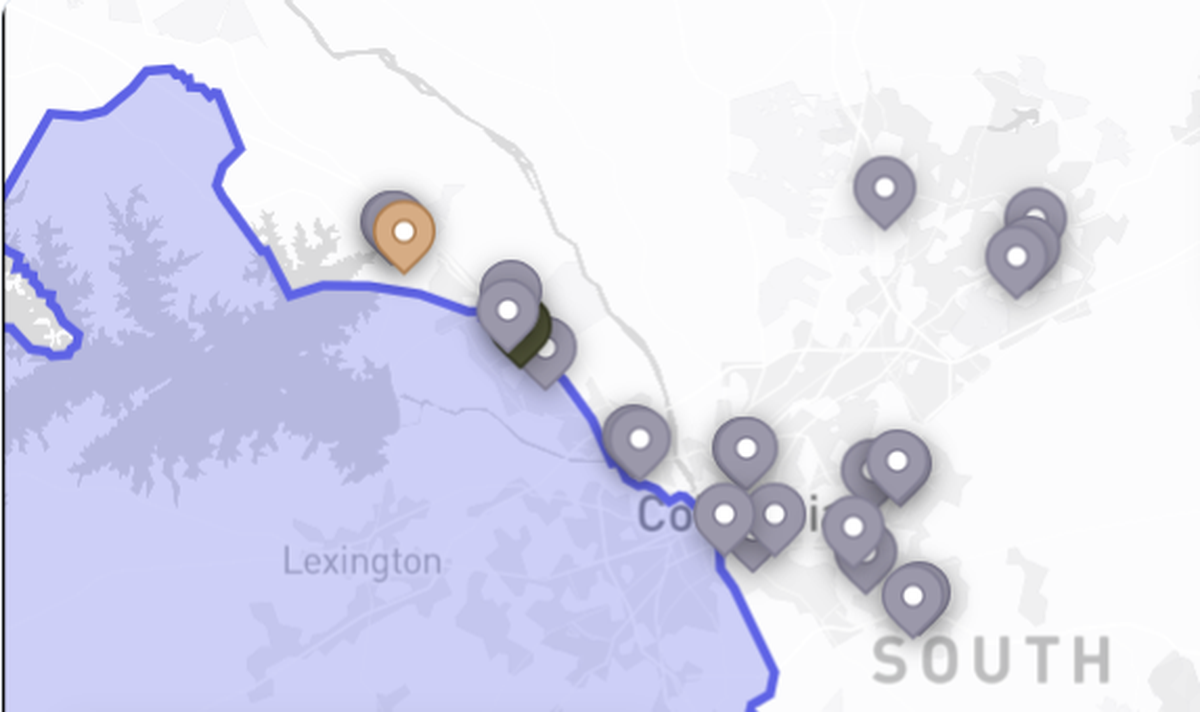
Data reviewed by The State shows that millions crossed the county line in calendar year 2025, mostly heading into Columbia for their shopping excursions. Some of those trips represent a quick hop over the county line, like the 375,000 trips made by county residents to Costco, or the 469,000 trips to the Walmart in Ballentine.
The data also includes more prosaic trips to Richland County, like journeys to the University of South Carolina or Prisma Health Richland Hospital. But it also shows a host of visits to Columbia shopping sites like Trenholm Plaza, which had nearly 275,000 Lexington County visitors last year.
“I think those 200,000 visits are coming from Lululemon,” said Jack Stuart, economic developer for the town of Lexington, who compiled the data. “Everyone wants a Lululemon.”
Phone numbers
Stuart’s office uses the data to track what kind of services Lexington residents are looking for that aren’t present in town, and tailor his recruitment efforts to better meet those needs without having to travel so far.
“Traditionally, my job would be focused on industrial recruitment, but now we’re really focused on small businesses and retail and getting quality of life through that,” he said.
The numbers come from Lexington locals themselves, who are unknowingly giving planners a lot of information about their spending habits. The data Stuart cites was pulled together using cell phone data, which allows him to see where the phone is traveling day to day and a pretty good idea of where the phone’s owner lives.
“It doesn’t know what your home address is, but it can tell what census track you go to,” by overlaying a combination of global imaging and U.S. Census data to the area where the phone is located, Stuart said. “If you have a free app on your phone, the data is there. It’s been sold to companies.”
That gives anyone looking at the data a strong idea of when people who live in Lexington County are traveling outside the county, and what kind of places they’re going to. Retailers will often use data like this to get a better sense of who their customers are and how they are coming to their stores.
Data wonks can then load the information into tools like Placer.AI, an artificial intelligence site that can break down and categorize the numbers and what they mean for the local economy. The site, which Lexington used to study the data, can even use AI to guess what the trends of the future will be.
The town’s economic developer then takes data like this to trade shows, so he has real-world numbers to show companies they already have customers in Lexington.
“I can get the interest of a company that the data shows we have a need for,” Stuart said. “I’ll see what we’re missing in market, and that’ll be a target.”
In demand
“The highest demand is for full-service restaurants,” he said. The Placer data shows a $232 million annual gap in Lexington County residents’ spending on such eating establishments and what’s available within the county’s borders, based on the STI Market Outlook data utilized by the site. Another $229 million is spent on limited-service eating places outside Lexington County, the data shows.
“Outside of that, it’s grocery stores,” which represent a $22.2 million gap in county annual spending, Stuart continued. “That’s typical for high growth areas. That’s what people are leaving the county for.”
Even some unexpected business needs like more car dealerships and gas stations can pop up in the data, he said. There’s $45.5 million in unmet demand for auto dealers, $26.3 million in electronics and appliances, $22.1 million in bars, and $18 million in office supplies.
There’s even some data showing that residents of Columbia’s Vista often travel the other way toward Lexington. Just based on the demographics of the area, Stuart estimates those are shoppers heading toward several women’s boutique stores in the Lexington area.
Although the data gathered is county-wide, Lexington County’s economic development office makes more sparing use of it because their recruitment targets are different, said Garrett Dragano, director of economic development for the county.
“Our office focuses on the manufacturing and industrial base,” Dragano said. “When we look at recruitment, we focus on warehouse, distribution and development of our county industrial parks.”
Those companies, he said, are more interested in the kinds of workers available in Lexington County than the kinds of customers there.
But the numbers do have an economic impact. The town previously used data showing how many residents made the 37-mile round trip to shop at the Trader Joe’s on Forest Drive to lobby the grocery store chain for a second Midlands location, before a new Trader Joe’s opened on Harbison Boulevard last year, Stuart said.
“My first great example was when we brought in Outback where O’Charley’s was,” Stuart said. “That was 120% driven by data.”
This story was originally published March 17, 2026 at 5:30 AM.
.jpg)