Charleston removed the monument, but John C. Calhoun is ‘living large’ in City Hall
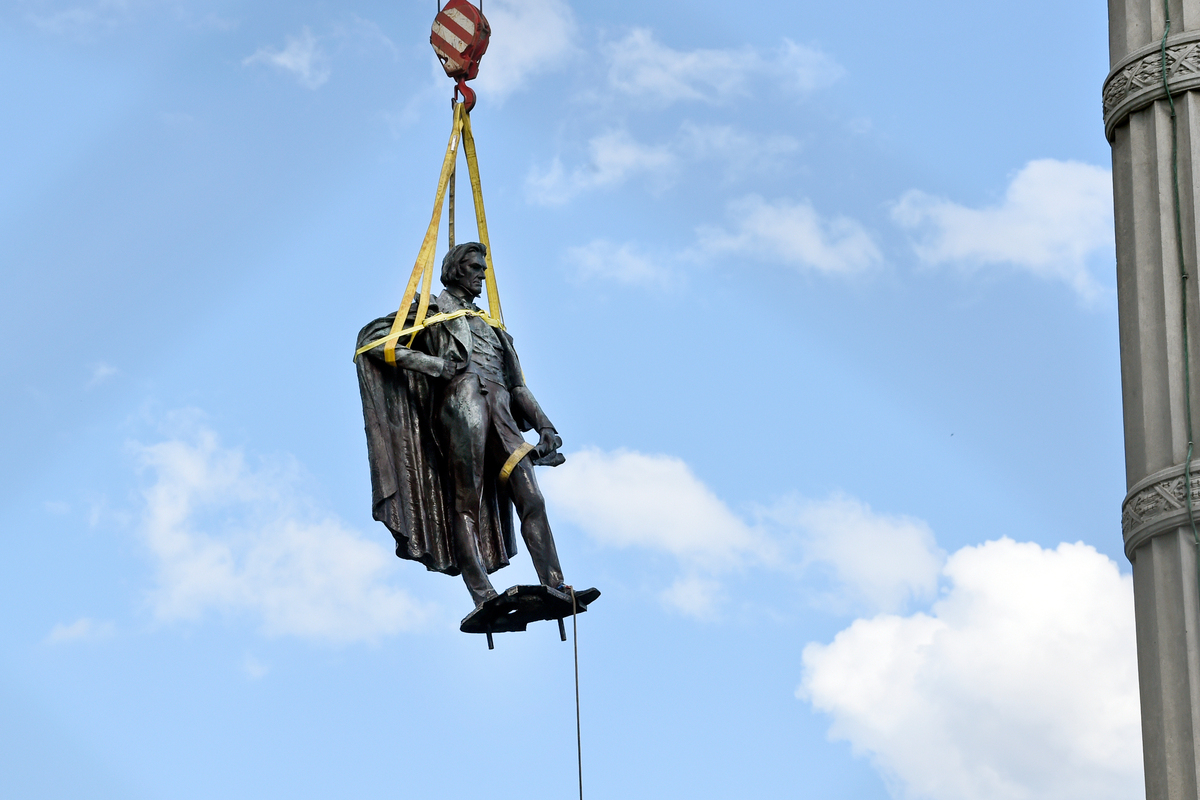
Somewhere, in an undisclosed location in Charleston, a 12-foot, 8-inch statue of John C. Calhoun awaits its final resting place. It’s a stark contrast to the prominence it once enjoyed.
For more than a century, the bronze statue towered above a changing Charleston in Marion Square, the heart of the historic city. Calhoun was twice a U.S. vice president, a South Carolina senator and also an ardent supporter of slavery, calling it a “positive good” in an 1837 Senate floor speech.
But last summer, amid a renewed national reckoning over relics honoring racist figures, Calhoun was brought down from his prominent perch after a unanimous Charleston City Council vote. When construction crews on June 24 detached and lowered the three-ton statue after 17 hours of work, hundreds cheered and some burst into song.
Despite Calhoun’s dramatic removal from the public square, his presence looms in Charleston City Hall, the city’s seat of power.
“I’m just going to say it. We pulled the statue down off a pedestal, but it’s still living large in City Hall,” Charleston City Councilman William Dudley Gregorie said.
The revelation came during a recent meeting of the city’s Commission on Equity, Inclusion, and Racial Conciliation. It illustrates the challenges that persist in this Southern city even after the removal of the Calhoun monument.
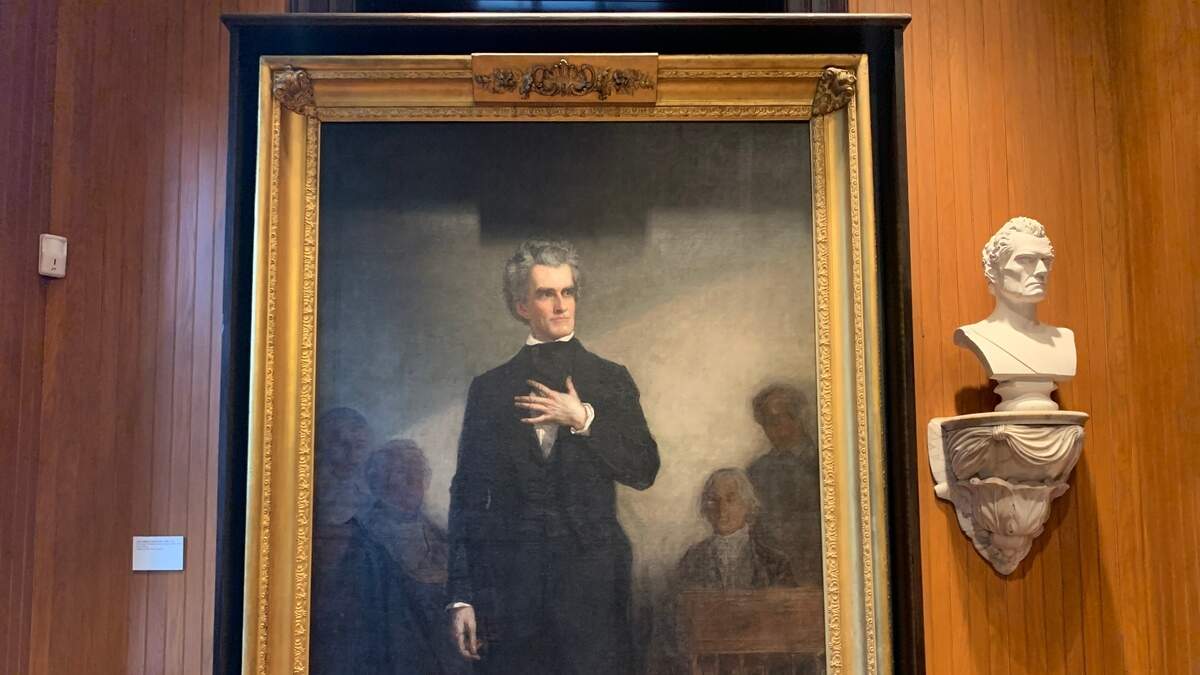
He is immortalized in three works of art owned by the city. A life-size portrait of Calhoun and an accompanying bust can be found just steps away from City Council chambers.
The third piece is a smaller bust of Calhoun that now resides in the mayor’s office.
As Charleston seeks to address complex issues rooted in structural racism, examining the city’s history and who it honors in public spaces is not a separate conversation. Instead, it is integral to laying a foundation of shared truths.
“Look at all the big things we are trying to tackle with this work, like housing and economic inequality,” said Gregorie, who co-chairs the racial conciliation commission, and is also one of City Council’s three Black members. “(Calhoun) is just one issue, but they all are interconnected. We can’t deal with any in isolation.”
An effort to create an ‘anti-racist’ city
The discussion about the city’s art collection is just one of the conversations happening among members of the racial conciliation committee.
Established in 2020, the group was formed two years after Charleston leaders narrowly passed a 2018 resolution apologizing for the port city’s role in the slave trade. The first meeting happened in September.
The commission was charged with looking into how the city can better address issues of diversity and opportunity and lead to an “anti-racist” city government. That includes reviewing how Charleston portrays its history and culture, as well as unpacking the structural inequities that continue in the city’s economy, housing, transit, criminal justice, education and health care.
The ordinance creating the special commission listed 10 specific responsibilities for the body. One of them was to “review and address historical markers, memorials and monuments.”
However, during the March 2 meeting, committee member Angela Mack suggested expanding their work to include a possible content assessment of the city’s art, which would center on “who the people are, why they’re there, what the significance is.” Mack is also the director of the Gibbes Museum of Art.
There are 110 pieces in the city’s art collection, 66 of which are on display in City Hall. A majority of those displayed works are paintings, and 41 of those 43 paintings are portraits of historical figures.
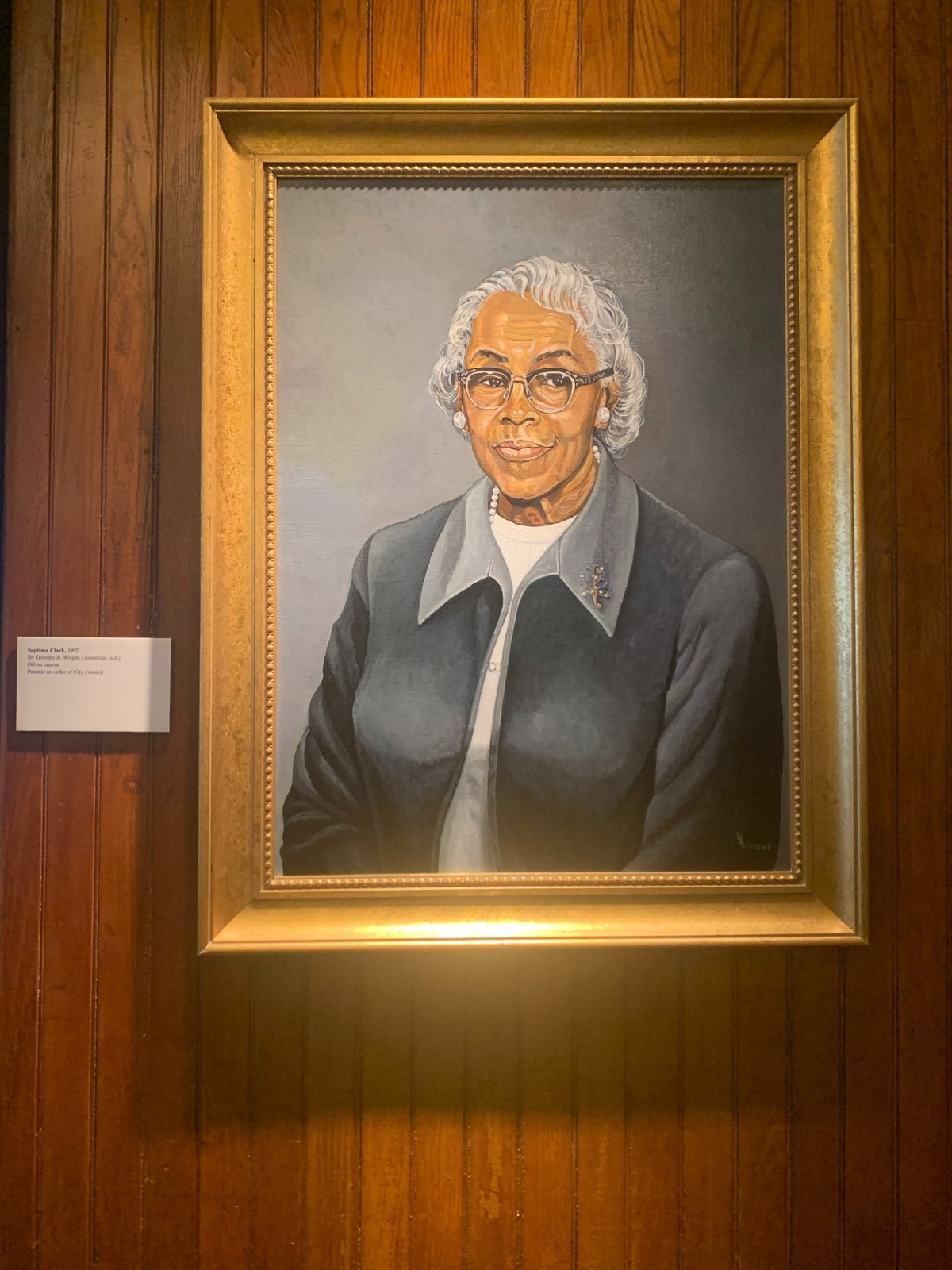
A number of the portraits depict individuals who either played an influential role in Charleston’s history, such as civil rights activist and educator Septima Clark, or people who visited Charleston during their lifetime, like President George Washington.
City Councilman Jason Sakran said he was struck by the lack of diversity he saw in the artwork that stared back at him inside City Council’s hallowed chambers.
Alongside Gregorie, Sakran serves as co-chair of the city’s racial conciliation commission.
During a recent City Council meeting, Sakran returned to Council chambers on Broad Street even though meetings continue to be held virtually over Zoom due to the pandemic. Before he sat down, he took stock of the art collection for himself.
“For me, at the end of the day, the one thing I keep coming back to is that this is about a recalibration, and it’s not about taking away,” Sakran said of the collection. “This is an opportunity for us to have a true representation of Charleston and those who helped make it what it is. And when I look around that room with 31 or 32 portraits and busts, and two honoring African Americans and two honoring women, that does not speak to the representation of Charleston then or now.”
No formal recommendations from the racial conciliation commission have been presented to City Council or the public yet, but Mayor John Tecklenburg said a report from the group will be submitted by May 11.
Some members of the commission, including the chair of the history and culture subcommittee, declined to be interviewed for this article and stressed that the committee’s work is ongoing.
The mayor said he feels “very positive” about the forthcoming recommendations. Without naming specifics, he also predicted some suggestions will generate “considerable discussion.”
“Even though sometimes it may seem uncomfortable, it’s important to have those discussions,” Tecklenburg said. “You find out about yourself and your city and who you are as a people.”
Experts say the ongoing dialogue about the city’s art collection is an opportunity for a deep conversation about Charleston’s values.
‘An honored location’
Kirk Savage, a professor of art history and architecture at University of Pittsburgh who has written extensively about the role public monuments and public art make in shaping cultural memory, said location and context matter.
“If we’re talking about a portrait that is in an important public space, like a government office, it’s an honorific. It’s in an honored location,” Savage said. “The entity that is showing it is implicitly endorsing it and honoring it by putting it there.”
That was the case for decades at Yale University, where a portrait of Elihu Yale, the school’s namesake, depicted a young Black man waiting on him as a servant. Wrapped around the young man’s neck was a metal collar — a symbol of human bondage.
The portrait hung above a mantle in the conference room that hosts meetings of the Yale Corporation, the university’s governing body.
“It was not a public place. It was not where even a student at Yale would have been able to go, but it was an honor to be in that room. It was an honored place for this blatantly racist image to be exhibited there, and it sent a really wrong message about what the values of the Yale Corporation are,” said Savage, who is a Yale graduate.
In 2007, after years of debate, Yale announced it would take down the painting and replace it with another work from the university’s collection.
While portraits are easier to move than large monuments, Savage said city art collections could become the next natural chapter born out of the national reckoning over Confederate monuments.
“When you start looking at these questions of representation, they do lead to these political questions that are still very much alive today: Who are we listening to right now? Whose interests and whose voices are we representing? And who is missing?” Savage said.
Adam Domby, a history professor at the College of Charleston, said the Calhoun portrait and busts in Charleston City Hall also send a specific message because the art is displayed in a place of power and governance.
“There is a real difference between City Hall and other places,” said Domby. “This is a place that is very much about the future. It’s about who controls the future of the city. City Hall’s purpose is not to teach history.”
The city’s own life-sized portrait of Calhoun depicts a scene that never happened.
The story of the portrait
In July 1850, four months after Calhoun’s death, Charleston’s mayor and City Council commissioned the portrait of Calhoun with the intention to display it in Council chambers.
George P. Alexander Healy agreed to paint it for a $1,000 commission. According to city records, the piece arrived in Charleston in late 1851 after exhibitions in Paris and at the Royal Academy in London.
The portrait was meant to depict Calhoun giving his last speech in the United States Senate, but the scene in the oil painting that hangs near City Council chambers never actually happened.
On the day Calhoun was to deliver his 42-page speech against the compromise of 1850 — which, among other things, sought to put limits on slavery as the nation expanded westward —he was clearly dying. The Library of Congress notes Calhoun was “emaciated and spectral in appearance” and had to be assisted to his desk. He wrapped himself in a black cloak.
When it came time to give his speech, Calhoun was too weak. U.S. Sen. James Murray Mason of Virginia read it aloud on his behalf.
A letter from Healy, the artist, indicated he had “taken the liberty of making Mr. Calhoun look a little younger, and in better health than he did for the past three or four years of his life.” In the painting, the black cloak is seen behind him — giving the illusion that a triumphant and healthy Calhoun had cast it aside.
In addition to teaching at the College of Charleston, Domby is the author of the book, “False Cause: Fraud, Fabrication, and White Supremacy in Confederate Memory.”
He said the Calhoun portrait in City Hall is an example of how paintings and monuments do not teach history. However, he said, their power is very much real.
“These monuments and paintings provide a historical narrative that upholds our world,” Domby said. “Removing the Calhoun monument was not just symbolic, but it was also not in and of itself enough. A lot of people see removal as an endpoint. It’s really just the beginning.”
The story of the bust
In the mayor’s office, Tecklenburg gets up from his desk and walks over to the large bay windows behind him. From the left corner, he plucks a 15-inch bust of Calhoun, which was previously hidden behind a stack of books.
Tecklenburg sets the piece down on a long table and gestures to it. Unlike the monument and the portrait, this version of Calhoun is dressed in anachronistic classical robes.
When Tecklenburg became mayor, he said the former mayor Joe Riley left behind two things in the office: a pair of golden scissors for ribbon-cuttings, and this bust on the top of a tall built-in bookshelf.
“I thought it was, like, Julius Caesar or something,” Tecklenburg said.
It wasn’t until years later when the city docent came into his office and told Tecklenurg not only that it was a bust of Calhoun, but the story behind it.
The bust belonged to Archibald Grimké, who was born into slavery in Charleston. He became the second Black graduate from Harvard Law School and a founding member of the NAACP.
President Grover Cleveland appointed him U.S. Ambassador to Santo Domingo. Grimké also wrote the first biography of Denmark Vesey, a Black man who purchased his freedom, helped found Charleston’s Emanuel AME Church and was executed for organizing a foiled slave revolt.
The small bust of Calhoun was given to Grimké by Mayor Gilbert Pillsbury, the Reconstruction mayor of Charleston. The two worked at the same law practice in Boston. When Grimké died, his friend Dr. Thomas Miller presented the bust to the mayor and City Council in 1931.
“I had no idea,” Tecklenburg whispered.
To this day, no one knows why Grimké sent the bust back to Charleston City Council. Minutes from an April 28, 1931, council meeting offer the only clue: Grimké asked Miller to “return it to his native city.”
“That whole story says a lot about putting things in context and trying to peel the onion back and search for the deeper meaning and the history of things, and how they inform where we’re going,” Tecklenburg said.
The removal of the Calhoun monument, Tecklenburg said, was more straightforward. He also said it was not about wiping out history.
“That depiction of Mr. Calhoun was given the highest place of honor in our city,” Tecklenburg said of the monument, adding that “to elevate his ideals to such a place of honor in our city at this point in our history is not appropriate.
Telling the story of this small bust of Calhoun in City Hall, though, is another matter.
“It’s different,” he said.
The mayor admits he’s still struggling to find the most appropriate place for it.
This story was originally published April 1, 2021 at 5:00 AM.