Rural Horry County is on the cusp of ‘exponential growth.’ But there are challenges.
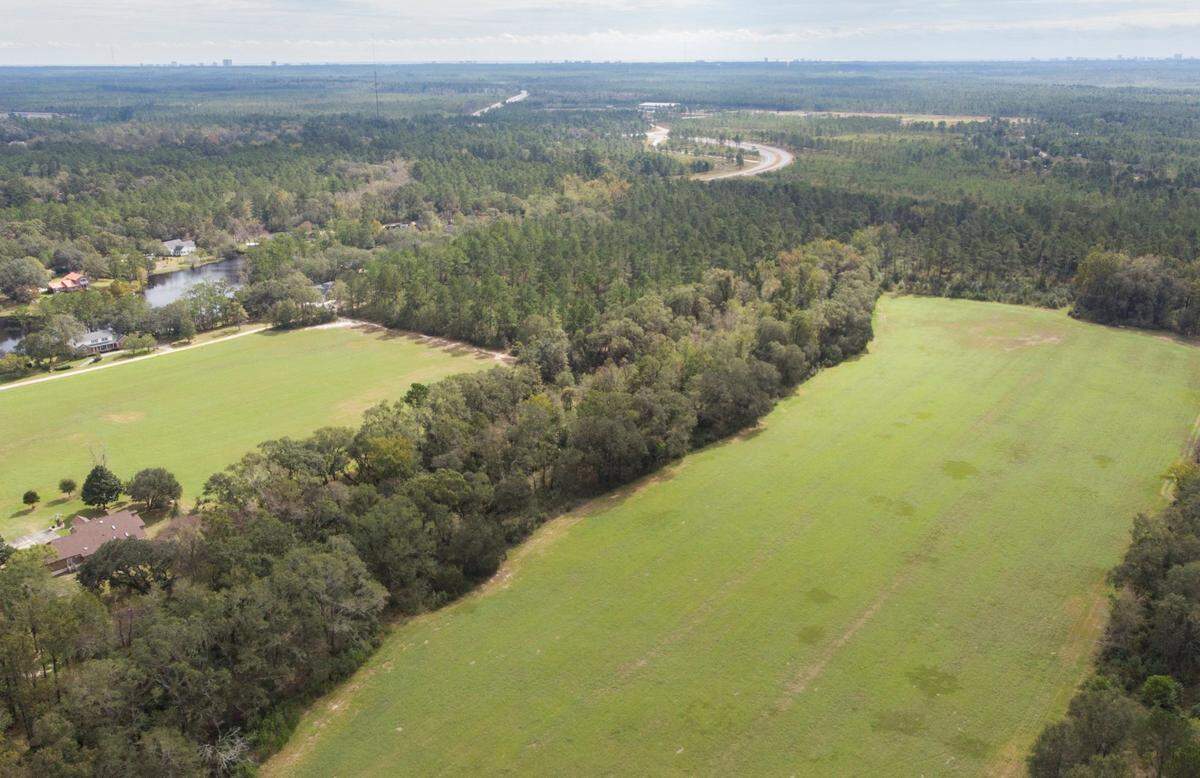
If you were to take a birds-eye view of Horry County — or maybe even take one of those $20 tourist-attracting helicopter rides — you’d see an obvious fact: Much of the land closest to the shore is built up with highways, business districts and neighborhoods, while much of the land West of the Waccamaw River is forests and fields.
And if you could take that same view and compare it to the past, you’d see another fairly obvious fact: Horry County’s growth in recent years has pushed West. There’s less land closer to the shore for development, but plenty the further away you travel. Major housing developments along Highways 905 and 90 in the last two decades — once rural, winding corridors near the Waccamaw, and central to the local economy — illustrate that fact.
But as people keep moving to Horry County, and the growth keeps pushing West, the county government is faced with an increasingly tricky problem: How does it manage the various “competing interests” that want to shape what Western Horry County looks like?
“We’re trying extremely hard to try to get out from behind the eight ball because of the exponential growth that’s happened to us,” County Council member Al Allen, who represents a large portion of Western Horry County, said. “We’ve got to respond better than we have in the past.”
But having the county respond to the growth isn’t as easy as simply playing catch-up. Rather, responding to the growth includes a number of competing interests, opposing dynamics and political forces. Consider the following:
In some rural areas of Horry County, like Bucksport, residents have told county planners they want more amenities closer to home, such as grocery stores, gas stations, fire stations, parks, maybe even a restaurant or two. But to have those amenities, the area would have to grow in population, meaning more homes and more cars on the road. Other residents, outside of Conway for example, say they want to keep their communities rural, and keep new homes and increasing traffic away.
When a county government does build new infrastructure, such as a road or fire station, it does so in response to the fact that people and businesses have already begun locating in that area. But by building the infrastructure, the county is also potentially inviting more growth to an area, possibly compounding issues.
Horry County Council is moving toward enacting impact fees — a one-time charge on new homes and businesses to help pay for infrastructure — in coming weeks. But state rules dictate where, how and when that money can be spent, meaning the county, if it begins collecting impact fees, will have to target that funding in areas that are already growing.
Growth in the county, in large part, has been driven more by market forces than central planning: Land owners, including farmers, sell to developers, who design and build new housing, providers of water, sewer and electric services follow quickly behind, and newcomers move in, all with little interference from the county, or money available to keep up with where the growth is happening. In some cases, municipalities like Conway will annex homes and properties that are connected to water, sewer and electric services, contributing both to their tax base and urban sprawl.
What’s left, then, is a situation in which growth in Horry County has outpaced local infrastructure projects leaving county leaders to both catch up to the growth, but also plan carefully how they catch up because of compounding consequences.
Around the county, that means roads choked with traffic, emergency service systems nearing capacity and urban sprawl, meaning homes are further and further away from services and amenities residents want and need.
“We’re trying to look down the road, look further than just the Waccamaw River as far as zoning and what development’s going to happen,” said County Council member Johnny Vaught, whose Conway-adjacent district has been one of the most rapidly-growing in recent decades. “(Growth is) happening further on out and it keeps swinging further and further out and that’s going to continue to happen. And all we can try to do is to project it as much as we can, but it’s still driven by market forces.”
The Carolina Forest area, partially within Vaught’s district, is a good example of many of those problems: Highway 501, Gardner Lacy Road, Postal Way, and either end of Carolina Forest Boulevard are heavy with traffic – much to the chagrin of residents. When the area was first designed, businesses and amenities were limited to either end of Carolina Forest Blvd. meaning residents living along that road have to make their way several miles to either end to shop, eat and go to the doctor. What was once dense forest used for industrial purposes is now nearly full of housing developments.
In that spirit, the county Planning Commission recently convened a subcommittee to study and plan how growth should occur as it pushes Westward, and how county leaders might keep some rural areas truly rural, while allowing other areas to grow denser.
John Danford, the county’s deputy director of planning and zoning, said the rural working group is aiming to develop new “zoning tools and ways we can come up with solutions for how to address growth in rural areas” and how the county can balance “all these competing interests.”
Planning Commission members, developers and other county leaders are all part of the working group, and together with the County Council, hope to draft solutions sometime this year. At present, the working group is planning to meet through September.
“It’s a fine line and it goes back to policy,” said David Jordan, an attorney with the county who’s currently serving as the head of the planning department. “And of course, policy is done on the council level (based) on where they want to see density and where they don’t want to see density.”
Meanwhile, some residents feel like they’re left in limbo, waiting for solutions to the growth they see happening all around them.
“I don’t think it’s good at all, we have to go piece by piece, how they handle this. There’s too many people…but they’re not accomplishing anything,” said Edward Koenig, who’s lived outside of Conway near Cates Bay Highway for 15 years. “Everyone is saying, ‘Hey, more people, they’ll pay more property taxes.’ But that’s not how it works.”
Was it always going to be this way?
In her seminal 1998 book, “Horry County, South Carolina, 1730-1993,” one of the most comprehensive histories of Horry County, Catherine Lewis, Horry County’s longtime head librarian, traces how people and development came to Horry County and makes several observations about how the county government responded as more people began moving here decades ago.
Based on Lewis’ research, it would appear that many of the problems residents complain about today — roads, zoning and density — trace back to the origins of Horry County Government in the 1970s. After being governed by state lawmakers for decades, the state legislature approved the Home Rule Act in 1976, allowing counties like Horry to establish their own independent governments for the first time. While a welcome development at the time, Lewis writes that one of the early problems of home rule, merely two decades after Horry County’s government was established, was the tendency of the County Council to view their role as managing day-to-day operations of the county, rather than acting as a central planning authority.
“One of the lingering problems of home rule is the tendency of elected council members to forget that their function is to make policy through ordinances and shape those policies through the budget process,” Lewis wrote.
Coloring that reality are the county’s zoning laws. Though the county had future land use plans as early as 1976, zoning rules were not formally established until the 1990s and early 2000s. “Zoning is an elusive goal at the county level,” Lewis wrote. Though local zoning laws are much more formalized and constrained today, that meant that development outside of the coastal cities was more likely to have been done piece-by-piece rather than from a central plan.
Added to that is the fact that Horry County planners and leaders can do little to stop development if a builder doesn’t need to have a parcel of land rezoned. And in the Western part of the county, land is more likely to be zoned Commercial Forest Agriculture — one of the broadest zoning categories that allows for everything from farms to housing developments to some businesses. That means that even if residents don’t want a particular development nearby, there’s little the county can do to stop it. Carolina Forest residents saw that dynamic play out recently. Residents opposed a housing development on land zoned CFA (the developer wanted to rezone the land to a different category), County Council voted against the project, but the current CFA zoning will still allow the developer to build homes there.
“In some cases you want the rezoning because it helps the CFA disappear,” said Bo Ives, the current chair of the Solid Waste Authority and who previously served on the county’s road-building commission.
Included in all of this is road development. Lewis notes that the county’s waterways — the Waccamaw River, the Intracoastal Waterway, as well as related streams and rivers — used to be the primary mode of transportation in Horry County. The introduction of the automobile in the early 20th century changed that.
Again, writing in the 1990s, before the most recent explosions of growth, Lewis noted: “The road system has never caught up with demand, nor is it likely to as long as the tourism industry along the Grand Strand continues to thrive.”
More people, more growth
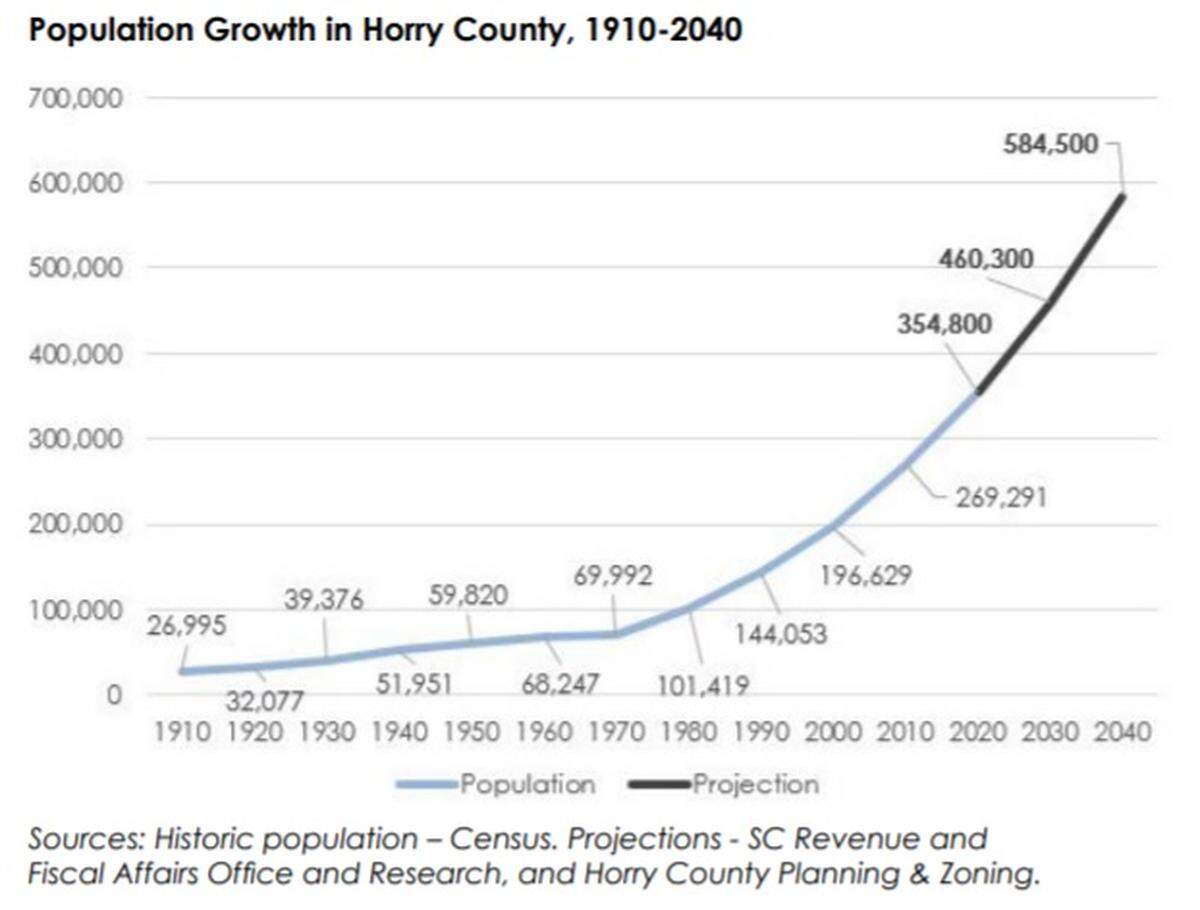
Even the most basic statistics illustrate how rapidly Horry County has grown in recent decades: In 1980, about 101,000 people lived here, census data shows. By 1990, the population had jumped to nearly 145,000. The population approached 200,000 by 2000 and the most recent estimates suggest more than 354,000 people currently call Horry County home. When the 2020 U.S. Census calculations are complete later this year, that figure is likely to be much higher.
Census data also shows the number of new homes that have sprung up recently. Estimates show that the county had about 178,000 units of housing in 2010, though that figure has jumped to nearly 215,000 in just the last decade. By 2040, county leaders estimate that an additional 275,000 people will live here, and that the county will need an additional 116,000 units of housing.
That, at a glance, is the problem county leaders are faced with. And because much of the land along the Grand Strand was built out in recent decades, all those new people and houses are now moving West. That means it’s on the county to build or widen roads, increase emergency services, improve traffic patterns and more.
For residents like Amanda Gill, all of that means the rural communities they hoped would stay rural are becoming denser and denser. Gill and her husband live on several acres near Cates Bay Highway, and Gill spoke against a new housing development in the area at a recent County Council meeting. She said she worried that adding hundreds of new homes to the area could eventually produce traffic and service problems similar to Carolina Forest, in addition to changing the nature of the rural area. Her rural community is one where all of the neighbors know each other and are on hand to help out, cook a meal or celebrate a momentous occasion.
“I got married a month ago and all my neighbors were at my wedding which was in my backyard,” Gill said. “Everybody knows everybody.”
Chief among the reasons why so many new people and houses pose a problem for the county is the fact that property taxes alone don’t pay for the infrastructure and services the newcomers need.
“There has been some planning in the past for these things in certain areas of the county but it’s not been fast enough to suffice the current growth we see and there hasn’t been enough drawn off the property taxes to hop out here right now and to do it,” Allen said.
That means, in essence, that Horry County’s growth doesn’t pay for itself. Rather, it’s tourism-related taxes and fees that, for now, fill the gaps. In recent months for example, since Horry County settled a lawsuit with Myrtle Beach over the hospitality fee, County Council members have begun discussing if they could use some of that money to widen parts of Highway 90.
Much of the road is two lanes and not every side road or new development has a turning lane in and out. That creates chokepoints along the road and can increase the likelihood of traffic accidents. That was a problem the county could have solved years ago, but didn’t, said former County Council Chair Liz Gilland.
“I don’t know why we didn’t do that for every other development that was built on Highway 90, 905, 707. We should have had ingress and egress lanes,” she said in a recent interview. “It was like, ‘C’mon people, we have to do something. And I’m not sure if we did anything.”
As the county works to catch-up on road-building, leaders are now looking to take early steps to widen thoroughfares like Highways 90 and 905. A proposal currently before the council would widen setbacks — the space between a property line and a road — along those roads, which would begin to create the conditions needed to add lanes. For example, according to county planners, the county will need to widen Highway 905 at some point and still maintain some distance between the road and property lines.
By preventing new development closer to the road, county officials hope that when funding does become available to widen certain roads, they’ll be able to purchase needed rights-of-way much cheaper than if they had to buy residents out of their homes.
But that strategy reveals one of the central tensions in the county: Officials should have widened roads like Highway 90 years ago, some say, but lacked the funding to do so. According to Ives, who served on the county’s committee to determine which road projects would receive funding under the RIDE 3 program, Highway 90 should have been prioritized as a project but it “would’ve taken all the RIDE 3” money. Lacking the funding for such projects years ago set the county on the course it is now, Ives said.
“By delaying the improvements that are necessary they’re allowing these developments to come in that force them to widen the roads,” Ives said.
Yet another factor in the county’s growth is the fact that Grand Strand Water & Sewer operates as an independent authority, meaning that it can build and serve new water and sewer and infrastructure independent of the county’s planning and zoning processes. The agency also charges impact fees, allowing it to pay for that new infrastructure. Ives said that’s allowed development to outpace other infrastructure like roads and emergency services.
“Where the sewer is is where the development will go,” Ives said. “We need to match land to development.”
And the issue of flooding is yet another that comes into play as the county is developed. Because Horry County is so flat, even modest changes to land can affect how stormwater drains, meaning new building can cause some properties to flood even if they haven’t in the past. And new developments in the vicinity of the Waccamaw or Pee Dee Rivers may have added risk of flooding as severe storms become more common. County leaders are currently debating new regulations for building in areas that flood.
Responding to — and encouraging — growth
As the county responds to growth — by, say, widening a road, building a new one, or building a new fire station — it’s possible those moves could entice even more development to an area.
“I think that’s what traditionally you’ve seen happen and I would expect that would continue,” Jordan said.
County officials hope to balance that dynamic, though, Jordan said. While their response to growth may encourage more growth, county leaders would rather concentrate people in certain areas, rather than have everyone spread out. Doing so is cheaper, for one, and allows the county to provide more comprehensive infrastructure to the greatest number of people possible.
“That’s where we want growth to go,” Jordan said. “If we four-lane Highway 90 and there’s full-time fire stations...that’s what we want, because we are growing and we have to put people somewhere, so we’d rather have them where the infrastructure is.”
Impact fees could also contribute to that dynamic. While implementing impact fees would provide a much-needed injection of cash to county coffers to build infrastructure, state law complicates matters. According to state rules, impact fees have to be spent on capital projects — not salaries or operating expenses — within several years of collecting the fee and within the area they were collected. A common refrain among some council members is that they could build a new fire station with impact fees, but they couldn’t hire anyone to work there.
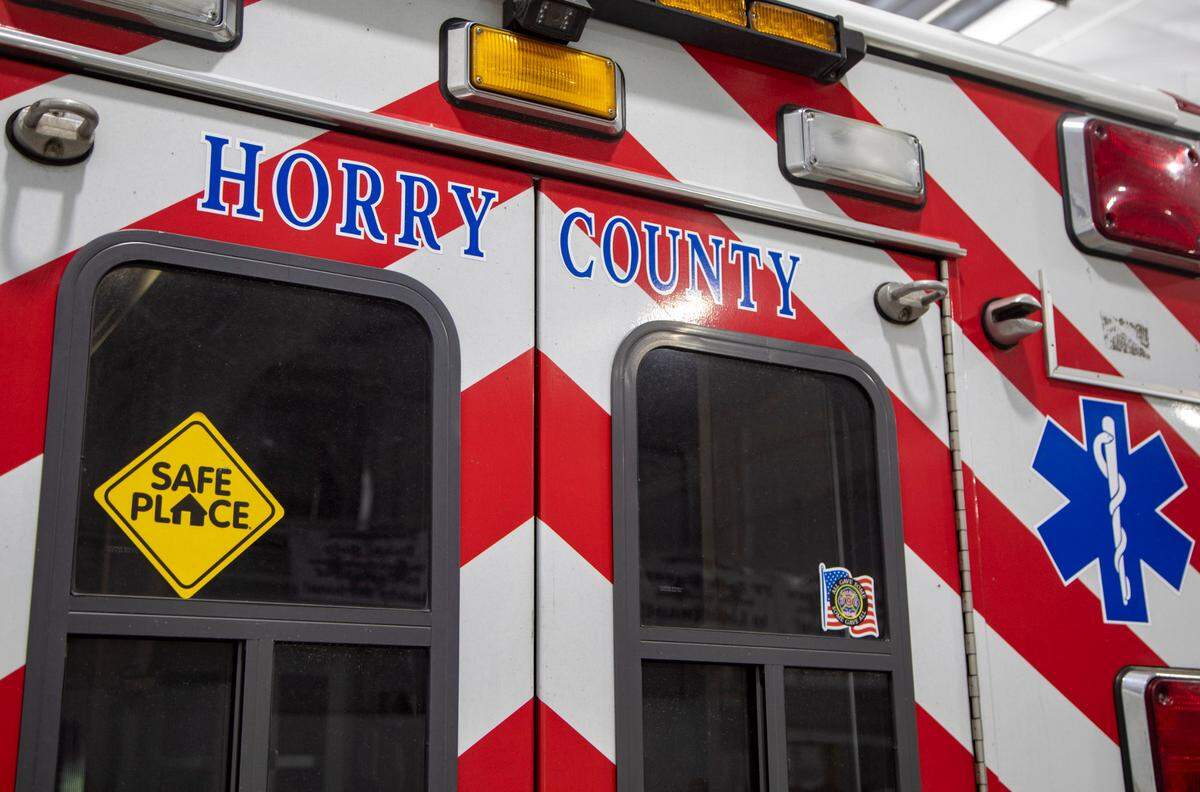
“If impact fees pass and if we drew off of that, that money would have to be spent in that area to build that fire station,” Allen said, explaining the conundrum impact fees carry. “But it’s after the growth has already been on the road, so you’re still going to be somewhat behind with the services because state law is set up that way and our hands are tied.”
Still, much like widening a road, using impact fees to respond to growth in a specific area could lead to more growth in that area. While that may or may not cause compounding problems for the county, it could mean that some areas of the county change permanently. County planners have said they’ve seen that dynamic budding already as they’ve worked on the Imagine 2040 plan.
“People really like the idea of rural character preservation, it was greatly desired,” Ashley Cowen, a senior county planner, said at a recent meeting. “A lot of residents wanted additional commercial amenities but then there was a lot of discussion about that. If you wanted those amenities, you would also need to have additional residential because of course commercial follows rooftops.”
She added: “It’s a give and take and you can see that reflected in the public input.”
Growth in Red Bluff
From Todd Huffstetler’s front yard along Highway 905, you can see the Pleasant Hill Baptist Church smack in front of you, and, caddy corner to the left, a large open field where developers recently pitched the idea of building a massive, 21,000-seat amphitheater for concerts.
The venue would have been a first for Horry County, potentially drawing some of the biggest names in pop, country and hip-hop music to the intersection of Highways 22 and 905 in the rural farm-church-corner store community of Red Bluff.
County Council unanimously killed that project in mid-May, much to Huffstetler’s disappointment. In his view, the rural community needs to grow more, and it should be the county’s job to guide the right kinds of growth into the area. Rather than simply allowing more and more people to move into homes and neighborhoods along the road, the Highway 905 corridor, and Red Bluff specifically, needs restaurants, grocery stores and parks, amenities to fill out the community.
“They’re over-populating it with houses is what they’re doing when they could build that amphitheater over there,” Huffstetler said. “That would’ve only been three days-a-week and that traffic would have been gone. Now they want to build houses that’re here seven days-a-week, 365 days a year and that’s traffic seven days-a-week. That doesn’t make sense.”
For Aaron Asbury, though, County Council’s rejection of the amphitheater project was welcome news. He and his family moved from the Chicago area to the Highway 905 corridor about 15 years ago and wanted to live in a place that was a short drive from work and the beach, but where they could come home to a quiet, rural piece of the world. He said he’s seen the area develop rapidly from farmland to new subdivisions over the years, and thinks the county should do more to control the growth.
“I would like to see a max amount of housing in the county per year, that way we can catch up to what’s being done rather than just opening the floodgates, and then we don’t have to play catch up,” Asbury, who serves as the president of his neighborhood’s homeowners association, said. “Let’s at least get caught up before we keep building. I understand that growth is coming (but) let’s be responsible.”
Those kinds of tensions have become more and more common in Horry County as the area has grown: Though the county has central planning documents to help guide the growth, Planning Commission and County Council members frequently vote on individual projects that amend those central plans, leaving it up to residents to tell leaders what they’d like to see in their communities. What comes out of those Planning Commission and County Council meetings is a piecemeal approach in which county leaders allow growth and new development to continue even though public services and infrastructure trail behind.
Part of why that approach causes tension is the county’s history. A central planning document like Imagine 2040 may outline certain areas as “rural communities,” and recommend a certain density of housing there, but the land in that area is still privately owned. As families who once farmed that land retire or wish to sell it off, developers purchase it piece by piece and, over years, seek to build new housing on it.
County Council members are loath to block or restrict development on those plots — selling their land to developers is how many farmers earn their retirement, some argue — even if that approach leads to more people and homes in an area than neighbors may want.
“You have developers coming along that (are) offering them big prices for that land and they’ve never had that opportunity before,” Allen said. “How can you deny them that opportunity to sell their land to collect that money to live on?”
Density in rural Horry County
Another part of why that approach to planning causes tension is density.
Years ago, Allen explained, the county’s approach to home building in rural areas was to allow larger lots for individual homes as a way to preserve the rural nature of the area. Homes packed closer together took away from the rural feel of an area, the thinking went.
Now, though, that thinking is changing, Allen said.
“Now, since some of the growth has started out there, people are seeing that the larger lot sizes are taking up more of the rural landscape,” he said. “If the growth demand is there and you have 100 acres of land, it makes a lot more sense to put, say, 300 homes in that 100 acres than to have to spread it out and only put in 150.”
The question then becomes: Would new residents be willing to live in a denser neighborhood in a rural area?
Gill said she and her husband like having enough acreage for their horses, and like living in a community where neighbors are spaced out. Asbury, too, said he values his space, and his wife even brought up the prospect of moving away.
“My response to her was, ‘Where do you move to?’” he said. “It’s almost like, where do you go?”
This story was originally published June 3, 2021 at 6:58 AM with the headline "Rural Horry County is on the cusp of ‘exponential growth.’ But there are challenges.."