
USC student parties threaten Olympia neighborhood. Are police, the city to blame?
On Fridays, Busch Light streams along some streets in the Olympia neighborhood.
On Sunday mornings, residents driving to church splash through puddles of strawberry flavored Bud Light Seltzer. Beer boxes and crushed cans lie by overflowing trash cans near rental properties.
On some evenings when the weather is nice, young women in bikinis have been hauled away by police. One day, a burning couch illuminated an Olympia yard.
That’s how homeowners in the former mill village describe coping with partying University of South Carolina students and other young people who have flocked to the once secluded corner of Columbia that’s now being called the Mill District.
Large living complexes marketed to students, two in the former Olympia and Granby mills, bookend the neighborhood that decades ago was a village for workers at the mills. Students and fraternity members also have moved into older rental homes that dot the community.
For students, maybe these are times to remember. But for long-time Olympia residents, the reveling has turned into a nightmare with elements of gentrification.
Viola Hendley, a homeowner and community leader, has picked up shorts that contain the stinking consequences of a party packed house with only one bathroom. She’s seen vandalized homes of owners who dare to challenge party-hardy students.
Some homeowners who spoke with The State didn’t want their names used or to say what street they lived on for fear of retaliation from college students who live near by.
Hendley’s husband, Scott, is okay with students having a good time inside the rental properties. He called their behavior “Discovering the magic of fire water.” But far too often the magic turns to carnality and spills into the avenues.
“They’re all fueled up. They’re slamming the car doors, screaming and yelling. They can’t seem to talk to each other. They yell,” he said. “It turns into a mess.”
That mess reached its height on Oct. 16 when a party of about 2,000 people was shut down by the Columbia Fire Department for creating a safety hazard. The party took place at The Orchard, a complex marketed to college students that’s near Virginia Street in Olympia. In a letter to students, USC President Bob Caslen acknowledged that the majority of the people at the party were USC students.
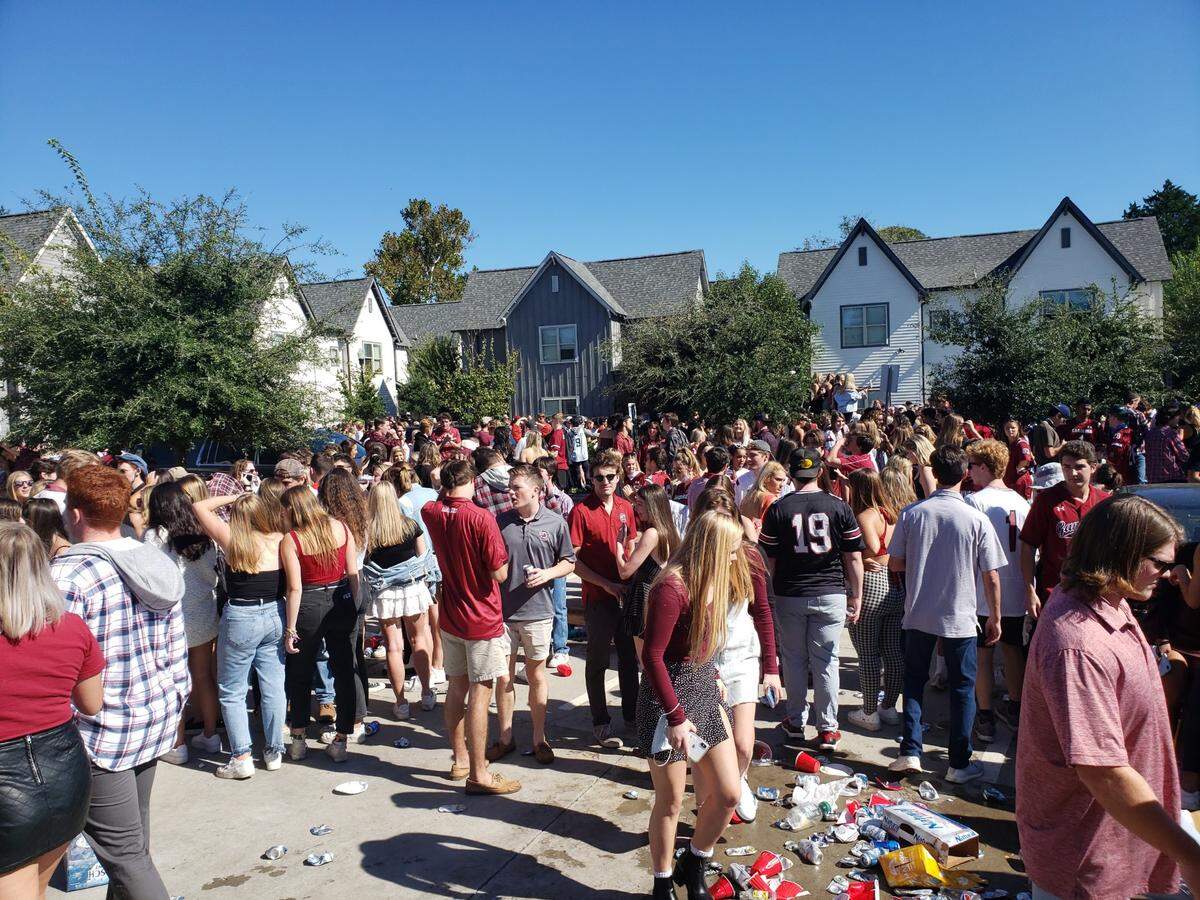
People at the party threw bottles and other items at firefighters who responded to the scene, the fire department said. The Richland County Sheriff’s Department charged at least one person for throwing a beer bottle at a deputy who was trying to get a DJ to turn off the music. The person was from North Carolina and was underage, drunk and carrying a Bud Light Seltzer when arrested, a deputy wrote in a report.
Long-time residents said it wasn’t the first party like that at the mostly-student apartment complex.
The Orchard did not respond to an email for comment.
One USC student died in a nearby quarry after a party in Olympia was broken up, according to the sheriff’s department.
While the death was tragic, it was unusual. More often, USC students are trashing the village and terrorizing neighbors, long-time residents said.
Homeowners are sick of it and want the university and police to step up to fill the authority role that the neighborhood leaders can’t.
A problem might be that the sheriff’s department was “being too nice,” Scott Hendley said.
The sheriff’s department may not continue to be so nice though. The department has made changes in how deputies patrol Olympia.
City and county zoning laws could be driving parties into the Mill District, according to USC officials.
University officials said they’re working with the neighborhood and the sheriff’s department to mend the imbalance of partying to quiet living. But the process is complex, ever changing and requires cooperation by various authorities.
In some cases, longtime residents like Kelly and Mike Anderson, who have lived in Olympia for 54 years, feel they’re being pushed out the neighborhood they helped build and define.
“The students have no respect for people,” Anderson said.
‘This is a college town’
From 1965 to 1967, his last two years of high school, Mike Anderson worked in the electrical department of Olympia Mills when the factory turned out fabric products.
Back then and years before, “We used to not have no kind of locks on our houses,” Anderson said.
They wouldn’t think of such a thing now.
Anderson and his wife checked their mail one day a few months back. They had a letter from someone they didn’t know.
The letter said the couple needed to get out of Olympia “because this is a college town.”
In times before the coronavirus, the Andersons endured the noise of students coming back to their street around 2 and 3 a.m. from nights out on the town, Mike said. The students were never quiet, and when the Andersons complained, the students became more aggressive.
After letting them know, the students would return at night and yell things like “Are we sleeping?” Mike said.
“They get out slamming doors, cussing, raising cane,” Mike said. His wife is “afraid someone’s going to burn the house down.”
The problems have become so severe that Mike is looking into moving to a different county.
After their street was clogged with cars, students and the chaos of The Orchard party was broken up, the Andersons were once again feeling like they have no say in their own neighborhood.
Hendley also said she’s feeling pushed out of the neighborhood she’s lived in most of her adult life.
Fraternity members have moved into Olympia over the years because of the proximity to USC’s Greek Village and the availability of rental houses, Hendley said.
Residents suspect many frat members live in The Orchard and invite their fraternity brothers to party in the common area of the apartment complex. The parties grow by word of mouth and through social media posts with other fraternities and sororities.
Social media posts indicate that the party at The Orchard included many fraternity and sorority members, but it’s unclear if a Greek Life organization planned the event.
More students have moved into Olympia because of the proportion of available rentals and the large living complexes in the Mill District, said Janie Kerzan, director of Student Life at USC.
That’s why it’s important for Kerzan and her department to continue to do what they’ve done for years — work with neighborhood leaders, police and other groups to address issues before they come up and fix the problems that arise.
Kerzan and other USC officials believe a new Columbia zoning ordinance meant to discourage parties is driving students into Olympia to get their kicks.
Olympia exists in a “doughnut hole,” meaning it’s not in the city limits though it’s surrounded by the city. So the area is not governed by the city ordinance but weaker county ordinances, which makes taking action again student renters difficult, Kerzan said.
While landlords in the city limits have been working with USC and the city to tamp down parties, the students living in the city are filing into Olympia where their peers have less strict landlords, according to Kerzan and USC spokesperson Jeff Stensland.
With bars closing earlier because of the coronavirus, students are partying more in the neighborhoods, which was fully anticipated by USC, Stensland said.
Homeowners and long-time residents said their attempts to define their neighborhood are being overwhelmed by student life.
But Hendley and others have been working with authorities to get a grasp on the partying.
Making a dent
Joe Weider had left his home in the Granby neighborhood, just on the other side of the tracks from Olympia, on Oct. 16. He was going to Rosewood Market to get some slicing tomatoes. He turned on Virginia Street and entered a chaotic scene near The Orchard.
He was shocked at what he saw.
Parked cars and fire trucks lined the street as hundreds of young people, many in Gamecock jerseys and khaki shorts carrying beer cases, ambled across the roadway. One young person wobbled toward Weider’s car and fell head first into his door and onto the roadway where he stayed, passed out. Weider’s car was left with a dent.
“I haven’t seen anyone that stoned since a Grateful Dead concert in the ‘70s,” said Weider, a member of the Mill District Alliance.
Neighborhood leaders want the Richland County Sheriff’s Department, USC and its police department to become more active in getting the situation under control.
One issue is that sheriff’s deputies haven’t been writing reports on parties they shut down or noise complaints, according to neighborhood leaders and USC. Without reports that name students, university officials can’t take any action to correct student behavior, leaders said.
The sheriff’s department said it will be changing how it responds to parties.
Being in a doughnut hole affects patrolling of the area. Despite having a substation less than a mile from Olympia, the Columbia Police Department doesn’t patrol most of the neighborhood. And the neighborhood is separated from the larger region that the county sheriff’s department patrols.
Another issue is that the university hasn’t put USC Police Department officers in the area, which neighborhood leaders have asked school officials to do, residents said.
That trio of issues points out the need for coordination among the sheriff’s department, the university and USC’s police department, according to Scott Hendley.
“I appreciate what the sheriff has done. They can’t come over and babysit,” Hendley said. “The university must have policies that the [USC] police force can follow through on.”
At a late October meeting of residents, the sheriff’s department and USC officials, “deputies discussed how area residents can help USCPD and RCSD by being more vigilant, with the goal of accurately documenting all incidents that take place,” said Capt. Maria Yturria of the sheriff’s department.
“Also, deputies highlighted specific ways community members can report issues to RCSD and USCPD.”
The sheriff’s department announced that on Friday nights into Saturday mornings, more deputies will be patrolling the Olympia area and will have a checkpoint near the neighborhood.
The sheriff’s department also agreed to cite more students specifically in the Olympia area who are engaging in unsafe behavior so USC can take action, Stensland said.
But sending more USC police officers into the neighborhood is unlikely to happen. The university has less officers than they did last year, and their main job is to patrol campus, Stensland said. The officers do occasionally assist sheriff’s deputies but the USC police can’t be there for every off campus call.
Hendley said she is sure that with the sheriff’s department, the university and homeowners working collaboratively, the problems can be fixed.
USC officials agree.
“These are complex problems and we’re committed through partnership to solving as many as we can,” Stensland said.
But Hendley talking directly to her student neighbors? That’s doesn’t seem like it’ll work.
She was recently in her yard, near the property line, when a group of students living next door started yelling at her, saying that if she crossed the property line they were going to sue and call the police.
This story was originally published November 9, 2020 at 5:00 AM.
CORRECTION: The last name of Janie Kerzan, director of student life at the University of South Carolina, was misspelled in an earlier version of this story.