Report: City of Columbia spilled nearly a million gallons of sewage in 2020
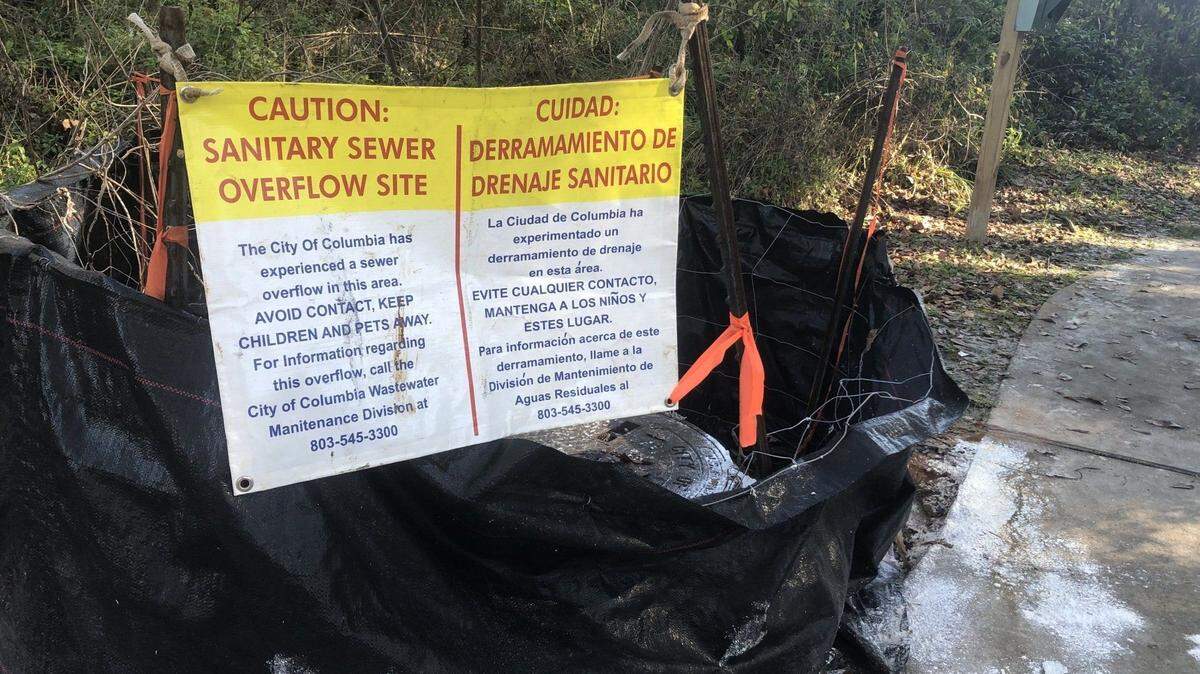
Nearly 1.4 million gallons of sewage were spilled by utility providers in the Midlands in 2020, with nearly a million of those gallons being spilled by the City of Columbia.
Those were the findings in the annual sewer spill report from Congaree Riverkeeper, the watchdog group that advocates on behalf of rivers and tributaries in the Midlands area. This marks the eighth year Riverkeeper has published a sewer spill report, which includes data from the state Department of Health and Environmental Control’s sanitary sewer overflow database.
According to the report, 12 agencies combined for 168 spills in 2020, and almost 1.4 million gallons of sewage were collectively spilled in those incidents. That’s up sharply from 2019, when 693,000 gallons were spilled in the Midlands. In fact, 2020’s output was the highest since 2016, when 2.4 million gallons were spilled across the area.
In the eight years Riverkeeper has been producing the sewer spill report, 2015 remains, by far, the year with the most spilled sewage, with 5.6 million gallons. That was the year a deadly, historic flood pounded the Columbia area in October.
Riverkeeper director Bill Stangler was disappointed to see sewer spills on the rise in the area of the Saluda, Broad and Congaree rivers in 2020.
“The trend is moving in the wrong direction from where we were, and that’s something that jumped out to me in those numbers,” Stangler said. “We were doing pretty good, we had gotten the numbers under a million (gallons collective spilled) in each of the previous few years. ... But this feels like it sets us back from that trajectory.”
It was a particularly challenging year for the City of Columbia, which operates the largest municipal wastewater system in the state. In 2020, it had 114 spills, accounting for more than 934,000 gallons. That was way up from 2019, when Columbia had 60 spills that produced 262,720 gallons.
Richland County was second with more than 222,000 gallons spilled in 23 incidents in 2020, and Blue Granite (formerly known as Carolina Water Service) was third with more than 179,000 gallons spilled in six incidents.
As noted by Stangler, a February flood contributed heavily to the Midlands’ numbers in 2020. On Feb. 6, a frontal system crossed South Carolina and produced nearly three inches of rain across the Midlands, and higher rainfall amounts in the Upstate and North Carolina. That water from those other regions eventually made its way to the Midlands via rivers and tributaries.
About a third of the total volume of sewage spilled in the Midlands last year was related to that February flooding, according to Riverkeeper.
Columbia Assistant City Manager Clint Shealy acknowledged that it was a tough year in regard to sewer spills.
“We kind of reversed the trend of (spills) dropping off and being able to squeeze that volume down,” Shealy said. “We look at it in terms of volume and the number of spills whenever we look at whether the year was successful. Weather plays such a big part in what we do.”
Shealy pointed to the wet weather in January and February as a big part of Columbia’s issue in 2020. Indeed, four of the city’s seven biggest spills came in the wake of that early February flooding.
But the assistant city manager also noted an October incident that led to two spills that accounted for nearly 369,000 gallons, or nearly 40 percent of the city’s volume spilled for the entire year.
In that situation, the city had an excavator clearing a right of way near a tributary to Mill Creek on Oct. 5. The area was wet at the time, and the excavator was on mats. At some point, the excavator driver went off the mats and, because the soil was so wet, it busted a sewer line.
“We were doing maintenance on the right-of-way to clear it, to be able to address sanitary sewer overflows, and unfortunately we had the unintended consequence of creating a very large sanitary sewer overflow,” Shealy said. “We ruptured the pipe accidentally with our equipment while doing the above ground maintenance.”
That led to a 315,000-gallon spill. The city set up a bypass system to address the situation, but then had an issue with that bypass two days later, leading to another 53,900-gallon spill.
“You couple that (October incident) with a really wet year in January and February, that’s why our numbers are up,” Shealy said. “That’s the long and short of it.”
Stangler said he is hopeful that sewer spills across the Midlands will decrease in 2021. He said he is keeping a close eye on trends.
“It’s really hard to get to zero spills,” Stangler said. “Things happen, pipes break. You get clogs and things. But it’s really big spills that concern me the most. ... We are still seeing problems where we are having spills that are tens of thousands or even hundreds of thousands of gallons.”
This story was originally published January 29, 2021 at 5:00 AM.