
‘He’s not safe.’ Lexington man fears for Ukrainian father in path of Russian invasion
Since Russia invaded Ukraine last week, Yuriy Petrenko’s life has been turned upside down.
On the surface, this longtime Lexington resident has kept up his day job managing a local trucking company. But a part of him is always thinking about a constantly updating line on the online maps, showing Russian armed forces moving toward his hometown in southern Ukraine, where his aging father still lives.
“Every morning I look up the advance of Russian fascists,” Petrenko said.
So far, things are fairly normal back home in Nikopol, on the banks of the wide Dnieper River that runs north to south through the eastern European nation before emptying into the Black Sea. Phone service still allows Petrenko to speak to his 83-year-old father Vasiliy, retired from a lifetime at the local manganese processing plant.
There’s no shelling yet, Vasiliy reports, although his apartment building has converted its 10-by-8-foot basement into a makeshift bomb shelter for a few dozen people.
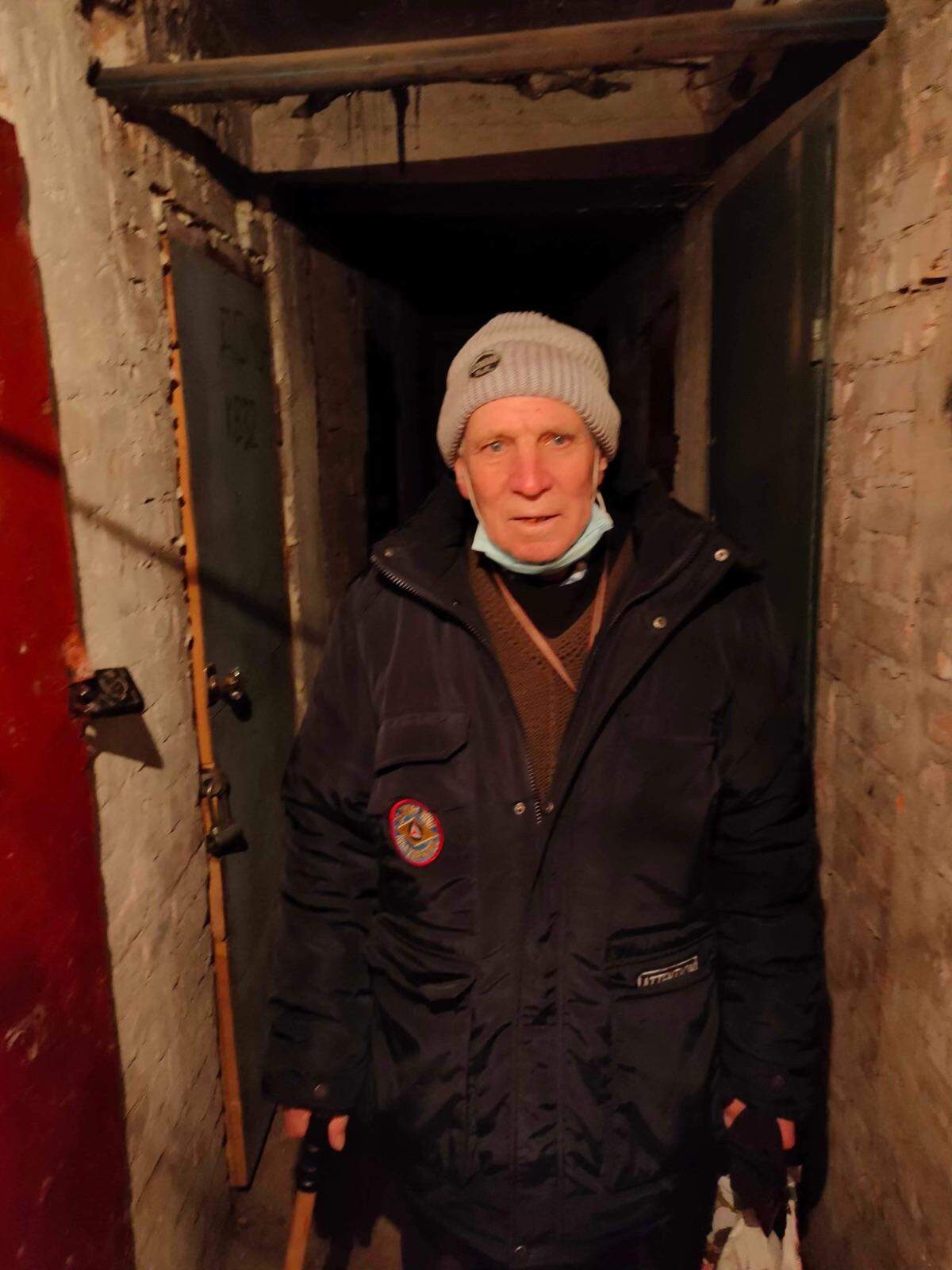
But the news tells Petrenko that the Russians have taken only a few days to move about 140 miles north from the Crimean peninsula, the part of Ukraine forcibly annexed by Russia in 2014, to within an uncomfortable distance of his hometown.
After speaking with his father Wednesday, the elder Petrenko reported a Russian detachment had reached a large nuclear plant on the opposite side of the Dnieper from Nikopol, but an unarmed crowd of locals surrounded the plant and harassed the soldiers enough that they thought better of trying to take it by force and moved on.
But the news left an emotional Petrenko worried about how long his father would still be safe.
“He’s old, so he’s not going to take (up) a Kalashnikov (rifle),” Petrenko said of his dad. “I’ve wanted to bring him here, just to visit, but he has a medical condition and needs to see a doctor every month. People in his age don’t want any changes, but considering the circumstances, he’s not safe there.”
‘Not our war’
Petrenko grew up in Nikopol, but has lived in the United States since 2006, the last six years in South Carolina. The youngest of his three sons was born in the U.S., and whenever Petrenko grows frustrated with his adopted country, he says, “I have to go get my little American.”
He and his family mostly keep to themselves, but the past week has led him to take a more public-facing role as a representative of his home country. He attended a rally at the State House in support of Ukraine on Saturday, has sought out media and politicians to talk about the situation there, and watched the widespread display of Ukrainian flags in Congress at President Joe Biden’s State of the Union address Tuesday night.
But he worries about American reluctance to back up that support with action; some Americans even support Russian President Vladimir Putin.
At Saturday’s State House rally, “people honked their support” in passing cars, Petrenko said, “but I heard one woman stop and say, ‘This isn’t our war. It’s your war. We don’t want to get involved.’”
But Petrenko doesn’t think Americans are isolated from the effects of Ukraine’s war. He predicted gas prices will rise because of the conflict and the resulting sanctions on oil-producing Russia, followed by food prices if the harvest in Ukraine, a major agricultural exporter, is disrupted.
But despite Ukraine’s requests to join both NATO and the European Union, the country was still outside the West’s formal defensive alliance at the time of the attack, and other nations have been reluctant to take direct military action against nuclear-armed Russia.
While he appreciates U.S. politicians’ words of support, “words do not stop bullets,” Petrenko said. “We need real military help. I’m not asking for boots on the ground, but send an aircraft carrier or planes. We need support at air and sea.”
For his part, Petrenko has started collecting items for Ukraine with the hope of getting them airlifted to Poland and distributed from there, both for civilian refugees fleeing the oncoming Russians and those offering their own makeshift defense against them.
“I wanted to get night-vision goggles, but I looked them up online and they’re too expensive,” he said.
The trucking manager said he hopes to speak to South Carolina’s Republican United States senators — Lindsey Graham and Tim Scott — as well as U.S. Rep. Joe Wilson, a Lexington Republican, about the conflict in Ukraine.
“They can come to my home,” he said. “My wife is an excellent cook.”
Russian perspective
Petrenko got a sense of how Russians view his country when he got a call from a cousin after the 2014 Maidan Revolution forced out Ukraine’s then pro-Russian president. Petrenko’s cousin had left Ukraine as a boy and moved to Siberia when Ukraine and Russia were still joined in the Soviet Union, and was later drafted into the Red Army toward the end of the Cold War.
“He said, ‘You have these Nazi rulers who hate Russians,’” Petrenko said. “I told him he should call his relatives and friends and he would know that’s propaganda.”
Putin has also accused Ukraine’s leaders of being fanatically anti-Russian “Nazis” and has said Russia’s goal is to “denazify” the country. Petrenko points out that besides Ukraine holding multiple democratic elections since the Maidan Revolution, current Ukrainian President Volodymyr Zelensky and other senior figures are Jewish.
The two cousins haven’t spoken in the eight years since. “It’s sad,” Petrenko said. “This is his homeland, but he’s been totally brainwashed.”
The family spat underlines how Ukraine and Russia share deep historical, cultural and even family ties built up over centuries. Despite international tensions, those ties left many Ukrainians shocked and infuriated that their “brotherly nation” would actually attack them.
The feeling goes both ways. Sherry Beasley has led multiple groups of students and researchers from the University of South Carolina to both countries going back to the late 1980s, and keeps up with friends inside Russia.
“My Russian friends are all mortified by what Putin has done to the country,” Beasley said. “They’ve been losing their freedoms for years.”
But given her experience with official Russian media, on which the average Russian depends for information, “I’m not sure they’re getting an accurate portrayal of what’s going on,” she said.
In the meantime, Petrenko has been worried about the effects of the war on his friends and family still in Ukraine. He’s been thinking about a photo he was sent from another city surrounded by Russian forces of a man laying dead in the street, his body blown in two at the torso.
He worries he doesn’t have the words to describe what it’s really like halfway around the world, or how it makes him feel.
“This is not a movie,” he said. “This is really happening.”
This story was originally published March 3, 2022 at 9:51 AM.
.jpg)