Richland County wants residents to vote for penny tax. Why won’t they say what it pays for?
Richland County is asking residents to vote to continue taxing themselves to pay for new roads, sidewalks and the COMET, the Columbia area’s public bus system. But the county won’t tell residents what specific projects their dollars will pay for — at least not until after the election.
In 2012, when voters first passed the 1% Transportation Sales and Use Tax, often called a penny tax, Richland County gave them a precise list of projects their money would pay for. Now the county is asking voters to extend the tax to collect another $4.5 billion over an estimated 25 years. So why won’t it provide a list of projects like it did last time?
County leaders say it’s because they’re switching to a new way of evaluating projects that should improve transparency in the long run and give the county more flexibility to respond to transportation needs and opportunities in real time, rather than being tied to an aging document. But they say there wasn’t time before the Nov. 5 election to rank the projects they hope to complete.
Officials say they are aware that some residents are still wary of the tax’s management, after the county’s prior handling of the penny led to a lawsuit from the S.C. Department of Revenue that it had used funds improperly. That case went all the way to the state Supreme Court and the county later agreed to pay back $15.5 million of improperly-spent dollars to the transportation fund.
Given the penny’s controversial past, will the new model add transparency, or just create more confusion?
Then vs. now
The current penny tax was approved by voters in November 2012 and imposed in May the next year. It promised to pay for projects like the widening of Clemson Road, projects to increase access to the Congaree River, sidewalks, bike lanes and more.
Not all of those projects got done, but a lot of major work did. Some projects were cut for funding reasons, and others were cut because they weren’t feasible, explained Michael Maloney, the county’s director of public works, who also oversees the penny. But no projects could be added to the list after the 2012 vote.
Maloney called that system “rigid and inflexible.”
“People would go, ‘Are you doing this road?’ I’m like, no, it’s not on our list,” Maloney said. “That’s been frustrating. And so this is ideal, to actually open it up to budgeting every year.”
Maloney said he knows residents will want to see a forecast every year, which he plans to provide. But the county isn’t going to just be picking projects at random, either.
Last October, the county council began pouring over a list of possible future projects compiled from months of conversations with residents at community meetings, city officials for the county’s various municipalities, and other transportation experts. They came up with roughly $8 billion worth of projects as part of a transportation needs assessment.
That list of projects will inform what the tax will pay for, but at least 40% of that list is expected to be uncovered by the tax, meaning residents may have an idea of what projects will get paid for with the penny tax dollars, but nothing has been set in stone. Plus, 22% of the tax collection is already dedicated to the COMET bus system, further limiting what projects the county expects to pay for with the next penny, if approved Nov. 5.
“If you look at the transportation needs, our needs far exceed that amount. So we will not be able to address all the projects, and we know that going in,” said Jesica Mackey, chair of Richland County Council.
The county plans to score the projects on the needs assessment every year, which leaders say will ensure the most impactful projects are being done first.
“When you go eight, 10, 15 years down the line, needs change, the community changes, and the penny wasn’t able to address those new needs (before,)” Mackey added.
But while the county may not have an exact list of projects, it does have a different document that did not exist in 2012 — a list of guiding principles.
Not laying out these principles is partially what got the county in trouble with the Department of Revenue beginning 2015, when the state agency audited the county and determined that it had been spending penny tax money on non-transportation related projects, which state law forbids.
Mackey said the priorities and principles this time are clearly laid out, an attempt by the county to be fully transparent with residents about how the tax dollars will be spent.
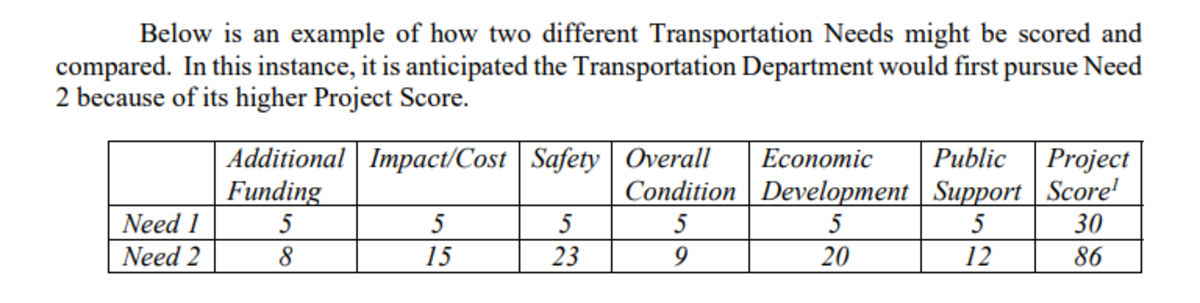
That document also outlines a specific scoring system, pinpointing factors the county will consider when prioritizing projects.
What are the guiding principles?
There are six guiding principles that will determine how the county prioritizes the project list should the penny tax extension pass. Each is weighted differently:
- Will the project improve public safety? (up to 25 points)
- How many people would be positively impacted by the project compared to its cost? (up to 20 points)
- Will the project help create or sustain jobs? (up to 20 points)
- Is there public support for the project? (up to 15 points)
- Is there outside money available for the project, like a federal grant? (up to 10 points)
- Will the project improve the condition of an area, say by addressing blight or allowing economic development? (up to 10 points)
How closely a project aligns with each of these six principles determines the number of points it would be assigned in each category. Higher-scored projects would be paid for first.
Richland County also plans to reassess the projects on the list every year, and will also consider new projects, or “emerging needs,” using that scoring system that looks at safety, function, outside funding – like help from a federal grant, among other factors.
The projects that will get top priority are those from the 2012 list that were cut for a lack of money. After those projects are paid for, the county will start with the new list.
This new penny would also create a pool of money for as-yet unidentified projects that come up over time, another stark difference between this proposal and the 2012 model. The current penny tax couldn’t be used to address any of the damage from the 2015 flood, for example.
When asked why the projects couldn’t be preliminarily scored before residents are asked to vote in favor of the penny tax, Maloney said it would simply take too much time.
“When we go out and do that [scoring], we’re going to be driving, walking, photographing, you know, kind of doing a needs assessment of each project,” he said.
With $8 billion worth of projects on the list, Maloney said they would not have been able to complete the work by Nov. 5.
Some of the possible projects
Some big ticket items on the county’s list of possible projects include:
- A $7 million intersection upgrade at Langford Road, Wilson Boulevard and Blythewood Road
- A $4 million shared-use bike path on Garners Ferry Road
- A nearly $5 million sidewalk on Assembly Street
- Tens of millions for work on major commercial-district roads like Harden and Devine streets.
- Road widenings worth more than $700 million, including of Spears Church Creek, Garners Ferry and Two Notch roads
- $25 million to separate the railway from the road on Assembly Street
- $20 million for another extension of Shop Road
And many, many more.
But Maloney said residents shouldn’t look at the needs assessment as a complete list of possibilities. They won’t be able to address every need identified, but they will be able to address a lot of what the county calls “community investment” projects.
“A lot of people ask, ‘What road are you going to resurface?’ I have a good answer for that one: all of them,” Maloney said, adding that this penny has a particular focus on creating space for those community projects.
Specifically, the county has promised to spend 48% of the new penny funds on community investment projects, like road resurfacing and paving, traffic safety fixes, bike lanes, greenways and sidewalks. But they would have flexibility on how to distribute that 48%.
County advancement projects, which are the bigger projects like road widenings and building new roads, will get 30% of the tax dollars.
The COMET bus system would get the remaining 22% for its operation and expansion.
The new penny would begin almost as soon as the current penny expires, which the county expects to happen by Dec. 2026. The new penny would last until Dec. 2051, or until it collects $4.5 billion. The current penny was permitted to last 22 years or until collecting just over $1 billion.
You can see a list of the projects on the county’s needs assessment, as well as the county’s guiding principles document, at richlandpenny.com.
This story was originally published October 24, 2024 at 11:15 AM.