USC launched food delivery robots. Now, lawmakers eye rules for these trending devices
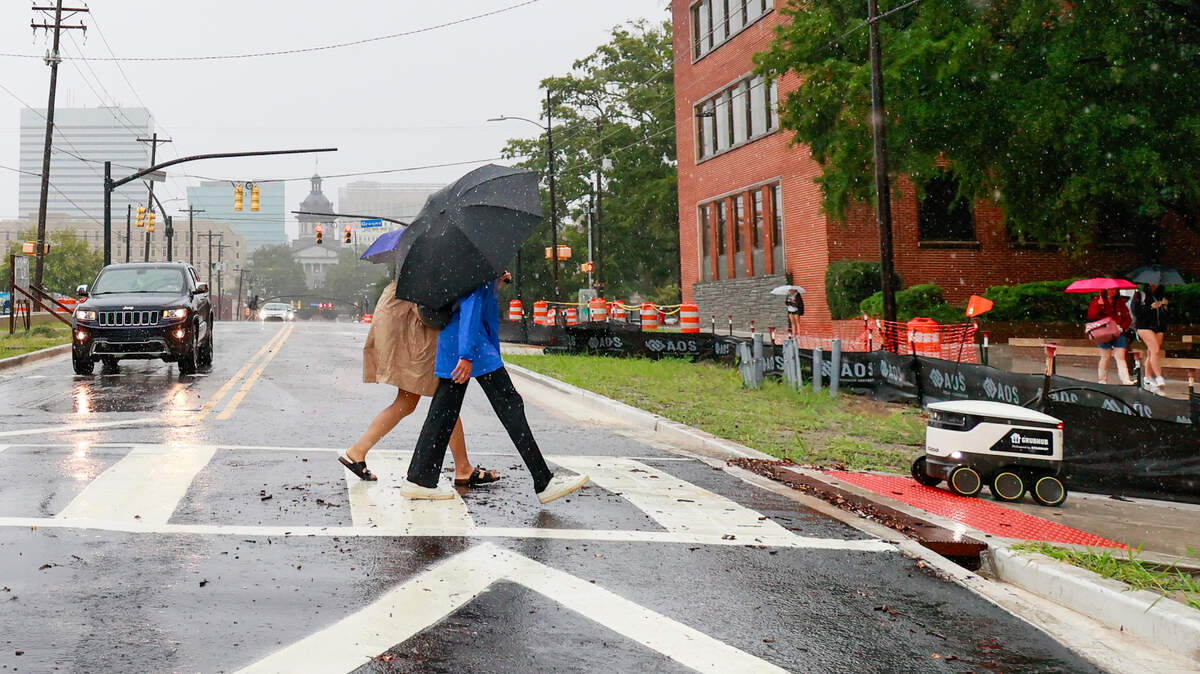
Could robots soon recharge Columbia’s food delivery scene? State lawmakers say maybe as they eye new rules for self-driving devices that, yes, deliver food.
The South Carolina House of Representatives Tuesday passed a bill that sets rules for those delivery robots operating in Richland County.
The initiative seeks to be “forward thinking,” explained sponsor Rep. Todd Rutherford, D-Richland.
The University of South Carolina launched delivery robots on its campus in early 2024, following a trend already seen in cities across the country. But there is nothing so far in state law that specifically addresses the delivery robots.
This measure creates guardrails for the new technology and gets ahead of an industry that Rutherford said appears poised to grow. Rutherford said he sees the technology taking off beyond USC’s campus and pointed to cities like Washington D.C., where the robots are already prevalent.
The bill passed the House 110-0 on a second reading Tuesday. The measure will still need to pass the Senate and be signed by the governor before it becomes law.
If the bill proposed by Richland County’s delegation does pass, it would establish a new slate of rules for the delivery robots to follow, but also give the robots the rights of a pedestrian. The bill also establishes some specifics: the robots are not allowed to travel faster than 10 miles per hour and they can’t be operated on streets with a speed limit higher than 35 miles per hour.
The bill also states that any municipalities inside Richland County can regulate the time and place that delivery robots can be used, but no town or city would be able to outright ban the devices. The bill’s full text can be found on the SC Statehouse website.
Starship Technologies, a San Francisco tech brand, claims its robots have already driven 8 million miles worldwide. The company inked a deal with Grubhub in 2022 with a specific goal of bringing the delivery robots to college campuses. The partnership made good on its promise, with the robots now delivering on over 50 college campuses in the U.S.
By February 2024, the robots had made it to USC’s Horseshoe.
Currently, USC has 20 such robots, which have “been very popular with the campus community,” USC spokesperson Jeff Stensland told The State.
He said initially there were concerns that the robots would be targets for vandalism, but that has not been a problem so far. He also said there have not been any safety issues regarding the robots. USC’s robots are only permitted to operate between Gervais, Assembly and Blossom streets because of current restrictions about operation on state highways, Stensland added.
If you spend any time around campus, you may have already seen them: little white boxes with wheels and an antenna, puttering along university sidewalks at about 4 miles an hour.
The robots can hold about 20 pounds, an estimated three shopping bags of goods, according to information on USC’s website. They navigate with help from a dozen cameras and “ultrasonic” sensors, but “can be monitored remotely by a human who can take control at any time if needed,” the university’s webpage adds.
Starship’s robots are not the only ones on the market. The food delivery app Uber Eats has secured its own partnership with robot maker Serve Robotics, a company that has promised to build 2,000 delivery robots in 2025 that will be most visible in cities on the West Coast.
Amazon introduced its delivery robot Scout in 2019, but by 2022 the company had called its wandering robots home after a series of problems, including that the robots couldn’t seem to navigate uneven sidewalks.
Now after several years of the robots slowly amassing territory, civic leaders are raising questions.
The Minneapolis City Council in Minnesota earlier this year agreed to conduct a study on how the robots have impacted job availability for students at the University of Minnesota, and to assess what national labor organizations consider best practices for the new tech, according to the Minneapolis Star Tribune.
At Arizona State University in September 2023, one of Starship’s robots malfunctioned and knocked down a university employee, injuring her in the process, according to a news report from the technology publication 404 Media.