This Lexington high school is 300 students over capacity. Is another needed?
More than a third of Lexington 1 school buildings are over building capacity, even as overall district enrollment has dipped, data from the school district shows.
As Lexington County continues to grow, the district has tried to stay ahead of the curve. But after a number of parents took their students out of the district, seemingly headed to charter schools, the school board has gone back to the drawing board on how to deal with the county’s growth and the shifting enrollment numbers.
To make matters more complicated, some parts of the county are growing faster than others, leading some schools in the district to fill up more quickly, while others either stagnate or sit underutilized.
“Lexington is growing, people are moving in. But when, say for example, a charter school does open, they don’t take 10 kids from every school equally,” Kathy Henson, chair of the Lexington 1 school board told The State.
The district is in the process of conducting a facilities study to identify possible solutions to the problem – Henson said the board is keeping all options for addressing the growth on the table.
“You have to have those data points before you start making decisions,” Lexington 1 school board member Christopher Rice said. “What options do you have to expand what you already have?”
Growing pains
Henson, who’s served on the school board since 2020, was a junior at Lexington High School when the district opened White Knoll High School in 2000, as the county’s burgeoning population pushed Lexington High to capacity. She was a teacher at the school when it split again in 2013 with the opening of River Bluff High School.
“It is not Lexington High School’s first rodeo to be booming and have to do something about it,” Henson said.
Lexington High School is more than 300 students over capacity, outgoing Superintendent Gerrita Postlewait said in paperwork submitted to Lexington County in regards to a planned housing development.
While Lexington High is around 300 students over capacity, the numbers are nowhere near the levels they were at when the district opened River Bluff, district spokesperson Libby Roof told The State. In the year before Lexington 1 opened River Bluff, Lexington High had 3,128 students, according to an end-of-the-year student headcount. At the most recent 135-day headcount, the school had 2,436 students.
That number is anticipated to climb, though, with Lexington High School expected to be 136% over building capacity by 2035. They’re one of a handful of high schools, and a significant number of elementary schools in the district, that are at risk for overcrowding in the future, a demographics study put together for the school district in the fall of last year showed.
Eight elementary schools and three high schools in the district are over building capacity, the study said. But building capacity doesn’t include the use of portable classrooms that some schools have made use of to address overcrowding – with the use of the portables, only two elementary schools are over capacity.
Still, while some schools are over capacity or expected to reach that point in the coming years, others are severely underutilized. Nearly half of the district’s elementary schools and three of its eight middle schools are operating at less than 70% total capacity.
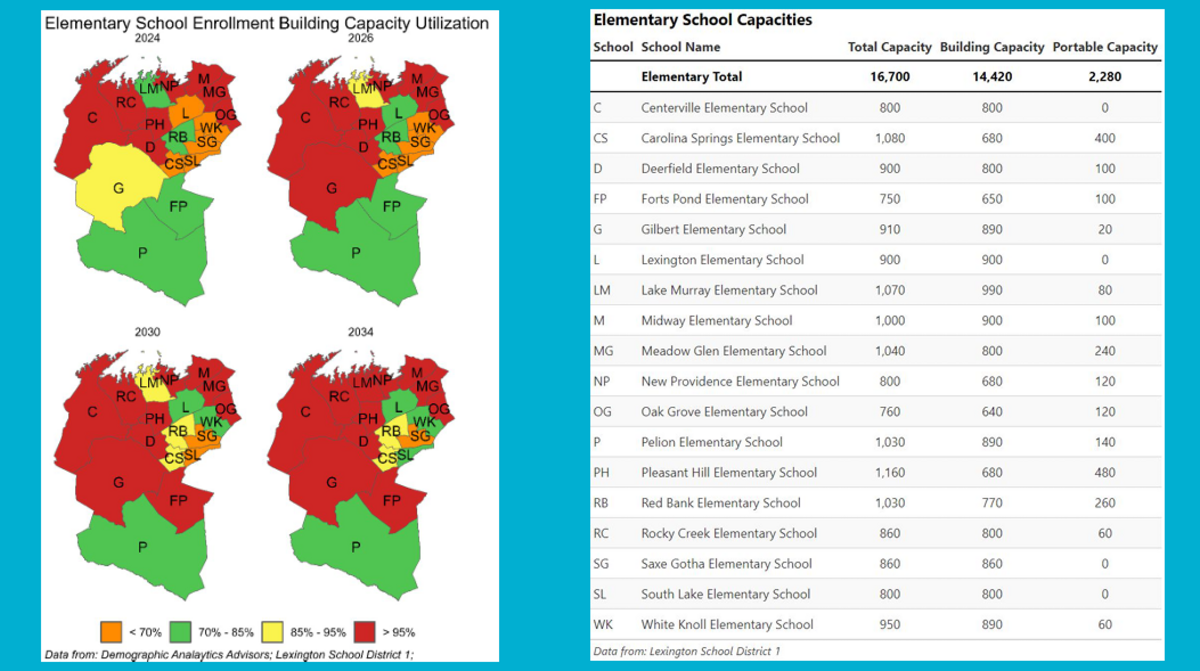
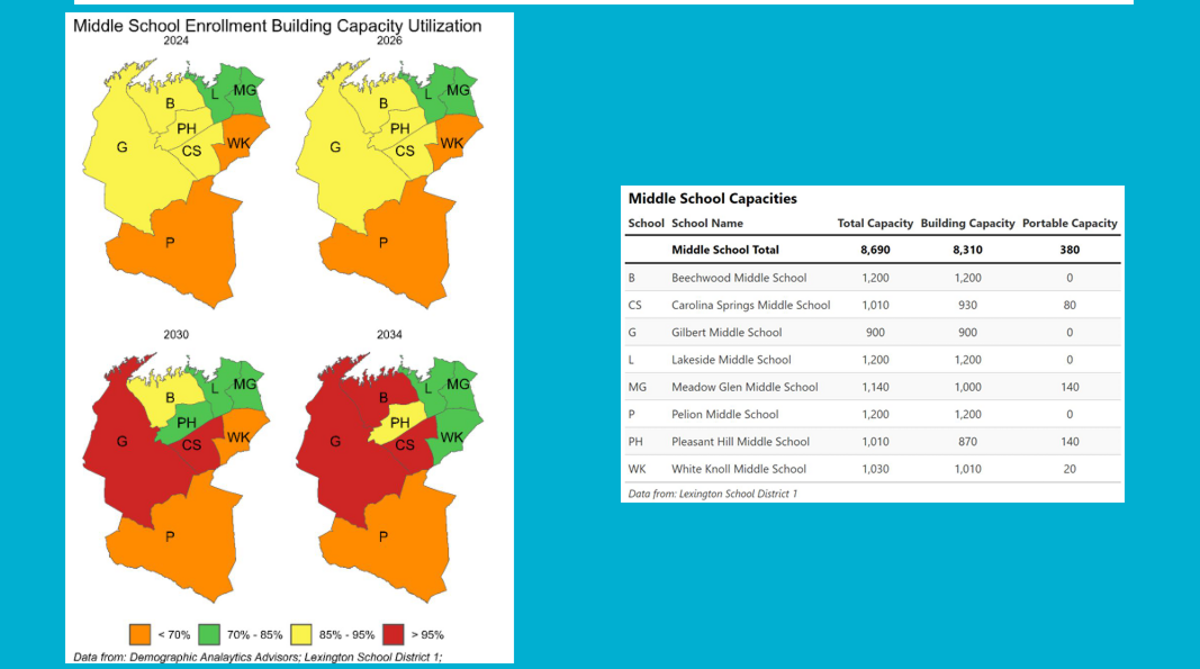
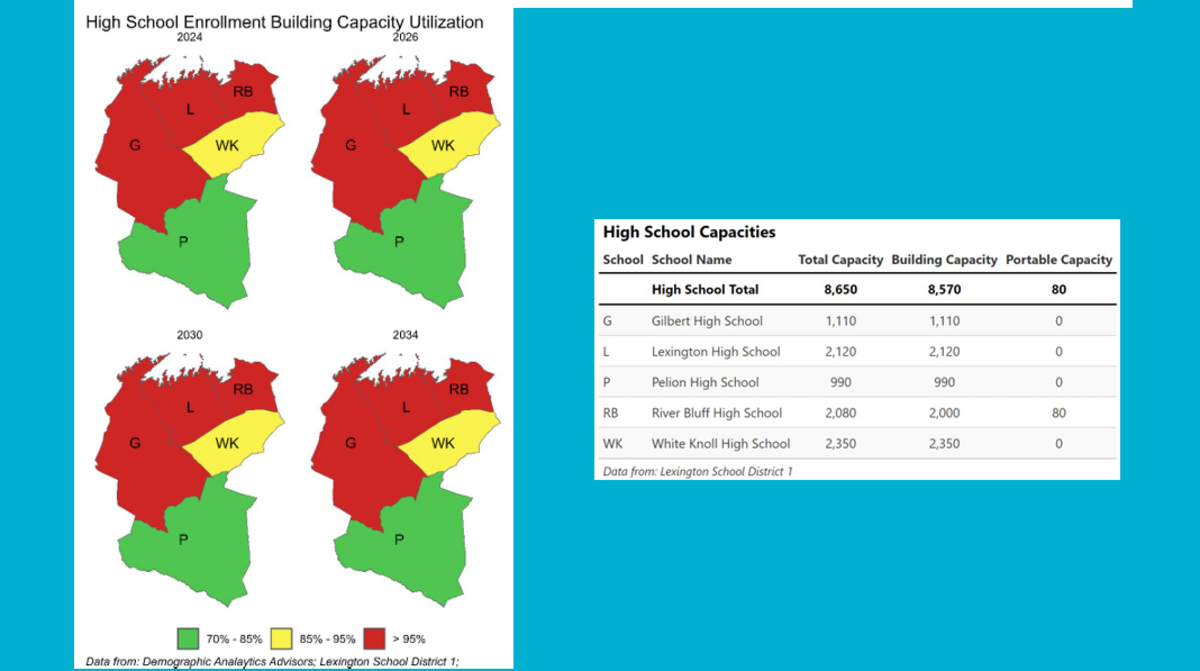
As board members await results from the facilities study, which is expected to be completed around the beginning of next year, the district is weighing every possible option – from opening a new school to rezoning certain areas for different schools and funneling students from larger schools to smaller, more underutilized ones.
Both are complicated, board members said. Building a new school is expensive and a task that would likely fall to taxpayers. Rezoning would be cheaper than building an entirely new school, but that can be unpopular among parents and students.
“We are trying to be very mindful of the community financially … and emotionally. Change is hard. Being a mom, if I have a little third grader or even a high schooler and they find out they have to leave their school next year, that’s really hard,” Henson said, noting that some parents chose to buy homes in certain areas based on the school zones.
Small classroom sizes impacts capacity
Capacity doesn’t just represent the amount of physical space for students to take up, Roof, the district spokesperson, explained. A school’s capacity can be impacted without ever demolishing a wing or adding a new classroom – certain programming or offering classes that are capped at smaller sizes can reduce program capacity, even if enrollment numbers have remained mostly the same.
“Capacity can be a fluid number … if you have certain types of programs, depending on their needs, that could limit the use of certain classrooms to only those programs so you have to take that into consideration,” Roof told The State.
The school district’s formulas for calculating its student-teacher ratios, which vary based on things like grade level and type of class, are lower than the state’s recommended formulas. Henson told The State when she was up for reelection last fall that a priority for her was to decrease classroom sizes.
The emphasis on smaller class sizes has served the district well as it relates to state report cards, which grade schools across the state based on things like graduation rates and school climate. Of the district’s 31 schools, only two were ranked below average for the 2023-24 school year, while 10 were ranked excellent. Report card data for the district’s newest school, South Lake Elementary, was not available.
But those grades come at a cost. The district’s budget has increased by more than $120 million since 2019, despite adding around 100 students in that time frame.
Students leaving for charter schools
On top of shifting enrollment across schools, the district has had to contend with a growing number of students leaving the district for charter schools like American Leadership Academy. In nearby district zones, others like Gray Collegiate, GREEN Charter School of the Midlands and East Point Academy have drawn students across the area.
American Leadership Academy, a K-12 charter school that emphasizes patriotism and strong moral values, opened in the fall of 2023 and is the state’s largest brick-and-mortar charter school with just under 1,900 students.
Since it opened, the school district has seen its enrollment drop by nearly 1,000 students, according to daily student headcounts. The biggest dropoffs have been for elementary school students, with the enrollment numbers dropping by more than 700 over two years.
“[Parents] have options that didn’t exist pre-COVID. There are more home-school options and there are more parents comfortable with home-school. There are more charter school options, there are also more virtual charter school options,” Lexington 1 school board member McKenzie Flashnick told The State. “Just because we have a new housing development go up, doesn’t mean that those people are going to go to our schools ... I think it’s really important to look at those [studies] and have a full picture of the projected data and make decisions that way.”
Nearly half of the district’s 18 elementary schools are over capacity, but with the numbers of young students enrolling dropping so rapidly, decisions about how to plan for the future have been complicated.
Plans for at least six locations of American Leadership Academy, which is based in Arizona, have been approved by The Charter Institute at Erskine, which recruited the charter school chain to South Carolina. That includes a massive complex set for Blythewood.
The influx of charter schools into local school districts impacts not only the ability to predict enrollment, but also the amount of money that school districts receive, Frank Adamson, a professor at Sacramento State in California who’s studied how charter schools have impacted local districts in other states, told The State.
In some areas, he’s seen districts lose more than a tenth of their budgets to an influx of charter schools.
“You have to still provide all the principles, all the teachers, all the sites, all the classrooms, everything, all the infrastructure and human resources that need to be provided for the students that remain, but you’re doing that while you’re losing anywhere from 5 to 10% or more of your budget,” Adamson said.
“You never know if all of a sudden another charter school is going to come here and build. And then in one of those growing areas, maybe that takes more students away. It’s almost like trying to build the plane while you’re flying the plane,” Rice said.
This story was originally published June 27, 2025 at 5:00 AM.