
‘Monster’ proposed student apartment project near USC dealt setback by SC state judge
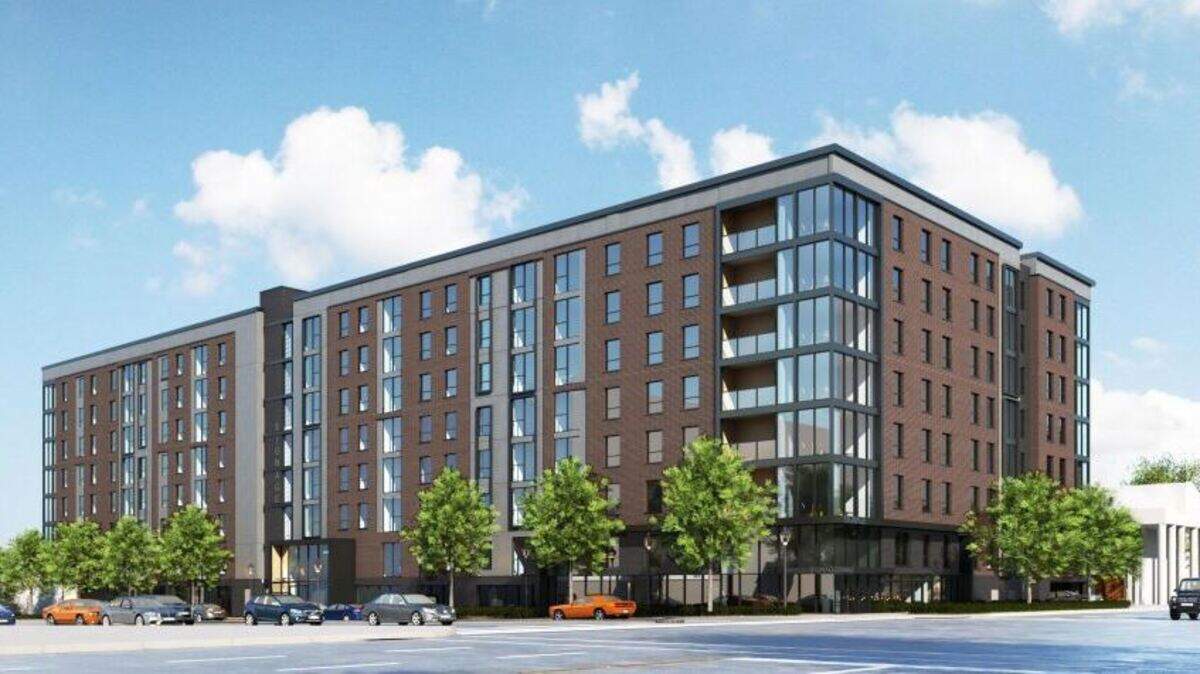
A state circuit court judge has derailed — at least temporarily — a proposed large downtown Columbia student housing tower that would likely dwarf historic and landmark buildings around it, including the new three-story University of South Carolina School of Law.
In ruling for the University Hill Neighborhood Association, state Judge Casey Manning rejected a request by the Indiana developer, Trinitas, the City of Columbia and the city’s Design and Development Review Commission to dismiss a lawsuit brought by the Association challenging the project planned for the intersection of Gervais and Pickens streets.
In his ruling, Manning also said the complicated zoning plan review process by which city officials gave power of approval of the eight-story project to the Design and Development Review Commission was flawed because the commission used a legally wrong height standard in reaching its determination that Trinitas’ proposed building could be 75 feet high instead of a lower figure. The project would have 276 apartments and more than 500 occupants.
On Thursday afternoon, Trinitas attorney Lyndey Bryant of Columbia, declined comment, as did a spokeswoman for the City of Columbia.
“That (Judge Manning’s) order was just an order on one of the motions in the case — the matter is still pending and the city doesn’t comment on pending litigation,” the city spokeswoman said.
State Sen. Dick Harpootlian, D-Richland, who fought the case on a pro bono (unpaid) basis with retired USC Law School professor Patrick Hubbard, a zoning law expert, said, “It’s not over. They can appeal. They have a number of appeal avenues. The ball’s in their court.”
But had his clients lost this legal round, Harpootlian said, “It would have been a serious blow. They (Trinitas) would probably be breaking ground.”
Harpootlian said Manning made some major rulings in the University Hill Association’s favor, including that the judge found the approval process legally flawed.
The Association was opposed to the project because of “its bulk, its mass, its height, too many students — it’s inconsistent with the neighborhood — compared to the surrounding residential neighborhood, it is a monster building,” Harpootlian said.
“People who have lived in that neighborhood have invested time and money — do the economic interests of an out-of-state developer outweigh those of the longtime residents?” Harpootlian said.
“There will be extra cars from all the people who live in Trinitas’ building, if it’s built, it will wreak havoc on traffic and pedestrians will be more in danger than they are now. It’s not what we need to be doing in the city of Columbia in that area,” Harpootlian said.
Trinitas announced the project in December 2019 and began going through the city’s review process.
On July 9, the city Design and Development Review Commission approved Trinitas’ plans.
On July 23, the University Hill Neighborhood Association filed suit against Trinitas, the city of Columbia and the city’s Design and Development Review Commission.
In that lawsuit, the Association charged that the approval process in itself was unlawful and mistakes were made in the approval itself, because the proposed building, which will be 75 feet tall and occupy nearly an entire city block, is too tall in height and large in size for the neighborhood and out of character with surrounding buildings and structures.
Adjacent and nearby historic structures include USC’s McMaster College, a small 1920s former Christian Science Church, the 1813 Horry-Guignard House and the 1908 Taylor House, the lawsuit said.
“Because of these aspects, the area has a sense of human scale and proportion. In addition, the large number of historic structures provides a meaningful sense of place in time,” the lawsuit said.
In an answer to that lawsuit, Trinitas denied that anything was unlawful about the city’s approval process and countered that University Hill Association’s description of the entire area in which the project was to be built was incomplete and therefore misleading.
Moreover, Trinitas said, the Association lacked “standing” to bring a lawsuit. However, in his ruling, Judge Manning ruled the matter was one of public importance that raised recurring issues that would come up with respect to other proposed projects in the future.
Trinitas, an Indiana real estate firm, makes money by buying and developing land near major universities, specializing in student housing, multi-family and mixed-use development, according to its web site. It currently is developing $500 million in student housing and other property, with “an additional $1 billion in its development pipeline,” the web site says.
If built, Trinitas’ Columbia project would have a variety of studio, two- and three-bedroom apartment units, a parking garage, swimming pool, fitness center, study rooms and other amenities, according to plans submitted to the city.
In recent years, as USC’s student population has increased, numerous student apartment complexes have sprung up downtown and outside the city proper.
This story was originally published October 10, 2020 at 5:00 AM.