
Preparing to leave office, US Attorney Adair Boroughs reflects on a career of doing justice
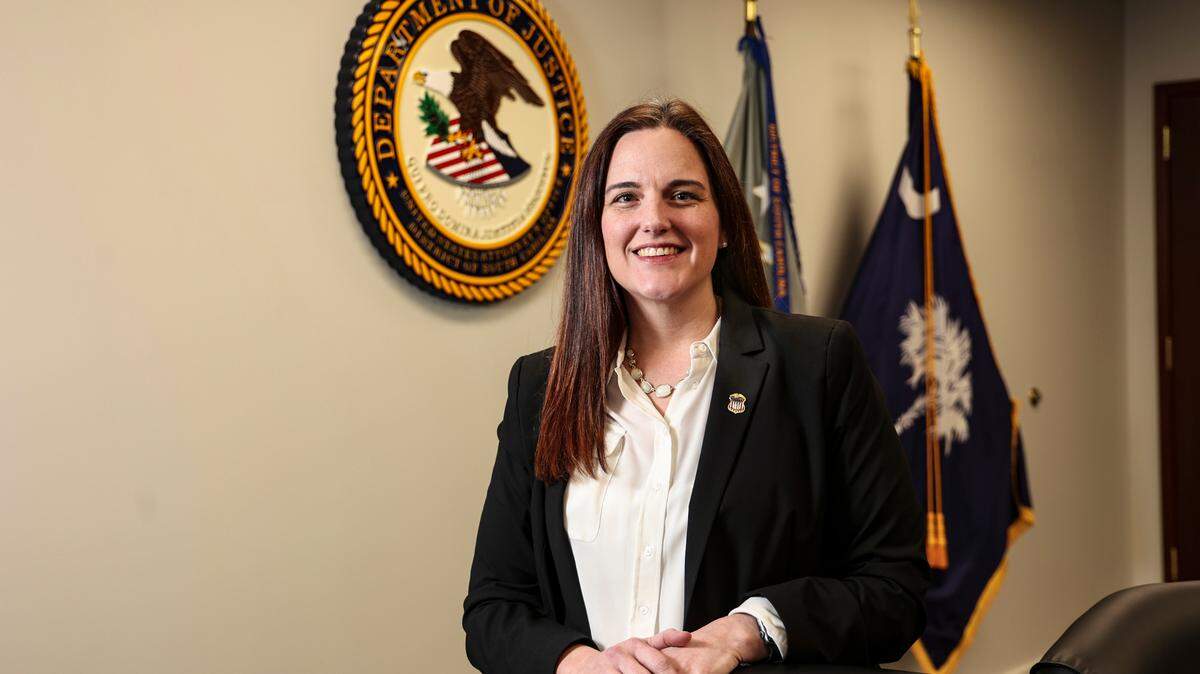
Adair Ford Boroughs describes herself as a problem solver. By her own admission, the United States attorney for South Carolina has never had a career plan. Instead, she says she’s been driven to find solutions to questions of justice and fairness.
It is a drive that has taken her from growing up in a double-wide trailer in Williston, South Carolina, to a math degree and a Truman Scholarship at Furman University and to Stanford Law School, the Justice Department in Washington, public interest law firms, an unsuccessful run for Congress and the highest levels of American law enforcement.
She is only the second woman appointed by a president to hold the position of U.S. attorney in South Carolina, the state’s top federal law enforcement officer. Appointed by President Joe Biden, she took over the office in June, 2022. The post oversees criminal prosecutions in South Carolina involving agents from the FBI, IRS, DEA and other federal investigative agencies.
Now, the unknown beckons once again for Boroughs, a Democrat, who will likely be replaced now that Donald Trump has assumed the presidency. It is common for incoming presidents to appoint new United States attorneys in each of the nation’s 93 judicial districts, especially if the new president and his predecessor are from different political parties.
“I’ve had a very non-traditional career. Usually lawyers specialize and stay in a lane. I’m not good at that,” Boroughs said in an interview with The State. “There’s thousands of issues that I could be happy working on and making my community and the world better.”
In the 2.5 years that Boroughs has led the U.S. Attorney’s Office in South Carolina, she has tried to address the big issues of gun violence, civil rights and hate crimes.
Among other high points, in February, 2024, assistant U.S. attorneys in South Carolina secured the first ever murder conviction under a federal hate crimes statute where the motive was the victim’s status as a transgender woman.
On Jan. 22, her office released its findings into a year-long investigation of the Richland County jail, which has been plagued by deaths, drugs and violence. A similar investigation into the Charleston County jail is ongoing.
Even as her days may be numbered in the role, last week her office scored a rare victory in fight against predatory scammers with the arrest and extradition of Hassanbunhussein Abolore Lawal. The 24-year-old from Lagos, Nigeria was alleged to have been behind the sexual extortion that led to the suicide of 17-year-old Gavin Guffey, son of a York County state legislator.
But one of her proudest achievements is starting a program to pay the office’s interns, just one of two U.S. Attorney’s Offices to do so. As a student who couldn’t afford to take unpaid internships, Boroughs said she was all too aware of how parts of the government were losing out on talent because of this policy.
“We were saying that unless you can afford to work for free, you don’t get that opportunity,” Boroughs said. “Paid internships are an issue of fairness to me.”
No date has been set for Boroughs’ departure, but as she prepares to leave the position, she is confident that the office’s mission-driven work will continue despite some people’s concerns about Trump.
Trump has repeatedly criticized the FBI and the Justice Department for investigating individuals close to him and, according to him, not investigating his political opponents.
“I have a lot of faith in the department and the career men and women here,” Boroughs said. “Leadership will change, priorities will change. . . . But the mission of the department doesn’t change.”
The Beginning
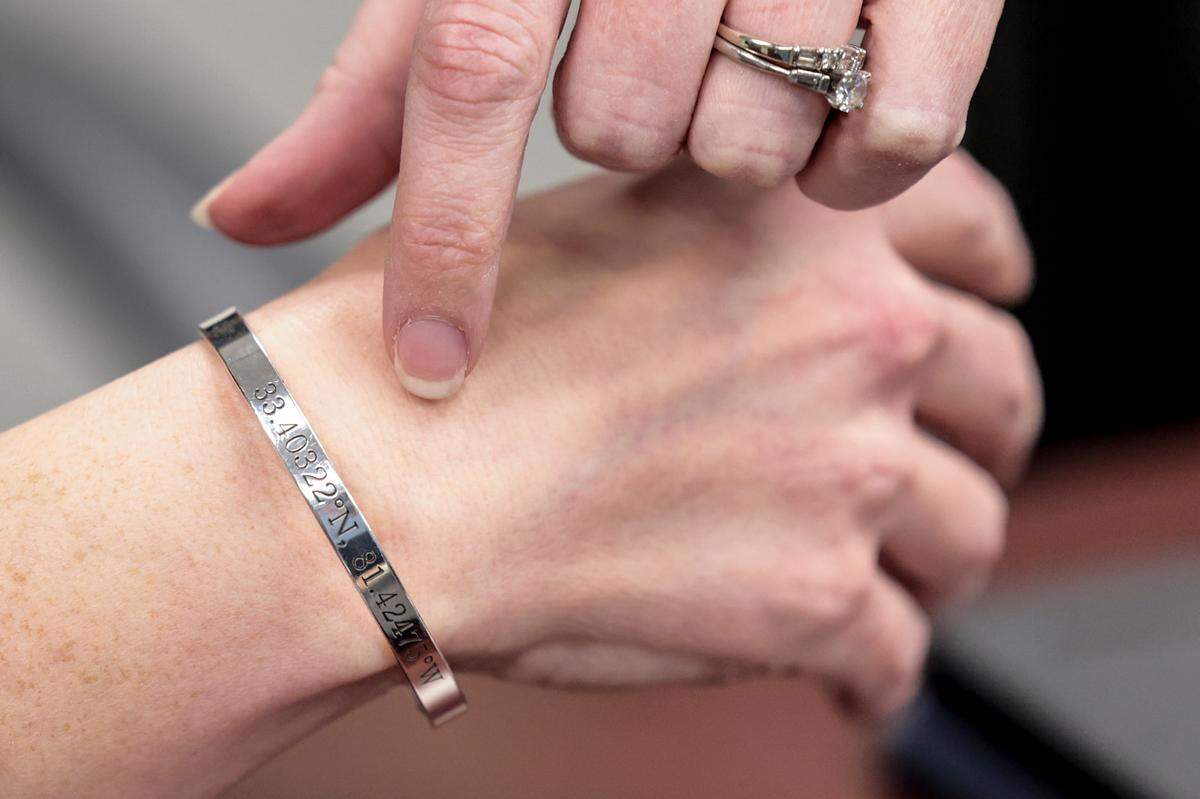
On her right hand, Boroughs wears a silver bracelet. Engraved on the outside is the longitude and latitude of Boroughs’ hometown, Williston, a town of just under 3,000 people with two traffic lights and where the poverty rate hovers around 25%.
The bracelet is a gift from the Ned Branch Missionary Baptists Church, an African American church in nearby Barnwell that many of Boroughs’ dearest friends from high school attend. The church, Boroughs said, has become a spiritual home that she returns to when she is back in Williston.
On the inside of the bracelet are engraved the words “The Beginning.”
It is a reminder of the voices she represents as she sits with some of the most powerful people in South Carolina and Washington, DC., she said.
“I feel an obligation and responsibility to bring the perspective and bring the voices of the people I went to high school with and the people I grew up with, because those voices are so often not in that room.”
“She’s able to play in the big leagues and also look out for the little guy,” said Chris Bryant, her law partner at a firm they founded in 2021, Boroughs Bryant, LLC in Columbia.
Boroughs’ mother was a public school English teacher and her father worked in various jobs as a carpenter, cabinetmaker and installing high-end windows and sliding glass doors.
He made the frame for a painting that hangs in her office’s conference room, titled “A Breath of Freedom.” Painted by Jonathan Greene, it depicts the crowd of people gathered outside the Charleston federal courthouse to hear arguments for the seminal legal case Briggs v. Elliott, which successfully challenged segregation in South Carolina schools.
Growing up in Williston, Burroughs “didn’t have anyone telling me ‘dream bigger,” she said, but that changed at Furman after she was awarded a prestigious Truman Scholarship. Awarded to undergraduates with a commitment to leadership, the scholarship guarantees $30,000 for postgraduate education.
It was this tight knit community of Truman Scholars, which calls itself the “TruFam” and includes such legal luminaries as Supreme Court Justice Neil Gorsuch, that encouraged her to dream bigger.
Besides marrying Bryan Boroughs, the Truman Scholarship “was probably the single most transformative thing in my life,” Boroughs said.
But the law wasn’t on Boroughs’ mind when she graduated from Furman University in 2002. She was working as a public school math teacher and, on the side, tutored students on taking tests, including the LSAT. While weighing getting a graduate degree in education policy, an off-the-cuff comment from Inez Tannenbaum, then superintendent of education, convinced her to pursue law instead.
During a meeting, Boroughs expressed her desire to change education policy in South Carolina and her interest in pursuing a graduate degree in education policy. Tannenbaum suggested the law instead, saying that legislators in South Carolina’s State House, a building dominated by lawyers, gave particular deference to law degrees.
Admitting it was “not a good reason to law school,” she did it “because I wanted someone to listen to me,” Boroughs said.
By December she’d taken the LSAT, and while she missed that year’s deadline to apply for the University of South Carolina’s law school, she won admission to top law schools including Yale, Duke, Harvard and Stanford.
Attending Stanford just felt right, Boroughs said. It was the first time she’d lived outside of South Carolina, and while her original interest was in education policy, she became increasingly interested in becoming a trial attorney while also growing “morally indignant” about cases on tax shelters that the U.S. Department of Justice was prosecuting, and losing, at the time.
After graduating from law school, Boroughs joined the U.S. Justice Department’s tax division in Washington, D.C. Only two weeks after being sworn in as an attorney she found herself arguing summary judgment motions. Within two to three years she was the lead attorney in jury cases.
While the Justice Department was an incredible place to learn, Boroughs said that she was never going to stay in Washington.
“I always knew I was going to come back to South Carolina. I knew this is where I wanted a career and a life.”
Doing justice
When federal district Judge Richard Gergel prepares to go into the courtroom he looks at his clerks and says “let’s go do justice.”
Boroughs carried that spirit with her, said Bryant, who clerked alongside her under Gergel, a towering legal figure in the state.
Shortly after Boroughs returned to South Carolina to clerk for Gergel, she found herself working on the death penalty trial for Dylann Roof, the white supremacist who shot and killed nine African American parishioners at Mother Emanuel AME Church in Charleston.
Her experience on the Roof trial strengthened her conviction about the importance of civil rights work at the United States Attorney’s Office.
Because South Carolina doesn’t have a hate crimes law, only the U.S. Attorney’s Office — using a federal law — can prosecute hate crimes in the state.
“I saw it in the Roof case, just how important it is to a community to have a hate crime tried as a hate crime,” Boroughs said.
The same was true for civil rights cases more broadly, Boroughs said. The federal government has expansive powers to open investigations into violations of civil rights and then bring either civil or criminal cases. That’s particularly important in South Carolina, which does not have a hate crimes law.
As a leader, Boroughs said that she found it most important to trust her team, and that her role was to make sure that they had what they needed and they knew “I’m going to back your play,” Boroughs said.
Eleventh Circuit Solicitor Rick Hubbard of Lexington County described Boroughs’ approach to working with local offices as “collaborative.”
But one area where some have questioned the U.S. Attorney’s Office’s involvement was in the Alex Murdaugh case. The office filed federal financial crime charges even though the state Attorney General’s Office was already handling financial charges against Murdaugh and his alleged accomplices.
Boroughs defends her department’s decision to get involved, saying that while the state murder case against Murdaugh always took priority, the federal financial crimes charges were meant to act as a “backstop” in case Murdaugh or others successfully beat or appealed the state financial charges.
Murdaugh’s banker, Russell Laffitte, was convicted in November 2022 on federal financial charges, but the convictions were overturned because of how the judge — Gergel — dismissed a juror. Federal financial crimes charges were filed against Murdaugh in May 2023, just two months after being convicted of killing his wife and son.
The timing of the charges was to prevent the statute of limitation from expiring on the financial charges, Boroughs said. Murdaugh pleaded guilty to both the state and federal financial charges.
By her own admission, Boroughs said that when she came onto the job, she found white collar crime more interesting. But violent crime, she knew, must be a focus. South Carolina has the eighth highest homicide rate in the country and the eleventh highest rate of deaths by firearms, according to the federal Centers for Disease Control.
She has deployed intelligence-driven, multi-agency approaches to uprooting criminal organizations. In Walterboro, the U.S. Attorney’s Office indicted 14 people, some connected to the violent street gang the Cowboys, on drug trafficking charges. In Myrtle Beach, a multi-agency operation spearheaded by the FBI led to the arrest of more than a dozen people connected to the Rollin’ 90s Crips, G-Shine Bloods and Gangster Disciples on drug and weapons charges.
Her office has also been involved in efforts like Cease Fire in Columbia and Safe Communities in Aiken. In these programs, high priority offenders are brought in and warned that federal charges for being a felon in possession of a weapon could result in decades-long prison sentences. The offenders are also offered resources to turn their lives around.
As her time at the office draws to a close, Boroughs said that she doesn’t know what’s next for her. For one of the first times in her life, she says she might take a break, but she doesn’t think it will be too long before she gets bored and starts looking for the next thing.
“I’ve just got to find what problem I’m going to work on next,” Boroughs said.
This story was originally published February 7, 2025 at 12:25 PM.