
Columbia chief: Misleading reports of Shandon stranger stabber ‘not the full narrative’
Initial reporting on social media and elsewhere about a stranger stabbing on a sidewalk in Columbia’s upscale Shandon neighborhood lacked context and inflamed an already volatile situation, Columbia police Chief Skip Holbrook said.
“I wouldn’t necessarily call it a false narrative — it was just not the complete narrative, and it wasn’t the full context,” said Holbrook in an interview. “A challenge for law enforcement today is staying ahead of the narrative because of the speed of social media.”
“People were taking positions and making statements based on not having all the facts,” said Holbrook, who has been speaking in recent days about the incident to neighborhood groups in Shandon and Heathwood.
This is what happened: On March 2, a Monday, around 6:30 p.m. as twilight began and people were still out, enjoying the end of a sunny day, an 18-year-old man walking on a sidewalk in the 2700 block of Wheat Street viciously began stabbing a 58-year-old man who was walking his small dog.
Hearing screams, three neighbors rushed to help, struggled with the assailant and subdued him. Police arrived quickly.
The suspect and the injured man, who remains hospitalized recovering from multiple stab wounds, did not know each other.
One social media report, texted anonymously to cell phones in the Columbia area three days after the stabbing spewed the tale that the attacker “is free, walking the streets of Columbia because a city judge gave him a PR (personal recognizance no money) bond. Letting a violent criminal out on a PR bond after an attack like this should outrage every resident of Columbia.”
Social media misled public
Social media, with no accountability, was spreading falsehoods.
In fact, said Holbrook, the attacker, Justin Reyes, 18, a student at the University of South Carolina, had suffered delusions from the onset of a severe mental health crisis. He was only released on a PR bond by a city judge because evidence was shown to Municipal Judge Gail Jabbers about his mental issues and after assurances he would be immediately institutionalized, Holbrook said.
Reyes was getting counseling at a nearby church, but left it and began walking on Wheat Street, Holbrook said.
The suspect’s mental health meant the police at first could initially only release certain details about the incident, Holbrook said.
Only after a lawyer, former state Sen. Gerald Malloy, D-Darlington, retained by Reyes’ family, made the mental issues public was Holbrook free to publicly discuss the matter more fully, he said.
“There was a narrative that we made the wrong charge, and that we were not objecting to the bond,” Holbrook said. “All that was incorrect.”
The weapon was a standard folding knife, Holbrook said.
Police charged Reyes with assault and battery of a high and aggravated nature and possession of a weapon during a violent crime. Reyes lacked the intent to kill and malice in the throes of his mental health crisis, so he was not charged with intent to murder, Holbrook said.
Police argued for no bond and if bond was granted, the defendant should be placed on GPS electronic monitoring. But the judge turned down both requests, Holbrook said. However, she did set conditions on Reyes, such as he cannot return to Shandon, nor can he be around the victim.
“We are professional police officers. We respect the decision and move on,” Holbrook said.
Matt McCoy, one of the police department’s most experienced violent crime investigators, was the lead detective on the case, Holbrook said.
What the family said
A letter made public by the defendant’s family lawyer Malloy made these points:
- “In the days leading up to this incident, the young man had been experiencing significant mental health challenges. His medication had recently been changed, and he began suffering from episodes during which he believed someone was pursuing him. Fellow USC students who knew him well recognized something was different with the young man and encouraged him to seek counseling, and efforts were made to obtain assistance through the University of South Carolina.”
- “Concerned after speaking with him Monday afternoon, his parents and members of their faith community attempted to provide support. A pastor assisted in arranging for someone to drive hm to a local support group meeting in Columbia. During this time, he remained in communication with his parents.”
- After being dropped off in the Shandon area, the young man called 911 seeking emergency assistance, expressing fear that someone was after him.... During this mental health episode, and while still on the phone with 911, he tragically misidentified an innocent passerby as the individual he feared. In that state, he attacked the individual with a knife.”
- “During the hearing, the Court was advised of the recent medication change and the severe mental health episode that had occurred. The Court carefully considered the facts and circumstances presented. The Reyes family advised — both directly and through counsel — that upon any release, their son would immediately be placed in an emergency facility for inpatient evaluation and treatment.”
What USC says
A USC spokesman confirmed that Reyes is a freshman and lived on campus.
“Concerning Mr. Reyes, I can’t disclose what, if any, interactions Mr. Reyes may have had with USC’s counseling and psychology services, as that information would be protected by federal privacy laws (FERPA, HIPAA),” said Jeffrey Stensland, Associate vice president for university ccommunications.
The university does “offer students 24/7 help through a mental health hotline and can do same-day assessments for students in need,” Stensland said in an email.
“These services are emphasized in both student orientation and reinforced during U101 classes. Resident hall advisors also are trained to provide assistance to students is in crisis. The numbers for a suicide prevention and crisis hotline also are printed on the back of every student ID card (Carolina Card).
“We urge any student experiencing mental health challenges to seek help. Students who may know someone in distress can also seek help on their behalf by contacting the hotline, USC’s Counseling and Psychology Services, or calling 911 if there is an immediate threat of self-harm or harm to others,” he said in an email.
Peaceful Shandon
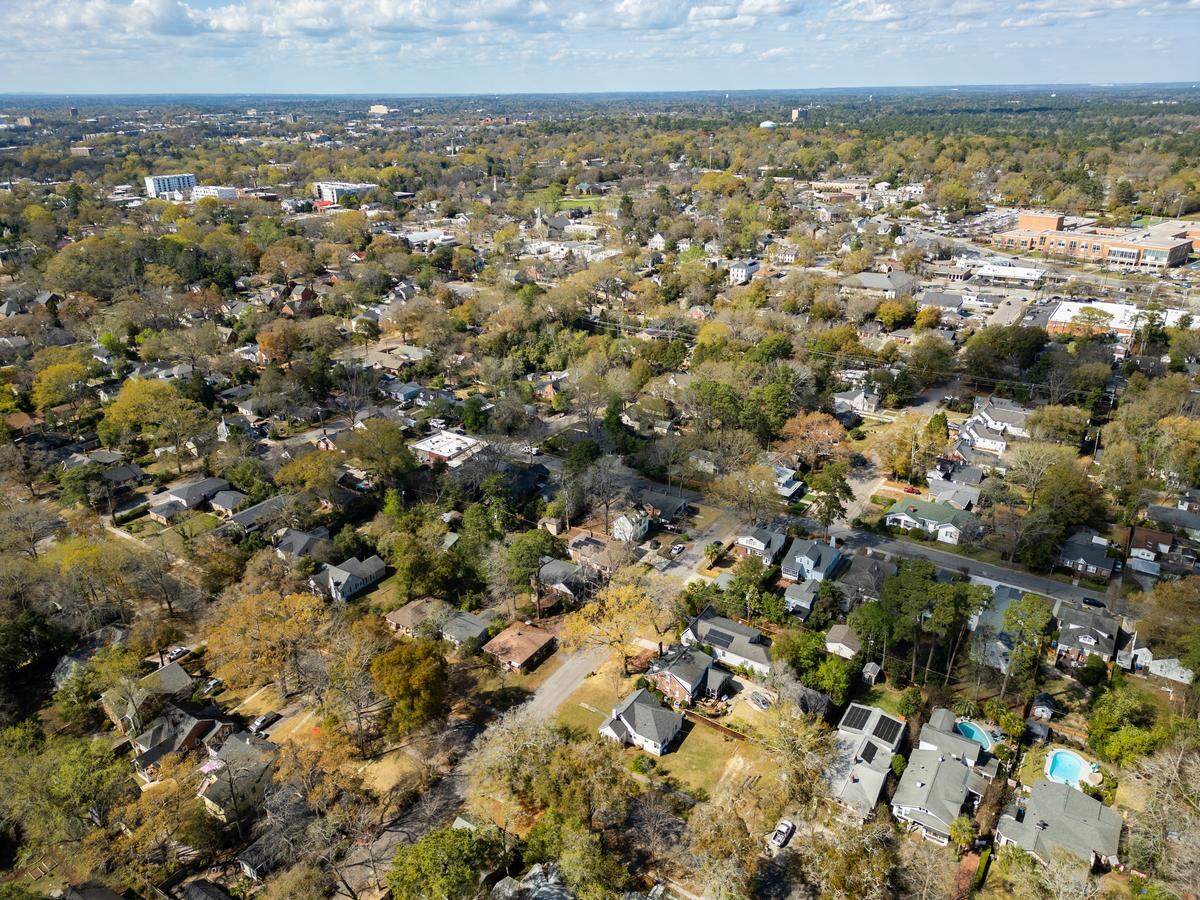
Violent crime is rare in Shandon, an upscale nearly all-white community of doctors, lawyers and other professionals, well-used sidewalks, leafy trees and an estimated 1,600-plus cozy one-and two-story homes usually costing north of $500,000. It’s a place of presentable yards, no cars parked on lawns, where golf carts and bicycles travel the streets, where you know your neighbors and most everyone picks up after their dogs.
On Wheat Street, where the stabbing took place, former Gov. Jim Hodges, former Supreme Court Chief Justice Jean Toal, state Rep. Seth Rose, D-Richland and former state Sen. John Courson, R-Richland, live within blocks.
A 78-year-old woman who didn’t want her name made public said she was listening to music inside her house when she heard screams coming from outside. She went out to her porch.
“There they were, somebody was over there stabbing the guy,” she told a reporter. “I called 911.”
It took a few minutes to subdue the assailant, she said. Meanwhile, the injured man was sitting down with his little dog beside him, she said.
“It was crazy. I mean, in Shandon. We’ve been here 45 years. The worst thing that happened is that somebody stole my ferns one time. It was Mother’s Day, and they stole them,” the woman said.
Hodges, who lives two blocks from the stabbing, said he knew at least one of the three men who subdued the attacker and the attack “was a topic of conversation that night, and it remains a topic of conversation. It’s kind of spooky, having a guy jump out from the bushes.”
Chief Holbrook said the assailant did not jump from bushes. Hodges said he had been told about the bushes by one of the men who rescued the stabbing victim.
Shandon’s last shocking crime happened in 2011, when beloved University of South Carolina assistant professor Jennifer Wilson was stabbed to death by a berserk boyfriend at her Monroe Street duplex. After a jury trial, the killer was found guilty and is now in state prison serving a life sentence.
Fifth Circuit Solicitor Byron Gipson noted the irony in the publicity devoted to the highly publicized stabbing in the well-to-do Shandon community compared with the lack of publicity given to more numerous similar incidents in lower income and more racially diverse Columbia communities.
“As long as it’s ‘not in my backyard’ — NIMBY — nobody really cares, Gipson said. “You can watch it play out. Four years ago, when shootings happened at the (Columbiana) mall. Shootings have been happening all over the city, but all of a sudden, it happens at the mall, and everybody is outraged — for three weeks.”
“But they’re not outraged when it happens in Greenview, they’re not outraged when it happens in Lower Richland, they’re not outraged when it happens along North Main but they are outraged when it happens in Shandon and Forest Acres,” Gipson said.
Gipson added in a text, “This incident was tragic on many levels. We should always be outraged by violence, especially when it is carried out against an innocent person. My hope is that all of our communities will express similar outrage whenever an act of violence is committed, no matter what ZIP code. I further hope misinformation will no longer govern the way our communities respond when these tragedies take place.”
What’s next?
Malloy, the Reyes’ family lawyer, said Monday that the 18-year-old is still institutionalized.
Reyes “is in the system for trial or some type of disposition, charged with a violent crime,” Holbrook said. “I would think of how things track on the mental health side would be very material as to the disposition of the matter.”
Fifth Circuit Solicitor Gibson said that from now on, the Reyes matter will be handled in general sessions court with a circuit court judge.
Reyes will have what is called a first appearance, which is an administrative hearing, and he doesn’t have to be present for that, Gipson said. “It is an opportunity for the judge to be assured that the defendant has a lawyer and the case is being tracked properly.”
Then, six to eight months later, there will be another hearing about evidence, he said. “We will be fully involved,” Gipson said.
At some point, Reyes will be likely be released from the facility where he is now. But that date is an unknown, along with what conditions he will be under.
“The question then is, ‘What’s going to happen when he’s released?’,” Hodges asked.
Andrew Clarkson, who with his wife, Caroline, is a 22-year Shandon resident, was at a Monday night meeting of the community’s neighborhood council and heard Chief Holbrook speak.
“I felt like the presentation was accurate. It satisfied any questions I had,” Clarkson said.
“Shandon’s very peaceful overall, but you’re going to get random things that occur from time to time.,” Clarkson said. “I just have grown to expect that. You don’t know where or when, but something’s going to come up. Hopefully we won’t have a reoccurrence anytime soon.”
This story was originally published March 11, 2026 at 5:30 AM.