
After 9/11, a Midlands school raised money to buy NYC a fire truck. Where is it now?
The 20th anniversary of the Sept. 11 attacks raises a lot of terrible memories for many people across the country.
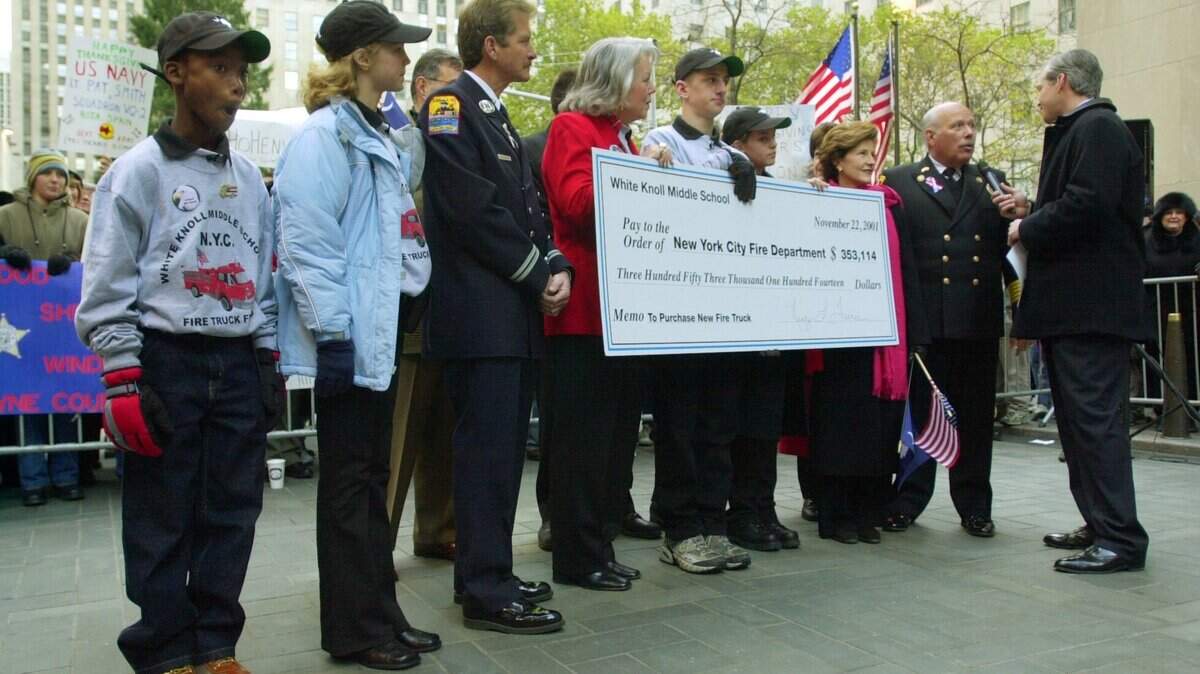
But in Nancy Turner’s photo album, the images of that time are some of her proudest. Within its pages, the former principal at White Knoll Middle School is seen holding a giant novelty check with the $540,000 her students raised to pay for a new fire engine for New York City firefighters after the devastating terrorist attack on their city.
Others show the trip to New York she and some of her students took to present the money, visiting the fire station, meeting then-Mayor Rudy Giuliani, and riding on a float in the Macy’s Thanksgiving Day parade.
“It happened pretty quickly,” Turner said. “We started in early September, and by the time the Macy’s parade came around we had raised enough money for the fire truck.”
Everyone involved in the effort two decades ago remembers a whirlwind effort that began with students selling patriotic buttons at football games and the state fairgrounds that ended with a high-flying trip to New York, backed by a flurry of corporate donations and national media attention.
After years of wear and tear, the fully-equipped ladder truck donated by those middle school students was decommissioned almost a decade ago. But for the people involved, it remains a major moment of their lives.
J.P. McManus was 12 years old at the time of the 9/11 attacks, and White Knoll’s subsequent push for the fire truck. He credits that experience with leading him toward his current job as a Lexington County sheriff’s deputy.
“I’ve always had a desire for service,” McManus said, noting his parents a few years later had to dissuade him from going into the military and instead go to college. “I went to school for biology, but something just kept getting me back to law enforcement, and it was that same thing; I want to help my fellow American, help my neighbor.”
Turner said she got the idea of donating a fire truck when she saw a news report about how many engines had been destroyed during the collapse of the World Trade Center towers. She called a staff meeting to sell White Knoll’s teachers on the idea.
“I was ready to beg and plead with them, but someone just said, ‘Dr. Turner, you don’t need to explain. We’re behind you.’”
With the school behind her, Turner called Columbia Fire Chief Jack Jansen to try to find out how one went about buying a fire truck. Jansen put her in touch with Sam Tenenbaum, a local philanthropist who had also suggested the city do something to help out New York firefighters who had lost so much trying to save the lives of others that day.
Tenenbaum helped get big dollar commitments from donors to match that raised by the school, and Jansen, a New York native himself, connected the effort with Ladder 101, the “Red Hook Raiders” who had lost not only a fire engine but seven members of their Brooklyn firehouse on 9/11.
The New York fire department put the eager donors in touch with their normal supplier, who could build a new engine to the department’s specifications. The White Knoll team told them they would pay for whatever is the more expensive model.
Tenenbaum learned from a story by The State’s John Monk that Columbia actually owed New York a fire truck. In 1867, just two years after the end of the Civil War, New York had sent the war-torn city one of its own horse-drawn fire carriages as a sign of reconciliation.
“The first one sank on a ship off Cape Hatteras,” Tenenbaum said. “So the soldiers raised the money themselves, Union soldiers stationed in Columbia, to bring them one.”
The Northerners also built Columbia a new fire station out of material from the 1865 citywide fire. That building now houses the Villa Tronco Italian restaurant on Blanding Street.
A former Confederate colonel, Samuel Melton, told New Yorkers that “should misfortune ever be yours,” he hoped Columbia would “obey that golden rule by which you have been prompted in the performance of this most munificent kindness to a people in distress.”
White Knoll students were likely unaware of such an old connection between the two cities, but social studies teacher Leigh Cogdill remembers the enthusiasm of her students for the project.
“I’m not sure how much they even understood what was happening, but they got so behind it,” Cogdill said. “That’s the spirit of White Knoll. Whatever they had to raise, this community does not have a lot of money, but they’re going to give and give.”
Money came in from far and wide. The efforts of the small Lexington County school made national news and money came in from all over the country. Children sent in small amounts of cash with hand-written letters for the firefighters, while adults mailed checks from as far away as China.
“We really couldn’t have done this without the support we got from Lexington, from Columbia, from all of South Carolina in how they responded,” Turner said.
Turner said it was never a problem getting the students excited about reaching the goal. “With middle school kids, the sky’s the limit,” she said. “They were full steam ahead.”
McManus said the events of 9/11 are the “closest thing to what Pearl Harbor meant for the World War II generation.”
“I don’t think I really knew the severity of it, but I kind of fed off the vibes of the adults around me,” McManus remembers of that day at White Knoll. “I remember parents coming to check their kids out early. They didn’t know what was happening. People thought we were going to war. I remember I got home and my parents sat me down and we processed it the best way we could.”
As the ladder truck neared the end of its service, the original purchasers sought a way to bring it back to the Midlands, hopefully to put it on display as an educational tool. But New York City authorities are reluctant to release a fire truck once they have it, even if it’s no longer in service.
“They go into the reserves, and then when you have a truck that breaks down, they’ll take it out,” said Irmo Fire Chief Mike Sonefeld, who has kept up with the local truck in the big city. “They have a junkyard where they take out parts for their other cars.”
It’s fitting, Sonefeld said, that if the engine can’t come back to South Carolina, “it lived a long life, and now pieces of it are on other fire trucks all over New York City.”
Instead, White Knoll Middle School students today can still see a mural of both the 1867 and 2001 fire engines painted to commemorate the event, along with a piece of the original Red Hook engine destroyed on 9/11.
Cogdill remembers the reception the White Knoll crew got when they visited the Red Hook Raiders’ home station, from the firehouse tour to the dinner they were treated to.
“They really made us feel like we did something that made a difference,” she said.
Turner’s husband, Leslie Turner, said “they made White Knoll an extension of Red Hook,” and that for years after, South Carolinians would show up at the station to see “their” fire truck.
Nancy Turner said the success of the fundraising drive, at a time when so many people felt helpless in the face of so much chaos and death, has a lesson for school kids and everyone else.
“People can do a lot of things that others say are impossible,” she said. “If you set your mind and heart on it, it can work.”
This story was originally published September 10, 2021 at 5:00 AM.
.jpg)