
USC students dig up Horseshoe to help uncover university’s past
Students in a University of South Carolina archaeology class spent this year’s spring semester digging up glimpses of the past on the university’s historic Horseshoe.
Honors professor Kelly Goldberg taught the course “Digging Through the Past: Exploring Archaeological Resources.” The course offered a hands-on opportunity to explore archaeological methods such as shovel tests and laboratory processing of artifacts.
“Archaeology is a research tool that’s meaningful beyond the immediate stuff you dig up out of the ground,” said Goldberg.
Goldberg is a clinical assistant professor and director of the USC Heritage Lab who taught the class for a second time. She said while the Horseshoe is littered with historic buildings and relics, there is still much more to be found below ground. She hopes that the discovery of building foundations, buttons, animal bones, bits of glass bottles, and more will reveal more about the way people once lived.
A shovel test involves digging a small hole the size of the shovel to analyze the soil and get an idea of what the earth holds. This type of test was performed last year to determine the potential of an excavation site. One of the shovel tests in front of the McKissick Museum had animal bone and glass bottles, showing Goldberg where to dig. This time around, she had more freedom with the excavation site than the first time she taught the class.
“It let us get our feet wet, and now we’re a little better organized.”
The class based its dig sites on a map made in 1884 by a fire insurance company that shows where old buildings were located. Based on the shovel tests from last year and the map, Goldberg believes that the remnants of the building they found are the kitchen that served the old president’s house.
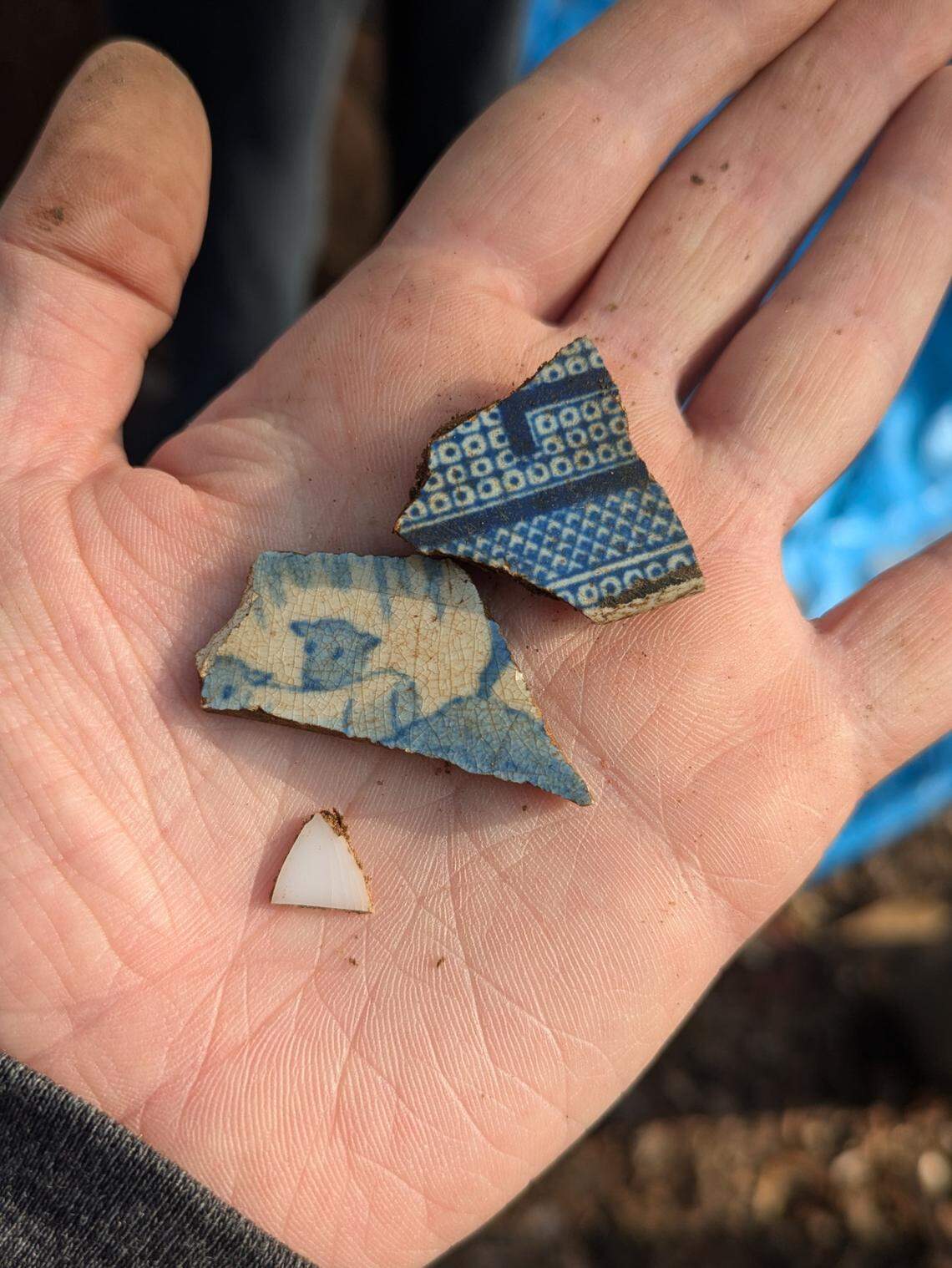
“One of our main goals was to just prove that there are archaeological remains that are still preserved.”
The foundation of the building and other artifacts such as pieces of animal bones and ceramics can help to prove that some remains are still preserved.
Enslavement on campus
“Another primary goal of this project, specifically, is to try to increase what we know about the experience of people who were enslaved on campus,” Goldberg said.
USC historian Jill Found has worked on documentation of the history of enslaved people at USC. Using journal accounts, receipt books, letters, and other sources that mention enslaved people on campus, she has been able to identify a list of around 40 names. However, a lot of the people aren’t written about in the historic record.
“When we have things that are about the history of the Horseshoe or the history of the campus, the people who are enslaved really aren’t included in those narratives,” Goldberg said.
A sign posted on the USC Horseshoe notes the enslaved people who worked around the old campus buildings. Goldberg believes there should be more representation of their lives on the campus than just one sign.
“But the problem is, with a sign like that, then people see that sign at that building, and they say ‘okay, this building is all of the representation of the experiences of these people,’” she explained.
Evidence from the map shows that there were around 10 or 12 different cabins where enslaved people lived on campus. Goldberg hopes to eventually make a ghost structure or outline of some of the buildings the class was excavating to help people think about how the landscape has changed.
Meanwhile, class members embrace their studies as a way of keeping the public informed about the past.
“It’s been nice to learn more about the history of the campus as well,” said Alana Overbey, an anthropology major, “and just kind of like other things that go into archaeology as well and trying to make it more accessible and tell people about it.”
Class favorites
On days the class was not on the Horseshoe digging, students learned about the history of the Horseshoe, reading works on enslaved people on campus, and talking about archaeology as a public information tool.
“I like the digging part, but I also love when we take the application to class,” said class member Hannah Parker.
Goldberg said it is important to inform the public about archaeology and how it can be used as an information tool. The artifacts and foundation of the building can help to show the history of what happened on the campus, and Goldberg believes it’s important to learn about the past.
“I think a big takeaway for me is having students think differently about the landscapes that they look at and walk on every day,” Goldberg said.
Goldberg hopes to catalog the artifacts found in the South Carolina Institute for Archaeology and Anthropology and notes that as the public has more access to these resources and materials, people can stay more informed on the history of the campus.
To learn more about the archaeology done by the spring class and other projects directed by the Public Heritage Lab, visit https://sites.google.com/view/publicheritagelab.
In the fall, USC will be hosting public archaeology lab nights, which will be open to anyone age 12 or over. Updates on dates and times will be posted on the website listed above and social media accounts. You may also email Goldberg at goldbeke@mailbox.sc.edu to be added to an email list to be notified of future open events.
Caroline Yahn is a student in the University of South Carolina Honors College studying advertising. She is involved in Epsilon Sigma Alpha, Zeta Phi Eta, and Healing Hands. In her free time, she enjoys reading, running, and spending time with friends and family.