Affluent seaside landowners plead for help in SC’s battle against rising ocean
.png "This photograph, obtained from Department of Health and Environmental Control records, shows a wall of sand bags that has been installed at Debordieu Beach to fight erosion. DHEC staff members have expressed reservations about the wall. This photo was taken in November 2021.")
Oceanfront property owners in an exclusive South Carolina community want a break from state rules they say are keeping them from fighting the rising sea.
And the politically appointed Department of Health and Environmental Control board is listening, despite reservations from its own staff.
The board has agreed to hear an appeal by a small group of Debordieu Beach landowners to use hard sandbag walls to repel the ocean.
The landowners, who had a contractor install the sandbag walls after a 2020 hurricane, want to keep the protective bags, even though coastal regulators say the devices were put in illegally and, in some cases, are filled with material that is not suitable for the beach. Regulators have ordered the protective bags removed.
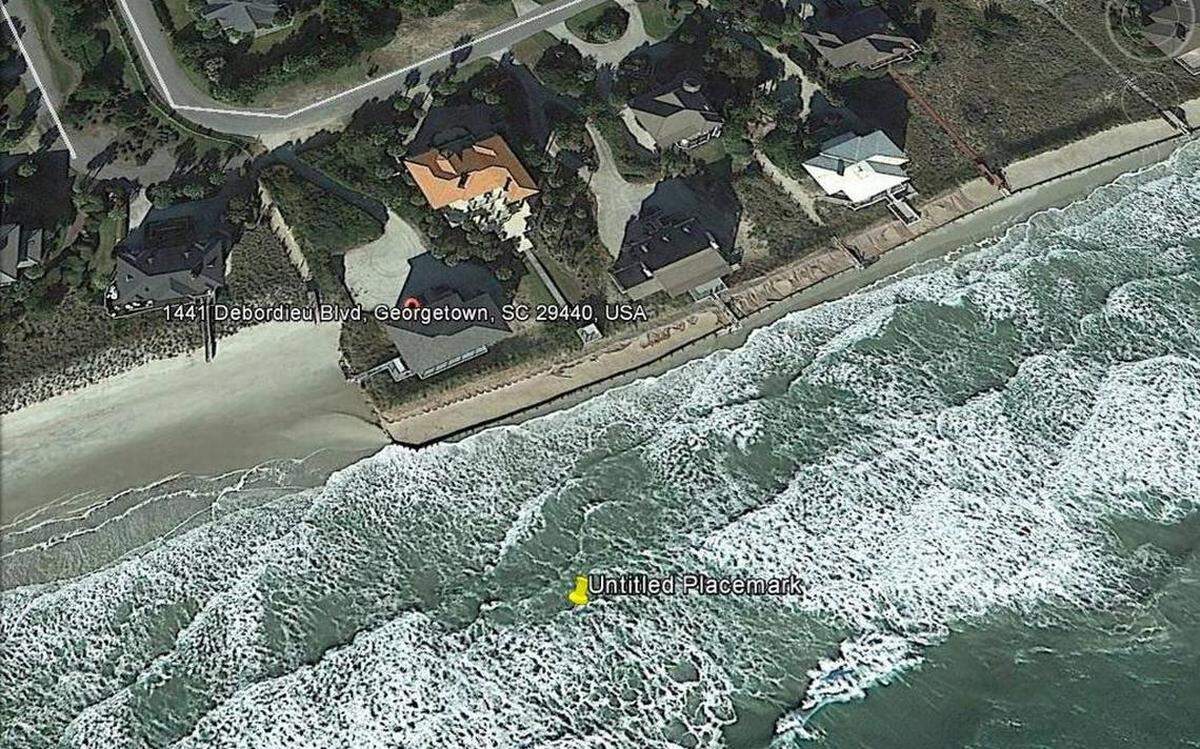
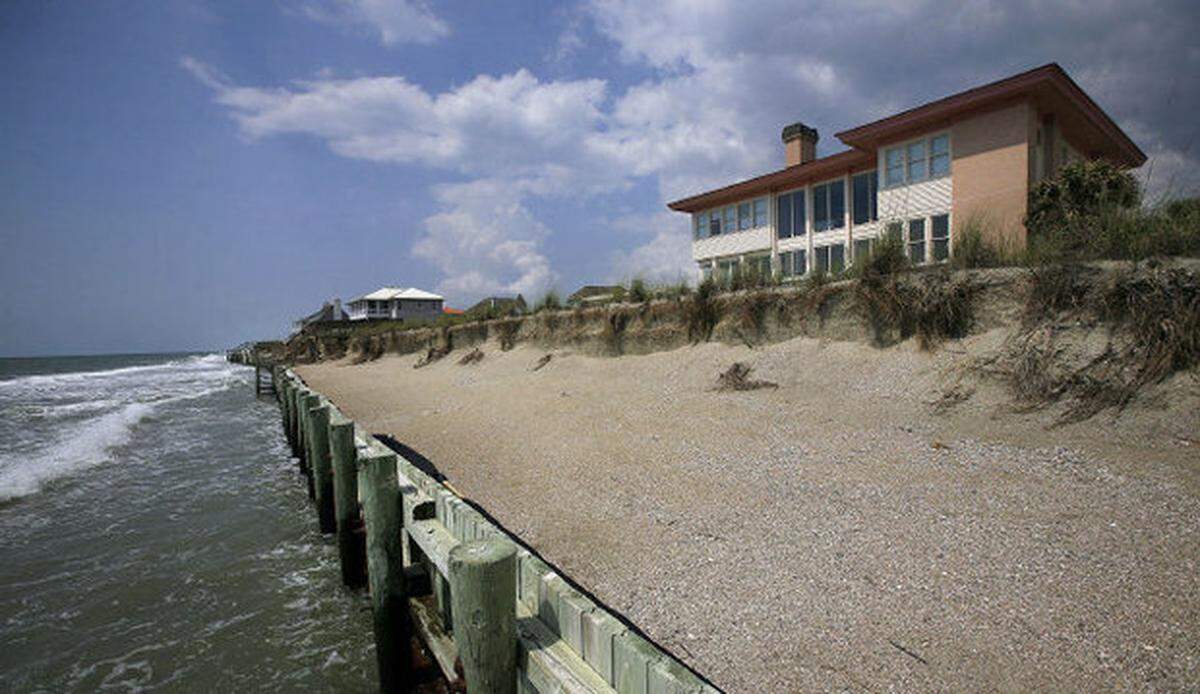
Beach erosion is so bad the landowners say they need help, records show. Photographs show water has washed precariously close to houses on Debordieu’s southern end, a heavily developed spot in Georgetown County with a battered seawall and one of the most erosion scarred stretches of the South Carolina coast.
“My property is in imminent danger of catastrophic loss,’’ Rodney Cain, the registered agent for landowner Northwest Properties, said in a December 2020 enforcement notice.
According to plans, the landowners want to bury the sandbag walls under a pile of sand to better fortify their oceanfront homes and lots south of Myrtle Beach. It’s part of what they say is a scientific experiment, to be done as part of an upcoming beach renourishment project.
But the DHEC coastal division has challenged that assertion — and it has launched enforcement cases against seven landowners on Debordieu’s south end for installing the sandbag walls without state approval.
The coastal division says the bags were not only installed without state permission, but South Carolina law also does not allow sandbags to be buried permanently under the beach. Sandbags are supposed to be a temporary solution when big storms hit, then removed when the weather improves.
It’s a concern because a wall of sandbags along the beach could threaten nesting sea turtles and worsen already serious beach erosion, leaving less room on the seashore for the public to walk on, environmentalists say.
Photographs included in the property owners’ appeal to the DHEC board show dozens of large sandbags stacked five and six rows high in front of the homes, along the aging wooden seawall.
During a DHEC committee meeting earlier this week, agency board members Sonny Kinney and Rick Lee said they are concerned about the ocean’s threat to seaside homes at Debordieu’s southern tip.
Kinney, who lives on Kiawah Island, called photographs of beach erosion at Debordieu’s south end “shocking.’’
The three-member DHEC board committee Kinney and Lee sit on voted unanimously to hold a hearing before the full board early next year. Committee member Seema Shrivastava-Patel of Lexington also voted to hold the hearing.The hearing would center on whether to overturn a staff decision that denied permission to keep the walls in place.
Kinney and Lee said it’s worth listening to the property owners’ request since their proposal is part of a scientific study.
Coastal Carolina University professor Paul Gayes has proposed leaving the bags and burying them with sand to see how well they protect land in the future, compared to other properties, records show. He declined comment when reached by The State, citing the upcoming DHEC board hearing.
Supporters say the pillow-case shaped sandbags, unlike traditional types of sandbags, are part of a unique technology that is more effective at building sand dunes and protecting private property along the beach.
State law allows erosion control experiments — with DHEC’s approval — if the efforts have a reasonable chance of succeeding. But DHEC staff members question whether the proposed experiment is realistic, and they say places facing state enforcement actions are not appropriate for research proposed by universities.
“That’s probably my biggest concern is the fact that we’re just saying no to investigating another option that could be beneficial to the coast,’’ Kinney said, noting that erosion is threatening valuable coastal land. “If you look at the pictures, they are scary and …. you’re talking about millions of dollars.’’
Lee, who lives in Rock Hill south of Charlotte, said “it was an eye-opener to see the challenge these property owners have along the coast.
“The last thing we want to do is just arbitrarily say no to a new technology that might help resolve some of the problems we have.’’
DHEC’s part-time governing board is appointed by Gov. Henry McMaster. DHEC staff members, who are full-time employees, are skeptical of the argument that the bags are a unique technology.
So is a leading coastal geologist familiar with the South Carolina coast.
“It’s not new technology; these are being used all over the country,’’ said Rob Young, a Western Carolina University geologist who studies beachfront development and erosion.
“If you want to see how it works and how it has been used, there are hundreds of case studies you could draw on without having to put in an installation on the South Carolina coast.’’
Those places include Massachusetts and Florida, where news reports show similar devices have stirred disagreements over their effectiveness.
The effort to better shield homes at Debordieu from the ocean is occurring as the South Carolina coast faces increasing threats from swelling sea levels and more intense storms, which are linked to rising earth temperatures. Sea-level rise is accelerating and some people say the best solution is to scale back development along the ocean to protect lives and prevent government bailouts.
Some property owners, however, are trying to protect oceanfront homes they bought as long as they can — and nowhere has that been more apparent than at Debordieu’s extreme south end..
The southern end of Debordieu is part of a gated community between Myrtle Beach and Georgetown with expansive oceanfront homes. It has been the subject of multiple disputes over efforts to repair a seawall that has protected homes on the south end since 1981 but is beginning to fail. The seawall also has blocked beach access and contributed to beach erosion, critics say. Debordieu homeowners also are fighting in court for the right to run rock walls, called groins, into the ocean from the beach to trap sand.
Emily Cedzo, who tracks beachfront issues for the Coastal Conservation League, said the stacks of sandbags installed at Debordieu are little more than seawalls.
Seawalls were banned in South Carolina in the late 1980s because they worsen beach erosion when hit by waves.
Allowing the Debordieu property owners to keep the hard sandbag walls could spur landowners across the coast to seek the same thing, which could add to erosion problems already occurring on public beaches as sea levels rise, Cedzo said.
“The concern is that absolutely you are legalizing materials that are incredibly similar to seawalls and the detrimental effects they have on the beach,’’ Cedzo said. “A seawall is in place to protect what is behind it to the detriment of what is in front of it – the dry sandy beach that you and I walk on.’’
Lee conceded that is an issue worth discussing as the board examines the Debordieu case.
Late Thursday, the Coastal Conservation League filed a request with the DHEC board that it be allowed to participate in the hearing about the Debordieu sandbag walls. Property owners would be rewarded for ignoring state law if the DHEC board overrules agency staff and approves leaving the bags in place, the legal request said.
“A reversal of the staff decision would open the floodgates to property owners who will take matters into their own hands and install their own illegal structures in the name of science,’’ according to the league’s filing.
Still, the Debordieu Beach property owners, a collection of successful business people from North Carolina, say they badly need to keep the wall of sandbags, records show.
The lots where DHEC says sandbag walls were installed without state permission are owned by Mark and Anne Tiberio, Michael and Laura Schulte, and Price and Carolyn Sloan, all of Charlotte. Northwest Properties of Hickory, N.C., also is an owner and, like the others, faces enforcement action.
DHEC is working on enforcement orders, but has not finished its work, agency spokeswoman Cristi Moore said.
Efforts to reach the property owners and their lawyers, Joseph Owens and state Sen. Stephen Goldfinch, were unsuccessful.
The walls of sandbags, which are made from a geotextile fabric, would provide multiple benefits, according to the property owners’ appeal.
Debordieu is preparing to renourish its beach, which will temporarily widen the shoreline. As that is done, the sagging timber seawall and the wall of sandbags would be smothered in sand. But erosion at the tip of Debordieu is significant enough that the renourishment project sand is expected to wash away in a matter of years, exposing the aging seawall. The community, which pays for its own renourishment, has had four different sand replenishment projects in the past 25 years.
The wall of sandbags would provide extra protection for the multi-million dollar homes when the sand washes away, records show.
“Despite the previous renourishment projects and the presence of the bulkhead, each of (the) properties and many of the adjacent homesites, have suffered significant erosion and/or associated flood damages following storm and tidal events,’’ the property owners’ written request for a hearing said.
“Many beachfront property owners …. have been forced to use a variety of measures to protect their properties after the dry sand beach and or dune system is eroded.’’
This story has been updated with information about a Coastal Conservation League legal filing. An earlier version also misstated the name of Western Carolina University.
This story was originally published December 22, 2021 at 11:27 AM.