
Restoring a sparse river plant has became a common goal for Catawba Nation, York County
It had been more than 100 years since a Catawba Indian had woven a basket from river cane.
Teresa Dunlap, a cultural class specialist at the Catawba Reservation in Rock Hill, S.C, proudly held up a primitive basket she had recently woven from the bamboo-type cane.
“Well, this basket does not look like much and there’s definitely a lot of work to be done to learn how to do it a little better,” she said with a smile. “The baskets that we made in our last workshop with the cultural center, were the first river cane baskets to be made in over 100 years, so to me, that’s really exciting.”
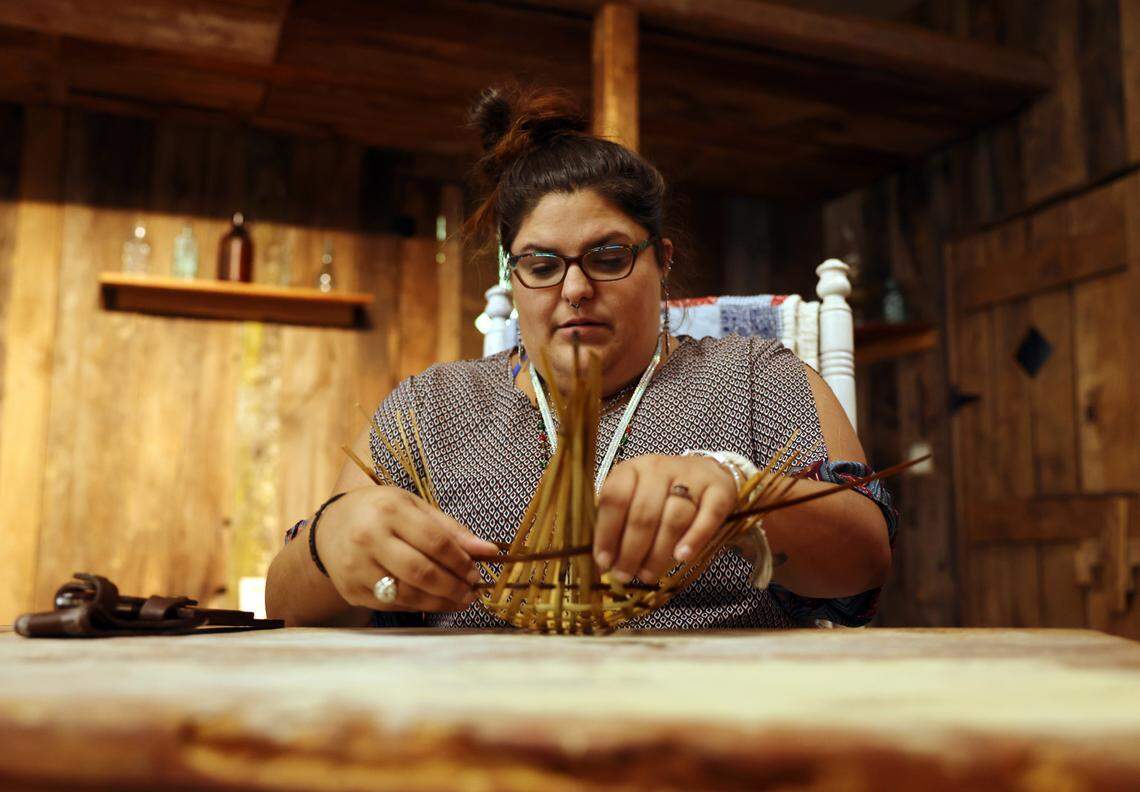
The Catawba Indian Nation has joined a group of Southeastern Indian tribes in an effort to restore the river cane. For the Catawbas, that means they will replenish a diminished swath along the Catawba River, which borders their reservation.
“We refer to ourselves as Ye Iswa, which is people of the river,” said Kassidy Plyler, cultural programs docent and exhibit coordinator at the reservation. “So we settled on the river and utilized it as a main resource.”
River cane was used by the Catawbas to make vital everyday objects — baskets, mats, blow guns, flutes, spear points and thatch for dwellings.
One must split the cane to have usable material for baskets, Dunlap said. It has to be thin enough to be woven. The Catawbas also will learn dyeing techniques using bloodroot and walnut hulls.
“We’ve been to several trainings and had some some visitors come to us to help us understand and relearn how to use the cane in basketry,” Dunlap said. “So to do that, it’s quite the process.”
The tribe has secured a grant to pay for training, Dunlap said.
“We’ve always used the resources that were readily available for us,” said Wenonah Haire, cultural services director for the tribe.. “And in that, in our ancestors’ time, river cane was quite abundant.”
Not readily available today
Dunlap said the river cane started to decline after settlers came to the United States.
“So it has been a really long time since Catawba people were using it on a daily basis, just because it’s not readily available anymore and what is available is not as healthy as it once was…so we’ve lost a lot of those traditions, unfortunately,” she said.
Also, river cane has been overused. Animals have grazed on it. Developments have replaced it. Invasive species have choked it. Prescribed burns to keep it prolific have been squelched.
Nowadays, river cane is very sparse, Haire said.
Marvin Bauknight, the natural resources program manager at the reservation, is fighting to bring back the plant. Though he’s not a Catawba Indian, Bauknight’s job is to return the plant to its prolific state. He has implemented a river cane restoration project that he says will be a multi-generational effort.
Herald reporter and photographer Tracy Kimball traveled with Bauknight last month on the Catawba Reservation along the Catawba river to see the cane in its natural state.
The cane grows alongside the dense trees and growth under a vast, shaded canopy. With an appearance similar to shrubs, the cane is one of three native bamboos.
On this July afternoon, Bauknight walked under the shaded path along the river, pointing out what’s river cane and what’s not.
He was excited.
A butterfly fluttered on the cane.
As a scientist, Bauknight pinpointed invasive plants cropping up around healthy stands of river cane.
“Look at that vine, it’s growing on it and choking it out,” he said. “That’s what happens when river cane struggles to grow, because it’s just being out-competed for sunlight.”
He pointed to the plants harmful to the growth of the cane: Burford Holly, Chinese Privet and Elaegnus. Bauknight said he is constantly trying to remove the invasive plants.
“Cane just can’t get a foothold here,” he said. “So what we’ve done is, as part of this river cane project, we’ve come in and eliminated competition, and it’s a constant battle because privet grows at an incredible rate and it’s got a seed bank that we can hardly deplete.
“If we remove the invasives and let the river cane grow, it will just practically sprout up and jump up real quick,” he said.
River cane is culturally important, but it’s also is environmentally vital.
The rhizomes, or underground stems, are so profuse and thick that they provide a filter to keep trash and debris out of the river. The rhizomes also provide chemical purification.
“It’s been estimated that if you had a 30-foot wide swatch of river cane, it can actually remove 80-90 percent of the phosphates and nitrogen that’s generated through agricultural (chemicals) in the fields,” he said. “That’s huge for a river like the Catawba.”
A new ally
York County is now helping in the fight to regrow river cane.
In 2018, York County bought 1,900-acres along the Catawba near the reservation to be used as a park. The park is now named Catawba Bend Preserve.
Workers for York County found large patches of river cane -- some growing under a power line right-of-way.
County workers were studying the property’s wildlife and environment along the five miles of riverfront to ensure the park’s design wouldn’t encroach on endangered species.
The Catawbas had already started growing river cane on their reservation.
So the York County Council approved a memorandum of agreement with the Catawbas that allows them to harvest the river cane.
The cane in that area are stout and grow well, said Joe Allen, Catawba Bend Preserve senior park superintendent. The Catawbas took samples of the cane to see if it would grow on the reservation and to work out some of the kinks in the process of transplanting it.
The patch of cane the Catawbas transplanted has started to grow. In 2024, the Catawba will return to the park to get more.
“They have done absolutely outstanding and they have had better survivorship of those samples then they ever expected,” Allen said.
“We hope that this is kind of the beginning of a great relationship and extending into other ways that we can partner together. We’re excited to see where it takes us and branches out.”
This story was originally published August 14, 2023 at 12:47 PM with the headline "Restoring a sparse river plant has became a common goal for Catawba Nation, York County."
