Richland County won’t name third parties paying huge fine at Scout site
Richland County has declined to release the names of the third parties it says are helping pay part of an unusually heavy fine for environmental violations at the Scout motor vehicle construction site just outside Blythewood.
In response to questions from The State, a county spokeswoman said Richland is not able to provide any more information than it has previously released.
Keywa Henderson, the county’s director of communications, told the newspaper May 1 that Richland taxpayers would not foot the bill for the whopping fine because the state of South Carolina and “various third parties’’ would pay.
The S.C. Department of Environmental Services issued the $1 million fine May 5, 2025, saying the penalty could be increased to $3 million if certain matters were not dealt with at the massive project site off Interstate 77. Either amount would make the fine one of the largest in South Carolina for sediment and runoff pollution.
Some county officials have maintained that contractors, instead of Richland officials, were responsible for environmental violations on the more than 1,600 acres, meaning taxpayers should not be charged.
Richland County was named as being responsible for the violations because it owned the land and held environmental permits for the work.
Multiple contractors and subcontractors have been involved in land-clearing, planning and construction. But none have stepped forward publicly to claim responsibility for the violations.
Thomas and Hutton, a regional engineering firm, signed an agreement with the county in February 2022 saying the company would be “responsible for any damages resulting from its activities.”
The contract, obtained from by The State newspaper under an open records request, also said Thomas and Hutton would be responsible for “negligent acts and omissions’’ of subcontractors it would hire.
The company, which is the construction project’s general contractor, would not say if it was helping the county pay the fine or how much that might be. But in a May 7 statement, the company said it supports the county’s efforts to resolve the enforcement action by the Department of Environmental Services. The company said it would not provide details until the enforcement “process is complete.’’
Thomas and Hutton’s statement said, however, that it did not agree with the severity of the penalty. The company called the Scout effort the biggest earthmoving project ever undertaken in the region, while noting that the work was being done during an especially rainy period in 2024. The company also said efforts to offset the environmental impacts, through a process known as “mitigation,’’ had not been fully considered by the state when it took the enforcement action.
Thomas and Hutton “was not a party to the consent order and would not have consented to the order as written,’’ the statement said.
The statement said the company “respectfully takes issue with certain findings, which fail to adequately account for three significant factors: the sheer scale of what is widely recognized as the largest earthmoving undertaking in the history of the Southeast, the historic and sustained rainfall throughout 2024, including that brought on by Tropical Storm Debby and Hurricane Helene, which resulted in 26 inches of rainfall above historical averages, and the extensive proactive mitigation measures implemented on the site.’’
Landmark Construction of Charleston had a major role in clearing the land. Efforts to gain comment from the company were unsuccessful. Landmark’s crews were on the property when state and federal environmental agencies raised flags about the rapid pace of the work and the potential ecological damage.
One Richland County Council member said she expects Richland to eventually release the names of those helping pay the fine, but now is not the right time. The county is trying to work with those who are making the payments, Councilwoman Cheryl English said.
Richland County will provide the information “but not until the project, I want to say, is complete,’’ English said, noting that giving out the names at the wrong time could hurt the businesses of those making the payments.
“It protects them,’’ she said. “Let’s say they go on another job. Are they negligent? I wouldn’t say they are. But if you release (the names) it may block them from getting further bids or whatever.’’
County Councilman Don Weaver and media lawyer Jay Bender said the county needs to be more transparent. The public deserves to know as soon as possible who has agreed to pay the county’s fine, Bender said. Bender said he knows of no provision in state law that allows the county to withhold the release of such information.
“It’s just absurd they didn’t tell you right off the bat about who is paying this,’’ Bender said.
”It is important because this huge construction project is being undertaken in our citizens’ names and with our money.’’
Weaver said the county should reveal the names of those paying the fine “so that it can be a learning experience’’ for Richland.
“This is not going to be the last industrial project we ever have,’’ he said.
At issue is how the land was stripped bare of vegetation and leveled to make way for the $2 billion Scout project off Interstate 77 in northern Richland County.
The U.S. Environmental Protection Agency and the S.C. Department of Natural Resources raised concerns about the work in 2023, saying it was moving too rapidly and possibly involved wetlands violations.
The site clearing became such an issue that work was temporarily halted at the Scout property in September 2023 to resolve concerns.
But after work resumed, violations were found for months in 2024, and the Department of Environmental Services fined the county last year. The state agency named both the county and Scout in its enforcement action, but only charged the county for the fine. Scout said the violations are not its fault.
The state levied the $1 million fine that could be increased to $3 million if the county did not guarantee certain improvements were made. Aside from providing information about stormwater ponds, the county has met its obligations, the Environmental Department says.
While Richland County says the problems are the fault of contractors, Bender said the county has some responsibility for the violations because it should have kept closer tabs on work crews at the Scout construction site.
Many people, including English, say the project is a good one for Richland County. It will produce clean electric vehicles and create up to 4,000 jobs, supporters say. English said the project will be “phenomenal’’ for Richland County.
The S.C. Department of Commerce and Richland County lured Scout to South Carolina, with the state Legislature ultimately committing $1.3 billion in incentives for Scout to build here. The Scout plant is expected to be producing cars in the next year.
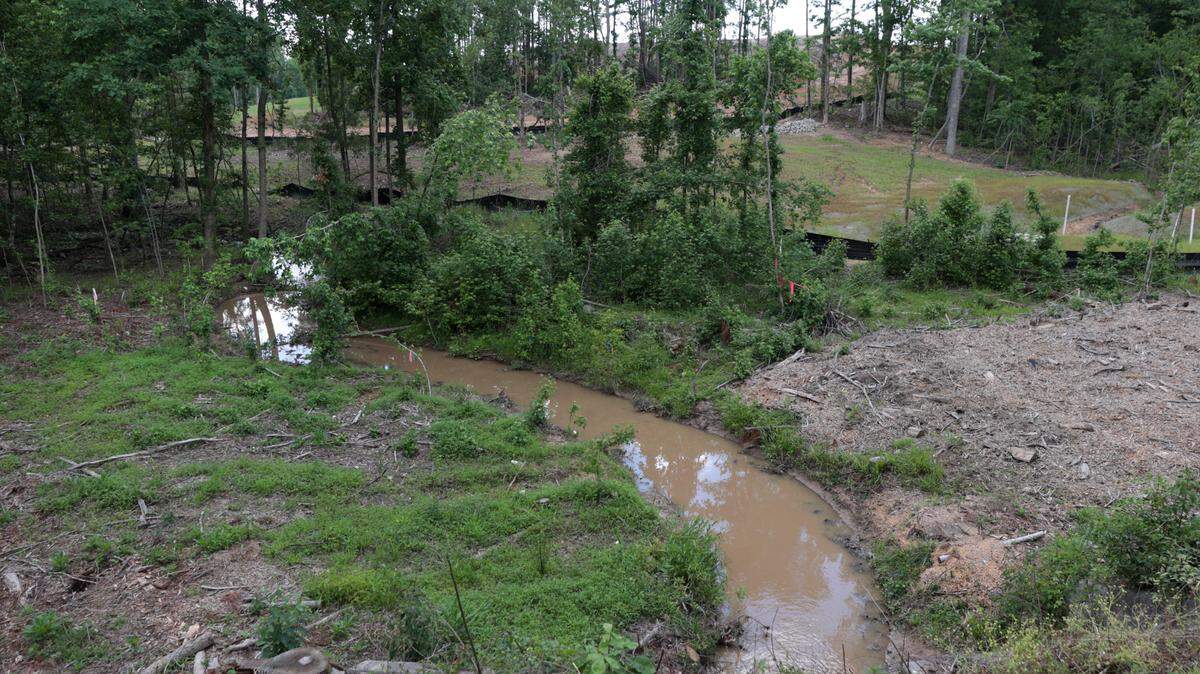
But the environmental issues have marred the project. Creeks below the site have turned brown with silt that can kill fish, while runoff has potentially spread pollution from the Scout site onto adjacent land. At the same time, the Legislature is embroiled in debate about whether to commit about $150 million more for the project to cover cost overruns.
The state of South Carolina will refund Richland County half the fine amount because state law requires counties where environmental fines have been levied to receive 50 percent of the money. The other half is outstanding.
This story was originally published May 7, 2026 at 1:49 PM.