A 66-million-year-old egg the size of a football is found in Antarctica. Who was mom?
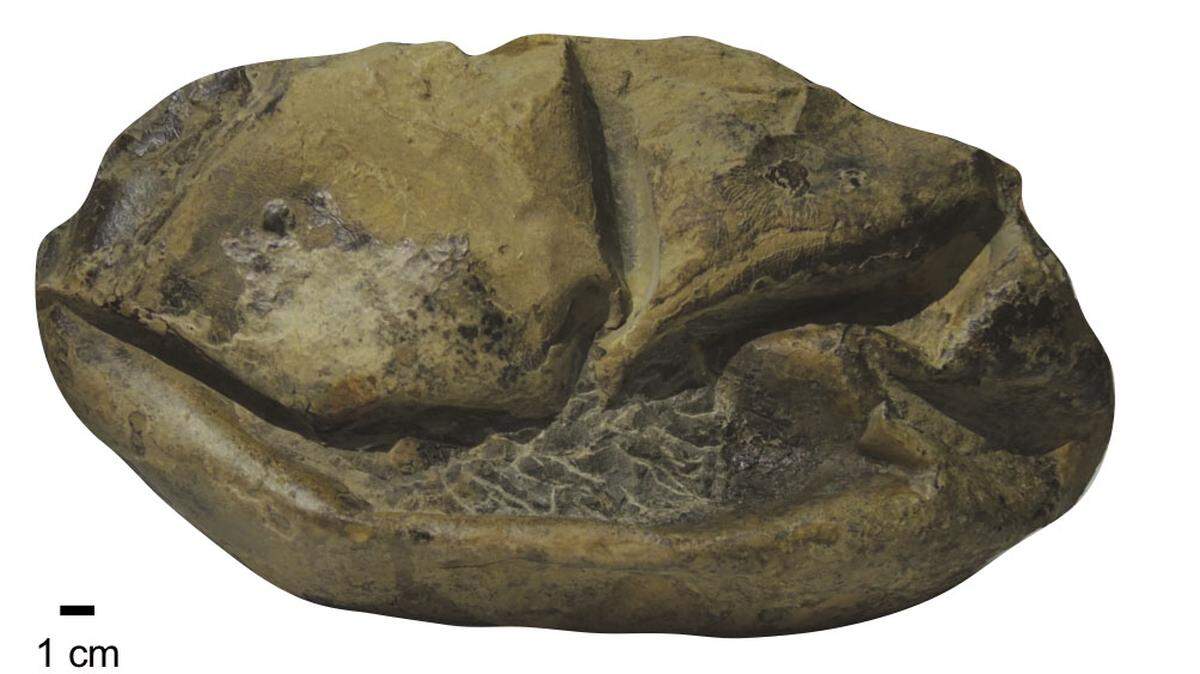
For seven years, a mysterious fossil resembling a deflated football collected dust in a museum in Chile, unlabeled and unstudied, puzzling geologists time and time again.
The fossil, nicknamed “The Thing,” was eventually determined to be the first fossil egg found in Antarctica, laid by an extinct giant sea lizard that was previously thought to give birth to live offspring, according to the study published Wednesday in the journal Nature.
The find is also the largest soft-shelled egg ever discovered, and the second-largest egg of any known animal to date, smaller only than that of the extinct elephant bird, which looked like an enormous ostrich.
Chilean scientists found the egg in a rock formation where other dinosaur fossils had been unearthed and had stored it in Chile’s National Museum of Natural History ever since.
“It is from an animal the size of a large dinosaur, but it is completely unlike a dinosaur egg,” lead author Lucas Legendre, a postdoctoral researcher at the University of Texas at Austin’s Jackson School of Geosciences, said in a news release. “It is most similar to the eggs of lizards and snakes, but it is from a truly giant relative of these animals.”
Legendre and his team studied samples of the empty egg under microscopes to confirm what it was, according to the study.
They learned it’s about 68 million years old from the Late Cretaceous period, a time where Antarctica looked nothing like the frozen environment it is today.
“Antarctica was rich in life,” co-author of the study Julia Clarke, a professor in UT Austin’s Department of Geological Sciences, told Mental Floss. “Temperate forests diverse in plant species covered exposed land. Giant marine reptiles and much smaller coiled ammonites and relatives of living birds hunted in the seas, while on land, mid-sized non-avian dinosaurs ambled.”
The egg measured about 11 by 7 inches, the release said, pushing “the limits of how big scientists thought soft-shell eggs could grow.”
Membranes from the egg looked similar to “transparent, quick-hatching eggs laid by some snakes and lizards today,” but after comparing the discovery to the body size of 259 living reptiles and the size of their eggs, the researchers realized how big the mother really was.
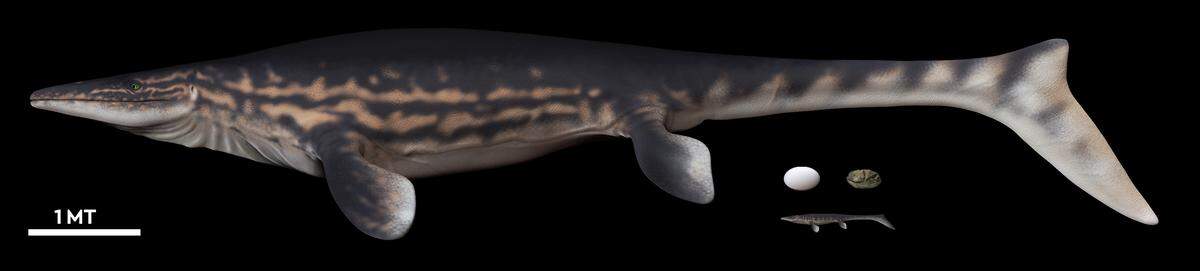
The reptile that laid the egg was likely more than 20 feet long “from the tip of its snout to the end of its body, not counting the tail,” the release said.
“In both size and living reptile relations, an ancient marine reptile fits the bill,” according to the researchers who think the egg came from a certain species of mosasaur.
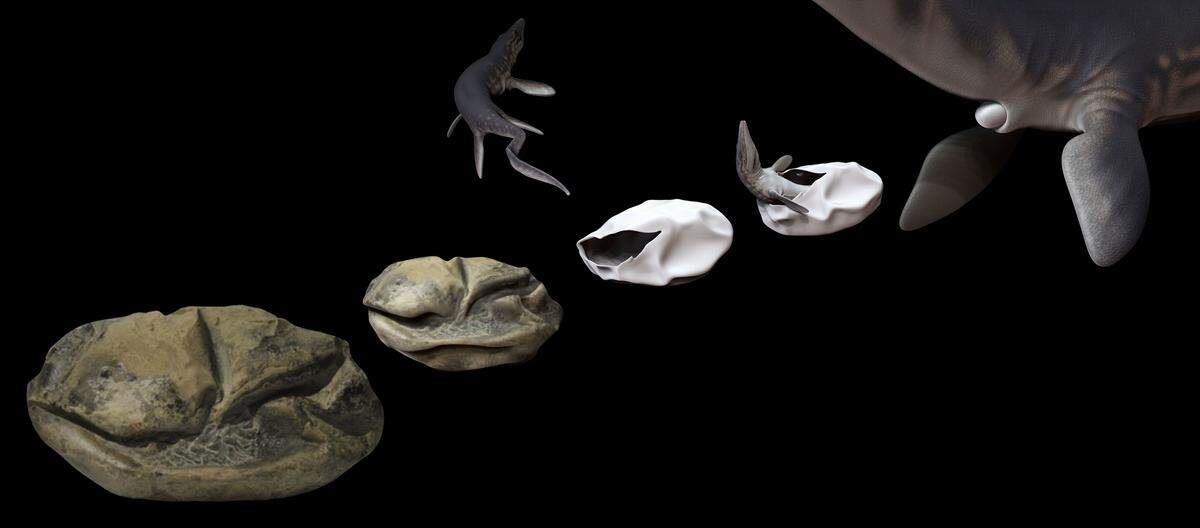
The team theorizes the giant sea lizard could have laid its eggs in open water, similar to how some sea snakes give birth today.
Another idea is that the reptile could have deposited its eggs on a beach with “some fancy maneuvering” by keeping half of its body submerged underwater, while it hindside went to work on the shore.
In that scenario, the baby dinosaurs would have crawled their way into the ocean after hatching, the way baby sea turtles do, the researchers said.
A separate study was also published today in Nature revealing that the first dinosaurs laid soft-shelled eggs, rather than hard ones, which was what geologists had always assumed.
Those eggs, and the one discovered in Antarctica, closely resemble those of turtles in their microstructure, composition and mechanical properties, the study said.
The latest discovery highlights “how much we have yet to learn about the evolution of eggs, from the first egg-layers that moved away from water to the immense diversity of eggs and reproductive strategies we see today,” Clarke told Mental Floss.
This story was originally published June 17, 2020 at 7:11 PM with the headline "A 66-million-year-old egg the size of a football is found in Antarctica. Who was mom?."