Does Sanders need to win Saturday’s Democratic primary to count SC as a win?
To a packed crowd filling the arena at Wofford College, U.S. Sen. Bernie Sanders drew a line in the sand Thursday night between himself and the presidential candidate polls say is favored to win South Carolina: Joe Biden.
“In my view, Donald Trump cannot be defeated by a traditional old fashion campaign,” Sanders told the crowd, estimated at nearly 2,000. “Joe Biden is a good friend of mine ... but I don’t believe Joe can beat Trump when people learn that he voted for the war in Iraq. I don’t believe that Joe can beat Trump when people understand he voted for NAFTA ... (and other) terrible trade agreements that cost us millions of jobs.”
Some in the crowd yelled ‘No!’ in reaction to the votes Sanders pointed out.
Fewer than 36 hours before polls open in South Carolina’s Democratic presidential preference primary, Sanders was in a far more advantageous position than months prior before the primary race heated up.
Biden entered the race with leads as high as 30 percentage points over Sanders in surveys of likely Democratic voters. In recent polls, that lead has diminished to as few as 5 points.
But when voters cast their ballots in Saturday’s Democratic presidential primary in South Carolina — a state where African Americans, who make up two-thirds of the Democratic electorate, have favored Biden overwhelmingly — Sanders may not need to surpass the former vice president to consider South Carolina a win.
Coming off a near-tie in Iowa, a slight win in New Hampshire and a sizable victory in Nevada, Sanders has the momentum and the national front-runner status filling his sails with wind, which means even a strong second place finish in the Palmetto State may be good enough for the Vermont senator.
“I think it would indicate Sanders would not be getting blown out in the rest of the South, which I think would be helpful to his campaign,” said Kyle Kondik, the managing editor of Sabato’s Crystal Ball at the Center for Politics.
“He doesn’t need to win a plurality of delegates in the South or anything. He just needs to make sure he isn’t getting crushed in that region, mainly by Biden. Where I think Sanders hopes to accumulate delegates on Super Tuesday are states outside of the South.”
Among the states Sanders is looking to do well in on Super Tuesday, when 14 states across the nation and one U.S. territory hold contests, is Texas, where Sanders has a 1.6-point lead, and California, where he has a 13-point lead according to the average of polls tracked by Real Clear Politics.
Sanders closing the gap in South Carolina polls “speaks volumes,” a Sanders’ spokesman said, attributing the narrowing to the work the campaign has done in the state, and not to money California billionaire Tom Steyer has spent here, aggressively courting black voters, among whom Biden has been very popular.
In 2016, Sanders’ campaign was dogged by questions about whether he could resonate with African American and Latino voters. The success in Nevada last week helps change that narrative, said Michael Wukela, the campaign’s SC state communications director.
“The victory in Nevada and a strong showing in South Carolina puts that narrative to bed once and for all,” Wukela said.
Though Biden still is leading polls in the state, by how much remains a question. Though Biden has consistently led in the polls in South Carolina, by how much varies from poll to poll. Some have him with huge leads, including a recent a Monmouth University poll showing Biden with a 20-point lead over Sanders, and an Emerson College Poll showing Biden leading Sanders by 16-points.
“Biden’s wide lead in the poll is underpinned by solid support among black voters in the state,” Monmouth said.
However, if S.C. polls showing Sanders within striking distance of Biden are on the mark, the outcome would be a good sign he can compete in other southern states, whose demographics are similar, buoying his campaign until he reaches states where he has stronger coalitions.
If Sanders can pick up at least 15% of the vote, the threshold needed to be awarded delegates either statewide or in congressional districts, it would ensure the current front-runner leaves South Carolina with only some — but not all — of the delegates.
“Because of proportional allocation it’s hard to catch up if someone is in the lead, but it’s hard to be mathematically knocked out, too,” Kondik said.
In contrast, a large win for Biden, similar to Sanders’ victory margin in Nevada, would give Biden momentum heading into Super Tuesday, Kondik said.
“We’ll have to take stock after Super Tuesday, but again, if Biden wins South Carolina, going away it will be a positive indicator for him in many other southern states voting three days later.”
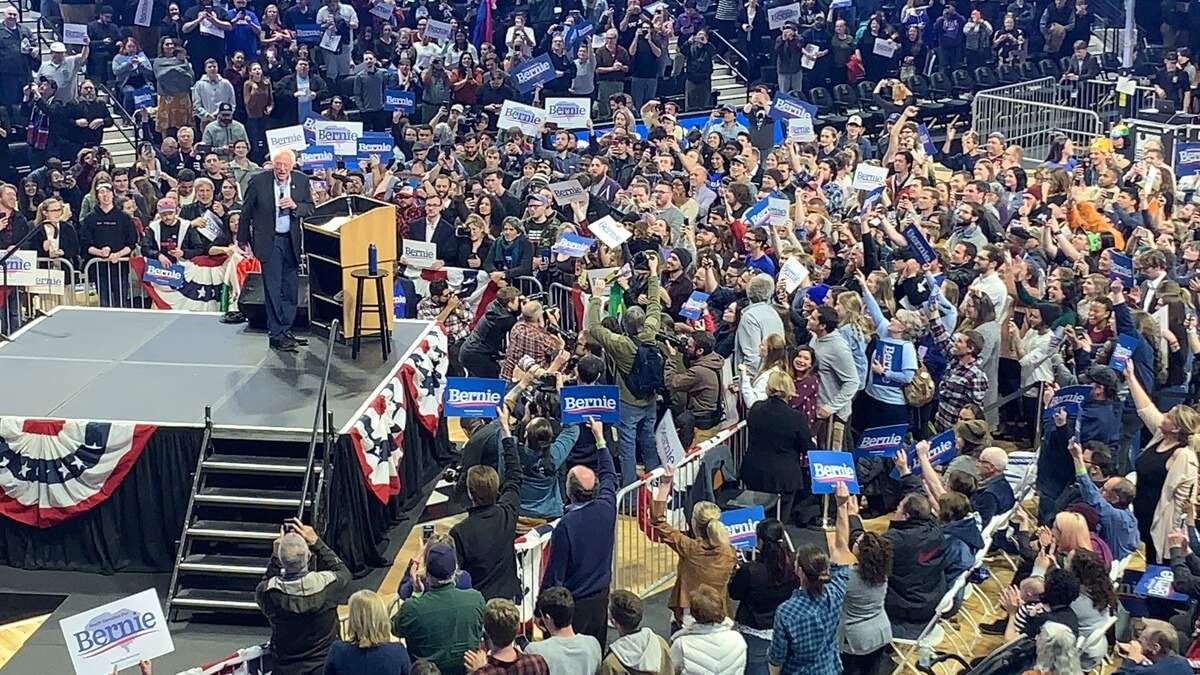
Sanders rally Thursday night inside of Wofford College’s Jerry Richardson Indoor Stadium, which is located roughly 15 miles south of the North Carolina border, drew a mostly white crowd of more than 1,950 people that a times cheered loudly like they were at basketball game inside of the arena.
“That part of (South Carolina) is whiter, and Sanders doing poorly with black voters, he might be trying to make up for that to some degree by presenting himself to a whiter part of the state,” Kondik said.
Being close to North Carolina also drew voters from the neighboring state.
Pamela Patterson, 65, of Green Creek, North Carolina, is a cautious Sanders supporter, but not completely sure if she’ll vote for him on Tuesday.
“Like many people my ultimate goal is we have to see a change,” Patterson said.
She worries about student loan debt because she took on debt to help put her kids through school and health care insurance because she was nearly bankrupted by health care costs before her husband died.
“I believe we are each other’s family, we should act that way,” Patterson said.
Clay Richardson, 37, of Spartanburg, voted for Sanders in the 2016 primary.
Richardson, who manages a custodial staff of about 30 in a school district, supports Sanders’ push to increase the minimum wage.
“They don’t make hardly anything and sometimes it’s really hard to get people pay increases,” Richardson said. “I feel like the only way for these people to get ahead is for somebody to raise the minimum wage.”
Among the push back against a Sanders’ nomination is that he wouldn’t be able to help down ballot Democrats in November as Republicans ramp up attacks on Sanders’ identification as a democratic socialist.
But Mo Bufton, 56, of Greenville, doesn’t buy the argument.
“I think they don’t realize the groundswell he represents. I think the polls are probably not correct,” Bufton said.
This story was originally published February 28, 2020 at 7:28 AM.