Milton Kimpson, from the cotton farm to top aide to Gov. Riley, dies at 90
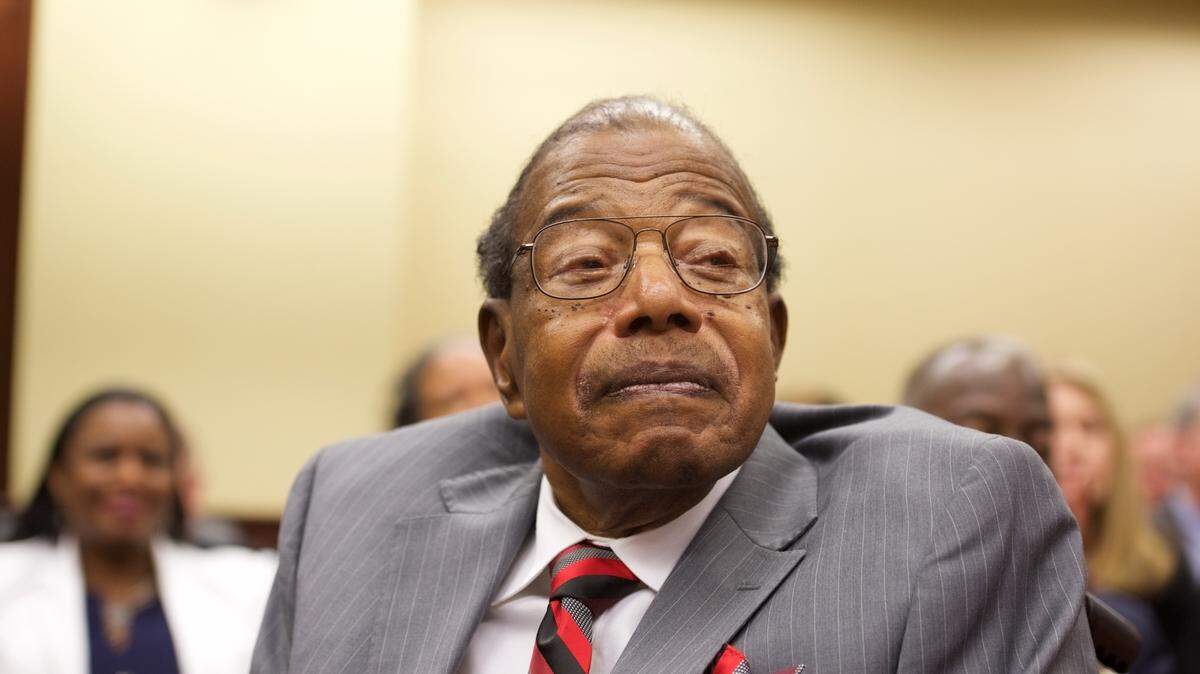
Milton Kimpson, whose rise to becoming a top aide in former Gov. Dick Riley’s cabinet started in a Calhoun County cotton farm field that bore the last name of a South Carolina senator that became integral to his evolution as a father and a devoted public servant who believed in the power of public education and prayer, died Friday in Columbia. He was 90.
State Sen. Marlon Kimpson, D-Charleston, one of Kimpson’s three sons, announced his father’s death on social media.
Though Kimpson had other health ailments, his sons said their father had tested positive for COVID-19 at the hospital last month, then tested negative, when his family was able to move him to a non-COVID-19 wing of the hospital and were able to see him.
The family plans to have a private burial service Thursday.
To say Kimpson was simply a role model would not do the late public educator and community-minded leader complete justice, said former South Carolina Gov. Dick Riley, who appointed Kimpson into the first term of his administration for a top executive post, unusual in the late 1970s when few African Americans served in executive roles.
Riley named Kimpson his chief of health, education and human services, a position the Korean War veteran held for eight years.
The son of sharecroppers, Kimpson graduated from Benedict College, one of two historically Black universities in South Carolina’s capital, with a degree in math, a specialty he taught at Booker T. Washington High School in Columbia before becoming a principal at two area elementary schools. He was hired as state supervisor of elementary education at the state Department of Education before he joined the Columbia Chamber of Commerce as its first community relations council executive director.
“He just had that personality, really a leader. He was very popular,” Riley told The State. “He was determined to get an education. He was a great believer in public schools, and that’s really where I saw a companionship that I knew would be worthwhile.”
U.S. House Majority Whip Jim Clyburn, who met Kimpson in the 1960s, said they were bonded by a common upbringing and life experiences, including both being fathers to three children, Kimpson to three sons and Clyburn to three daughters. The Columbia Democrat told The State Monday they complimented each other as Kimpson, the educator and Clyburn, the politician.
“There was a thing when we hung out, the pendulum goes back, mine left to right as Milton went from right to left and we met in the center very often,” Clyburn said. “But we camped out in the center, that’s where we met.”
Cotton to college to the Cabinet
Until Kimpson’s death, he and his wife of more than 60 years, Wilhelmina, lived in the same house they raised their three boys in, a middle-class home tucked into the historic Eau Claire neighborhood. Wilhelmina Page Kimpson still lives there.
“They had many opportunities to move, but dad thought we should be an example of the community,” said Marlon Kimpson, the state senator. “My dad thought we should stay in the same house in that same community so we could be a testament to people growing up around us, going to work, cutting the grass and taking care of the family.”
Milton Kimpson was born on Oct. 1, 1930, in St. Matthews, South Carolina — a rural cotton town in Calhoun County with fewer than 3,000 people. He was the second of four children born to sharecropper parents, Melton and Ruth Wright Kimpson. Kimpson was never shy or embarrassed about his upbringing, his sons said, proudly proclaiming his ability to pick 250 pounds of cotton a week on land owned by the Gressette family, the namesake of the Senate building Kimpson’s son Marlon now works in. The building was named after Sen. Marion Gressette, who served for half a century in the state Legislature and was known for leading efforts to fight desegregation in the state.
Unable to afford college, Kimpson and his siblings earned money to go to college by singing in a quartet at churches throughout Calhoun and Orangeburg counties. While uncommon for African Americans to go to college in that era, Kimpson thrived at Benedict, pledging Omega Psi Phi fraternity. At Benedict, he later served as board trustee emeritus and opened two endowment funds for students.
“For over 68 years, Dr. Milton Kimpson was a passionate and loyal supporter of Benedict College. He is recognized as one of our most distinguished graduates,” said Benedict’s president Dr. Roslyn Clark Artis in a provided statement. “His work as an educator, community leader and administrator will forever remain highly respected across the state of South Carolina. Dr. Kimpson’s commitment and service to Benedict College is notably unmatched and unparalleled. He served on the Board of Trustees for 41 years and was elected to Board Emeritus status in 2011. He has left an enduring legacy that will be fondly remembered for generations to come.”
Benedict houses the Milton Kimpson Center for Graduate Studies and Continuing Education Building.
“He would tell us about those stories to help us appreciate the opportunities we had,” said Kimpson’s eldest son, Milton Kimpson, an administrative law judge. “We knew about St. Matthews. We knew about sharecropping. We knew about him and his brothers and sisters worked their way to go to college, how other people in St. Matthews ridiculed his family for sending his kids to college. We knew the success story.”
Not only as an educator, Kimpson was able to tap into his love for public education in the Riley’s administration.
Just elected governor, Riley said he talked Kimpson into joining his administration after he saw him give a speech with the Columbia Chamber of Commerce. So impressed with his delivery, Riley said Kimpson was exactly the top aide he needed.
Kimpson became one of five of Riley’s top executive appointees, charged with dealing with education and social services.
Riley said the pair dug into many tough issues that included the Education Improvement Act, a sales tax for public schools.
But Kimpson’s appointment also was notable for another, much more visible reason: he was Black, and African Americans held very few key roles in state government, a change Riley said he pledged to change.
“I wanted my staff to look like the population of South Carolina,” Riley said. “That clearly meant more African Americans in key, legitimate, high-level positions that were really decision-makers and role models.”
Riley continued, “He was a leader in my staff, and he was very, very well respected by all of the staff. He was just a key part of any successes that I had as governor. He was my communicator in many many cases. He was a special guy.”
During a time in which race relations were fraught, Dwight Drake, an attorney with Nelson Mullins Law Firm who worked with Kimpson in the Riley administration, told The State that Kimpson was “extraordinarily helpful to the governor and to this state through many ways during that time.”
“He was truly a remarkable person. His life story was compelling in and of itself,” Drake said. “He contributed greatly to the success of the Riley administration in many many ways. When Milton talked, people listened because they had enormous respect for him and his background.”
In Riley’s administration, Kimpson insisted the governor have Black interns.
Among them was state Sen. Darrell Jackson, D-Richland, who was then student government president at Benedict and whose father was close friends with Kimpson. Kimpson took Jackson under his wings and, later, Kimpson would become Jackson’s constituent.
“I had a love for politics, but that put me in a totally different light,” Jackson said. “Here’s this young man, grew up in Lower Richland, get to go to the governor’s office and wear a tie every day and interact with people like Milton and Dwight Drake. I’m convinced, had it not been for that, not sure where I am today.”
Jackson helped spearhead a resolution to name the interchange at Interstate 126 and I-26 after Kimpson.
As a lawmaker, Jackson said he came to rely on Kimpson’s guidance, oftentimes much to his chagrin.
Twenty years ago, when the Legislature was pushing through legislation to move the Confederate flag from the top of the State House dome to the grounds, Jackson said he had dug his heels in and was unwilling to just allow the flag to remain at the Capitol.
He said, “Look at this as a journey, not a destination. We’re going to get it off the dome, and, yes, live with it on the yard,” Jackson recalled Kimpson saying. “But, he said, ‘One day, it will be removed on the yard.’ I will never forget it.”
The flag was eventually removed from the complex altogether in 2015 after a white supremacist killed nine Black churchgoers in Charleston.
After the flag was furled, Kimpson called Jackson and said, “ ‘Sometimes, this old man from Calhoun County gets it right.’ And I said to him, ‘Mr. Kimpson, you get it right all the time.’ ”
The doting father
As he was professionally, Kimpson was structured in the home.
A couple of things were pretty firm in the Kimpson house, his sons said: you go to school every day and church every Sunday.
Kimpson was a lifetime member of St. John Baptist Church, where he sang in the senior choir and was chair emeritus of the deacon board. He also invested his time heavily into the preschool, a testament of his love for education, his sons said.
“I remember him calling me on Sunday mornings when I was in college, asking if I had gotten up to go to church,” Milton said. “He would not miss an opportunity to go to church.”
He also was quite the disciplinarian, the sons said, “because he loved us so much and wanted us to do well,” Marlon said.
And the legacy of public service he devoted his life to, Kimpson tried to cast that same legacy onto his sons.
Kimpson ran once for statewide office in the early 1990s but lost, never quite comfortable himself with elected office.
His sons are all professionals with advanced degrees: Marlon, the state senator and attorney; the eldest, Milton, the administrative law judge; and Marc Kimpson, a fiscal analyst with the state agency responsible for the retirement system.
“Our dad was always available to us,” Milton said. “He loved us dearly. While we always didn’t agree, we all know that he loved us dearly and he went out of his way for us and just gave us so many opportunities. He was such a wonderful role model for us.”
That included, Marc said, road trips to places such as Canada and Colorado, trips that served the purpose of merely exposing three young Black boys to different places and different experiences.
“By the time I saw him, he could not respond. But you could tell he was still living,” Marlon said recently of his late father. “We understood his desire for us to carry on the Kimpson legacy. He was so concerned about his name and not messing up what he and his father, his mother, the legacy that they had established.”
No better way to do that, Milton said, then, when they’re ready, to get back to work.
“Be back at work doing what he helped us do,” he said.
This story was originally published February 2, 2021 at 5:00 AM.