
Richland County would lose House seat under SC redistricting proposal. What to know
Richland County is poised to lose a seat in the South Carolina House under a draft House map released late Monday that proposes merging two existing districts.
House Districts 70 and 80 in eastern Richland County would be consolidated into a single district, according to the redistricting proposal, which will be discussed Wednesday at a legislative hearing.
The proposed realignment would set up a Democratic primary race between lawmakers Jermaine Johnson, of Columbia, and Wendy Brawley, of Hopkins, in a redrawn District 70.
Neither lawmaker returned a request for comment on the proposed voting map and its implications for their political futures.
Johnson joined the House in 2020, succeeding the late state Rep. Jimmy Bales, whom he beat in a Democratic primary last year. Brawley, a former Richland 1 school board member, was first elected to the House in 2017 to fill the seat of the late longtime Rep. Joe Neal.
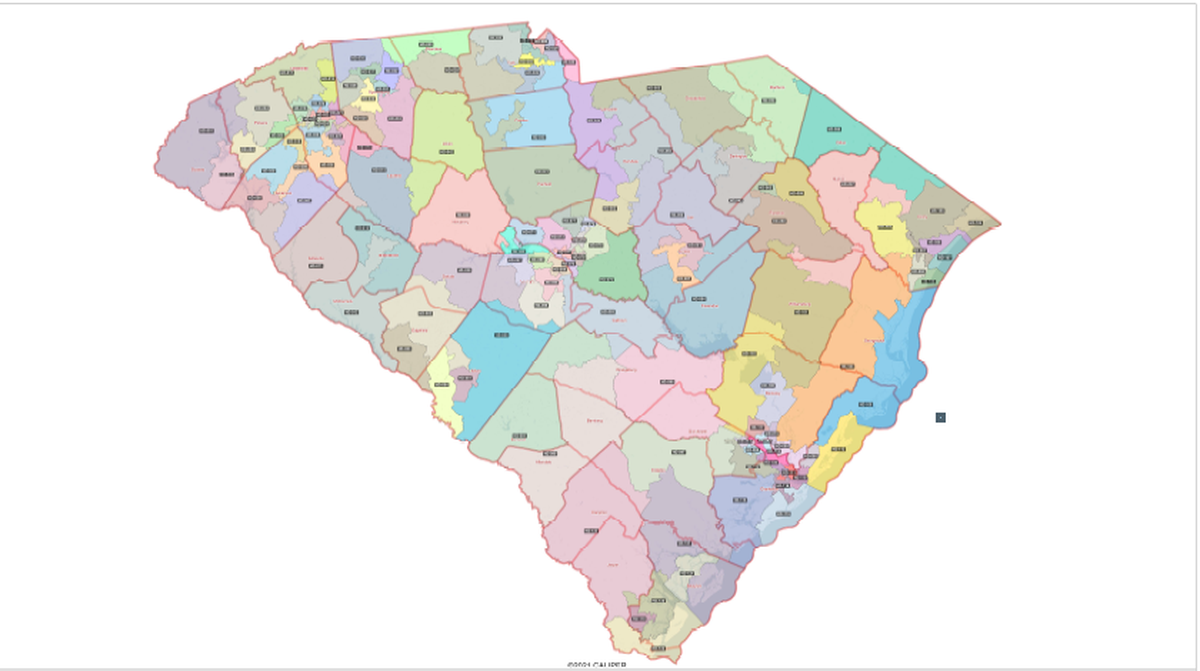
Under the House’s plan, District 70 would border Calhoun, Sumter and Kershaw counties along Richland County’s eastern edge, and have the highest proportion of Black residents of any district in the state. The diverse District 80, currently composed of portions of Richland and Kershaw counties, would move to Charleston County and transform into the third whitest district in the state.
The House proposal comes days after the Senate’s redistricting subcommittee released a map that would eliminate one of four Senate districts currently held by Richland County residents. Under that plan, Sen. Dick Harpootlian’s District 20 would be absorbed by Democratic Sens. Nikki Setzler’s District 26 and Darrell Jackson’s District 21, and Charleston County would gain a new Senate district.
The proposed voting map changes come as state lawmakers take on the once-a-decade process of redrawing voter districts to ensure all have roughly the same number of people.
South Carolina has added about 500,000 people since 2010, a greater than 10% increase in population, with growth concentrated along the coast, in parts of the Upstate and in the counties south of Charlotte.
The redrawn maps reflect population increases in areas like York, Lancaster, Berkeley and Horry counties, and population declines in rural areas, particularly along the Interstate 95 corridor.
Since 2010, Richland County has grown more slowly than the state as a whole and significantly more slowly than other major population centers like Greenville and Charleston counties, according to recently released census figures.
How are SC voting districts drawn?
South Carolina’s 124 House districts all must have populations of roughly 41,278, plus or minus 2.5%, and its 46 Senate districts must have 111,270 people, plus or minus 5%, according to each chamber’s redistricting guidelines.
The state’s seven U.S. Congressional districts have the strictest population guidelines, requiring as close to 731,204 people as possible, with little room for deviation.
In addition to ensuring population equivalency and the contiguity of districts, voting maps also must comply with the Voting Rights Act, meaning they cannot dilute the strength of minority voters by concentrating or dispersing minority populations — known as packing and cracking — in ways that prevent them from choosing their candidates of choice.
Beyond adhering to those primary map-drawing criteria, lawmakers also take into account district compactness, attempt to limit the splitting of counties, cities and voting precincts, and group together “communities of interest” when drawing voter maps.
The House’s redistricting guidelines also explicitly consider incumbency and seek to protect sitting lawmakers from having to face off against one another, as Johnson and Brawley would be forced to do if the draft map is adopted.
The proposed House map also sets up primaries between incumbent Reps. Russell Ott, D-Calhoun, and Jerry Govan, D-Orangeburg, in a redrawn District 93 and Lucas Atkinson, D-Marion, and Roger Kirby, D-Florence, in a modified District 57.
Ott, who lives in St. Matthews and serves as assistant House Minority Leader, said he didn’t expect to find himself in the same district as Govan, former leader of the Legislative Black Caucus.
“It’s fair to say it was somewhat of a surprise,” he said Tuesday. “Not necessarily to see incumbents drawn together, but ultimately the way the districts were drawn as far as Orangeburg is concerned.”
Ott said he and other members of Orangeburg County’s House delegation had crafted a proposal to reduce the number of lawmakers representing the county, which has lost population over the past decade.
Rather than dropping an Orangeburg legislator, however, the draft map keeps four House members in the county and actually appears to split the city of Orangeburg, population 13,000, into four separate districts, Ott said.
“I just don’t think the city of Orangeburg got treated fairly,” he said, adding that the failure of mapmakers to act on the county delegation’s input has caused him to question the Republican-led redistricting process.
“Is this a process that is truly attempting to create lines that make sense for South Carolina, or is this a process that is intended to protect the majority?” said Ott, who has represented District 93 since 2013.
Kirby, a lifelong Lake City resident whose District 61 encompasses portions of Florence and Marion counties, also said he was caught off guard by the draft map.
If approved, he’d find himself in District 57 with Atkinson and an almost entirely different constituency.
“I think we all had the realization that there was going to be some combination of districts, I just had no conception of how thoroughly I would be drawn out of my old district,” Kirby said.
The redrawn District 57 separates Kirby from his Lake City voter base and prevents his own family and longtime friends from voting for him.
“I’m actually drawn out of my hometown,” he said. “My whole family lives here. My children, my sister and her family, my mother and father, nobody can vote for me in this district. None of my friends, none of my classmates.”
Kirby said he’s still determining his future plans, but for now is not planning to throw in the towel on a reelection bid.
“I think there’s always paths forward,” he said. “But it is disappointing.”
SC lawmakers to take input before adopting maps
A House redistricting panel will meet noon Wednesday to take public testimony on voting map proposals submitted by interest groups and could return Friday to take more input, if necessary.
Proposals under consideration Wednesday include maps drawn by the League of Women Voters of South Carolina, the NAACP and several Democratic groups.
A separate Senate redistricting panel is expected to meet Friday to take public comment on a map proposal its staff released last week.
Both chambers have said they plan to adopt new maps and a new U.S. Congressional map in December.
Senate Judiciary Chairman Luke Rankin, R-Horry, who chairs the Senate redistricting panel, said lawmakers likely would tackle the Congressional map last. Neither chamber has released a draft congressional map to date.
The most substantial changes in such a map are likely to center around South Carolina’s 1st and 6th Congressional districts, currently represented by Rep. Nancy Mace, R-Daniel Island, and House Majority Whip Jim Clyburn, D-Columbia, respectively.
Mace’s coastal district has surged in population over the past decade while Clyburn’s majority-Black district has lost residents. Both are about 85,000 residents away from the “ideal” population and will need to undergo significant modifications to conform to redistricting guidelines.
Clarification: This story was updated after a new draft voting map was uploaded to the House redistricting website, replacing a prior map that showed District 80 moving entirely to Kershaw County and District 41 leaving Richland County.
This story was originally published November 8, 2021 at 6:09 PM.