
S.C. Attorney General Wilson targets TikTok, backs Congressional ban. Here’s why
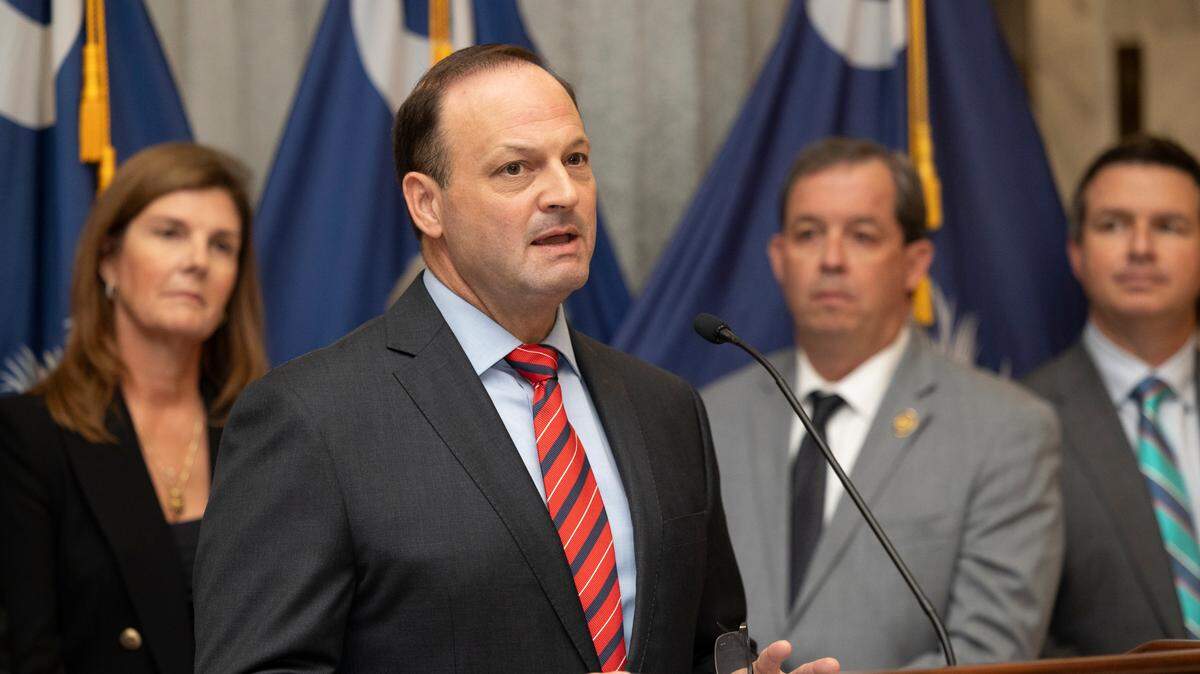
Asked if he lets his children use TikTok, South Carolina Attorney General Alan Wilson answers with an emphatic “no!”
“If your children have TikTok on the phone, don’t get rid of the app, get rid of the phone,” Wilson told The State in an interview.
The popular social media app known for its short form videos, powerful algorithm and addictive features has attracted an estimated 170 million users in the United States. But it has also come under fire for allegedly designing the app to promote compulsive use in younger users and for alleged links to the Chinese government.
These links led Congress to pass a law banning the app unless it fully divested from its parent company, Chinese-owned ByteDance. On Friday, lawyers for TikTok will present oral arguments before the United States Supreme Court, attempting to hold off the looming ban.
TikTok supporters have said that banning the app is a violation of the First Amendment and would destroy a place where millions have found entertainment, community and even started businesses.
Wilson is not one of these supporters.
“TikTok is kind of like a gun, it’s a tool. And a gun in the hands of a maniac is a deadly weapon. A gun in the hands of a police officer is a useful resource,” Wilson said. As a tool, TikTok “is in the hands of the US’s number one pacing threat. That is the Chinese Communist Party,” Wilson said.
Last week, Wilson joined 21 other attorneys general from around the country in filing a brief with the Supreme Court in support of the government’s ban.
The central claim is that the Chinese Communist Party, which Wilson describes as an “existential threat” to national security, exercises “overwhelming influence” over TikTok’s parent company, Beijing-based ByteDance.
Citing government reports and stories in outlets including The New York Times, The Washington Post, Axios, Forbes, the brief characterized the app as posing a threat to national security through its ability to funnel sensitive personal information back to China.
Among other data, the app collects information on the user’s locations, other apps they have downloaded, contacts and even where their eyes are looking on the screen, according to the filing.
The concern, according to the brief, is that this data could provide the Chinese intelligence establishment with the ability to track the real time locations of Americans, including public officials and journalists.
When contacted, representatives of TikTok referred The State to their briefing before the Supreme Court, which characterized the government’s efforts as ban the app as a violation of the First Amendment. Additionally, lawyers for TikTok have argued that there is “no evidence” that TikTok has either manipulated content or misappropriated private data.
Crucially, TikTok has also attempted to head off a ban by making assurances about transparency and data protection for lawmakers. Most significantly among them was an ambitious $2 billion plan, named ”Project Texas,” to house data from American users as well as key features of content moderation in the United States. The plan would also give government auditors access to TikTok’s source code to inspect for evidence of foreign interference.
But the magazine Fortune reported that former employees described the project as “largely cosmetic” and it has been broadly dismissed by lawmakers.
The app has few friends in South Carolina’s leadership. TikTok has been banned from government devices by order of Governor Henry McMaster and can’t be accessed on Clemson University’s wifi.
But Wilson says that he is not unsympathetic to the significant role that the app plays in many people’s lives.
“It’s not about banning TikTok. It’s really about divesting it from the Communist Party. I know a lot of people use TikTok to express themselves. Some have monetized it, some have used it in advocacy. I’ve never made an issue of the content.” Wilson said.
In trying to separate the case against TikTok from questions about the First Amendment, Wilson reiterated that his concern was about the app’s ownership.
“I do not trust the platform TikTok, as it currently exists, because it is owned by ByteDance, which is owned by the Chinese government,” Wilson said.
Wilson largely declined to discuss the addictive features of the app because his office is suing TikTok over features they say are designed to keep young people glued to the platform. he highlighted features such as TikTok’s seemingly infinite scrolling mechanism as part of an intentional design to hook young people on the app.
The long-term goal of the Chinese government, Wilson said, is having people so dependent on the app that it is an integral part of society.
While President-elect Trump has said that he has a “soft spot” for the app and filed a motion saying he didn’t want the app banned until he took office, Wilson told The State that it would be a mistake to see this as a difference of opinion.
“People are like, ‘Are you going to war with Trump on this?’ And I said, ‘I don’t think we have different positions,’” Wilson told The State. Instead, Wilson argued that any difference was simply a matter of tactics. While the incoming president utilized the “bully pulpit,” Wilson said that he was looking at any and all legal remedies to allow Americans to continue using it while wresting control of the app away from its current ownership.
The point, Wilson said, was “to defend a law that was an overwhelmingly bipartisan bill from Congress — and you don’t usually get a lot of that in D.C.,” Wilson said. “But when you have this much bipartisan support centering on national security, it’s worth defending that.”
This story was originally published January 9, 2025 at 11:31 AM.