
Kratom is a billion dollar industry. Who benefits when SC regulates it?
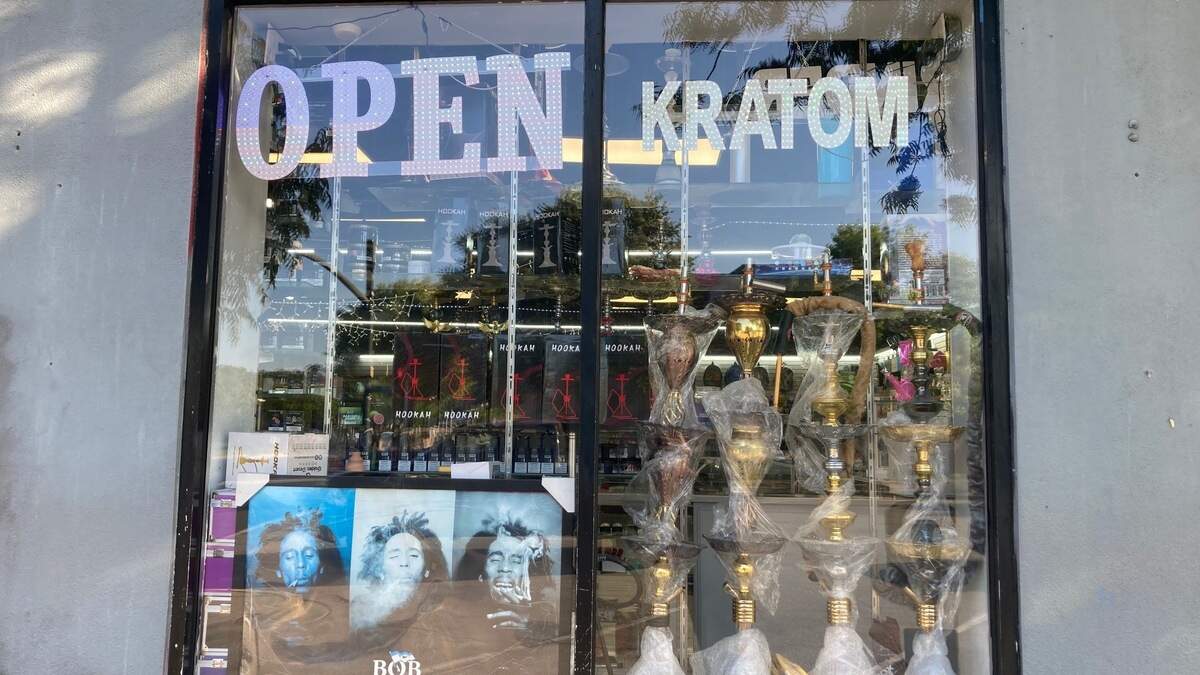
In the window of Smoker’s World in the center of Columbia’s Five Points neighborhood, the word “kratom” is lit up in neon green lights. It’s advertising an increasingly popular drug made from the leaves of a Southeast Asian tree closely related to the coffee plant.
You can find it in gas stations, convenience stores and smoke shops advertised with promises that it provides calm, focus and energy. In it’s raw form, it’s sold as a green powder that can be packed into gel pill capsules and brewed into teas and bottled drinks. New and powerful derivatives of the plant’s psychotropic chemicals are cropping up in gummies and chewable tablets. In South Carolina, anyone of any age can walk into a store and legally purchase as much as they want.
Many users say that at low doses, the drug provides more energy and better moods. But at high doses, it functions like a narcotic, dulling pain and inducing euphoria. While not containing any opioids, organic chemicals in kratom bond with the brain’s opioid receptors and can suppress cravings for opiate drugs. This has led to the drug being marketed as a healthy, natural solution to the nation’s addiction crisis.
But kratom, while lawful, has not been approved for any use by the federal Food and Drug Administration. While the federal Drug Enforcement Agency has warned that kratom can be addictive at higher doses, there is very little research at the state level. For example, the state Department of Alcohol and Other Drug Services’ 2024 survey of drug use in the state does not contain any reference to kratom, despite estimates that the number of Americans using the drug each year could be as high as 15 million.
With no federal law governing kratom, the drug has fallen into a regulatory purgatory.
In South Carolina, the General Assembly wants to change that by passing the South Carolina Kratom Consumer Protection Act. If passed, South Carolina would join 14 states that have passed some version of the Kratom Consumer Protection Act; at least a dozen more states are considering action.
But fault lines have opened up in the industry. The crucial sticking point is whether legislators will ban or restrict either the synthetic or semi-synthetic versions of kratom’s most active compounds.
While industry groups representing kratom manufacturers say they welcome regulation and have spent millions lobbying for states to pass laws, there is no consensus on exactly how to govern this little-known industry that Bloomberg estimates generates $1 billion a year.
“We are not tying to pick sides in any way, shape or form,” said the bill’s sponsor, state Sen. Russell Ott, D-Calhoun. “The biggest goal of mine is just to get it behind the counter and out of the hands of young kids,”
What does the bill say?
The legislation would require a customer to be at least 21 years old to purchase kratom or its derivatives and would set standards on labeling for these products. This includes information about the concentration of the drug’s active ingredients and recommended serving size.
Sellers who violate the law would be fined $1,000 for the first violation and $2,000 on all subsequent violations.
Significantly, the bill also places no limits on the sale of concentrates of 7-hydroxymitragynine, better known as 7-OH. This organic compound is found in very low quantities in kratom leaves, often less than 2% of the total organic chemical makeup. But it’s thought to be primarily responsible for both the drug’s recreational and therapeutic effects.
Because 7-OH occurs at such low concentrations in kratom leaves, it is often manufactured by chemically altering mitragynine, another organic compound found naturally in high concentrations in kratom. This process produces what the industry calls “semi-synthetic” 7-OH.
In the last few years, companies have developed 7-OH as a popular and potent standalone product, often sold as flavored, chewable tablets.
But 7-OH’s potency has generated controversy. Despite 7-OH not being an opioid, some tests have found that it binds to opioid receptors in the brain ten times more than morphine, according to a study in the journal Nature.
Where kratom is a plant that has been consumed for centuries across Southeast Asia, critics have accused 7-OH manufacturers of using deceptive marketing to peddle a dangerous, untested synthetic product. In a statement on its website, the Global Kratom Coalition, an industry group opposed to 7-OH, warned “what is currently known about its (7-Oh’s) safety is concerning.” The coalition has argued that products containing synthetically derived 7-OH “should not be considered as kratom products.”
Other states, including California and Oklahoma, passed laws requiring that 7-OH make up no more than 1% of the total active ingredients in any kratom product.
While earlier versions of the bill banned the sale of 7-OH outright, it was amended following a lobbying effort by a pro-7-OH industry group. The new version, which will be voted on by the full Senate, only bans “fully synthetic” 7-OH or other compounds.
The amended bill places no limits on how much 7-OH can be present in a product so long as it appropriately labeled.
Jonathan Miller — general counsel for Holistic Alternative Recovery Trust Inc., the pro-7-OH industry group the lobbied for amendments for the South Carolina bill — said that laws banning 7-OH are “motivated by anti-competitive interests.”
“Unfortunately there are some in the kratom industry that want 7-OH to go away,” Miller said. 7-OH products are relatively new, with some entering the market just 18 months ago. But in that time, Miller says that users have said the 7-OH has cured their dependency to opioids. It’s “life-saving,” Miller said.
For their part, legislators say they are trying to find a middle path while maintaining a free market.
“We’ve all been dealing with issues in our communities and taking well-advised input from folks that are in this area of intervention,” said state Sen. Daniel Verdin, R-Greenville, chairman of the Senate Medical Affairs Committee. “We would not inappropriately tilt the playing field or the marketplace from one product to another.”
Benefits and dangers of kratom are largely unknown
As the state moves forward with legislation, some experts have urged a more cautious approach given the lack of information about the drug.
“Any regulation is better than none,” said Ashley Bodiford, director of prevention at the Lexington/Richland Alcohol and Drug Abuse Council, who agreed with the legislature’s steps to establish age restrictions in line with alcohol and tobacco.
But Bodiford urged caution over the lack of research into some of the claims put forward by sellers of kratom and 7-OH. Bodiford said that she’s seen the drug emerge in South Carolina in the past eight years.
In her experience, Bodiford said that individuals in recovery who admit to using kratom are typically combining it with other drugs. And while some people might be using kratom or 7-OH to try to wean themselves off of more dangerous opiates, the lack of significant research means that what the public and policymakers know about potential benefits and risks are based on anecdotes, Bodiford warned.
Because the active compounds in kratom, including 7-OH, are binding with opioid receptors, long-term users who stop taking kratom or its derivatives can experience withdrawal symptoms, Bodiford said. As potent extracts become more common, she’s worried about a higher risk for dependence.
Abhisheak Sharma, a University of Florida scientist who studies kratom, said in an interview with the Tampa Bay Times that 7-OH tablets were comparable to “legal morphine.”
But compared to the opiate epidemic that swept the U.S., the risk still appears low. Kratom causes less than 1% of all overdose deaths in the United States, according to the federal Centers for Disease Control. In a study of 27,338 overdose deaths recorded by the CDC between July 2016 and December 2017, Kratom was found to be the cause of death in 91 cases. And in all but seven of those cases, the victims had taken other drugs.
In the last several years, high-profile incidents have contributed to rising concerns about the drug’s safety. In 2021, a South Carolina man with kratom and fentanyl in his system drove through an intersection in downtown Charleston and struck and killed an 11-year-old girl visiting from Denmark, according to media reports.
The same year, a 23-year-old Georgia man who died of a kratom overdose left behind a to-do list that included “stop taking kratom,” according to media reports.
In 2024, kratom pioneer Botanic Tonics, which manufactured a drink called Feel Free, settled a class action lawsuit that accused the company of misleading marketing and labeling.
Both the Carolina News and Reporter and ETV reported on individuals in South Carolina who developed crippling addictions to Feel Free, which also contained kava, another psychoactive plant. Posters on a Reddit group for people trying to quit Feel Free say they were lured in by “wellness” benefits or because they believed it would help them quit other addictions. Instead, some say they ended up spending thousands of dollars drinking more than ten bottles a day while suffering “brutal” withdrawals.
The founder of Botanic Tonics, JW Ross, was formerly an oil executive originally named Jerry Cash. In 2010, he pled guilty to embezzling $10 million from his company, Quest Energy Partners. According to documents filed with the California Secretary of State, Ross currently serves as the Chief Executive Officer, Secretary and Chief Financial Officer of Global Kratom Coalition, which actively lobbies against 7-OH products.
But on the other side are accounts of people who say kratom and 7-OH have helped them.
In a hearing before the state Senate Medical Affairs Committee, several senators recounted personal experiences with individuals who said kratom helped them manage chronic pain and break their addictions to pain pills, heroin and fentanyl.
Ott, the bill’s sponsor, says that until they know more, the law governing kratom and 7-OH should be about keeping it out of the hands of young people and providing regulation and harm reduction for people who use it to replace opiaites.
“People call me and say, ‘Yes, I do have a dependency on kratom,’” Ott said, “but if I’m smoking cigarettes, I’m dependent on nicotine. Now if I’m chewing nicotine gum, I’m not inhaling smoke, but it’s still a dependency.”
Kratom industry divided over 7-OH
Unlike high-profile battles over the future of cannabis and its derivatives, THC and CBD, the kratom industry has largely flown under the radar. This lack of attention hides the scale of the multi-billion dollar industry’s legislative effort to pass bills that have become a referendum on the future of the market for kratom and its derivatives.
To fight for its interests, the Holistic Alternative Recovery Trust, which was formed in 2023, hired four lobbyists to help reshape the South Carolina Consumer Protection Act by eliminating bans on 7-OH products.
The original text of the Kratom Consumer Protection Act itself was originally developed from a model bill advanced by the American Kratom Association, which pushes for tighter regulation of kratom and was, until recently, opposed to 7-OH.
To advance their model bill, the association spent more than $1 million on lobbying nationwide over the past decade, according to the website OpenSecrets, which tracks money in politics. The association spent $550,000 in 2024 and in 2023 it spent $42,000 on a single lobbyist in South Carolina in an unsuccessful effort to get the group’s consumer protection bill passed, according to public records.
The original draft proposed a blanket ban on synthetic or semi-synthetic versions of 7-OH. This was in line with association’s previous stance that 7-OH presented a “significant safety risk to consumers” and had a “greater risk of abuse” compared to natural kratom, according a “consumer alert” the group released in April, 2024.
But in October 2024, the kratom association made a sudden about face. In a joint press conference with the recovery trust, Mac Haddow, the association’s senior fellow on public policy, said the group was dropping its opposition to 7-OH so long as it was appropriately labeled and did not market itself as kratom.
This year, the organization, which did not respond to a request for comment by The State, did not have any registered lobbyists in South Carolina, according to public records.
The Global Kratom Coalition, which opposes 7-OH and in 2024 paid $124,000 to a single Atlanta-based lobbying firm, said it “objected” to the association’s new position.
“Rebranding does not mitigate the danger of selling a pure opioid without restriction,” said the coalition’s executive director, Matthew Lowe.
Last year, the kratom association and the kratom coalition became embroiled in a media war over California’s kratom consumer act, which limited the amount of 7-OH in kratom products. In a letter, former Arizona congressman Matt Salmon, now chairman of the American Kratom Association, accused the coalition of using ambush tactics and backroom negotiations to tilt the market in their favor under the guise of stringent regulation.
The association would not support a bill “unfairly targeting competing products to those marketed by Botanic Tonics,” Salmon said.
The kratom coalition did not respond to a request for comment.
Consumers should have the right to pick what product works best for them so long as manufacturers lived up to their “responsibility to meet a good faith basis of safety based on labeling and conditions of use,” said Haddow, adding that the kratom association “does not pick winners and losers.”