
Despite federal cuts, SC solar project moves forward. Here’s where
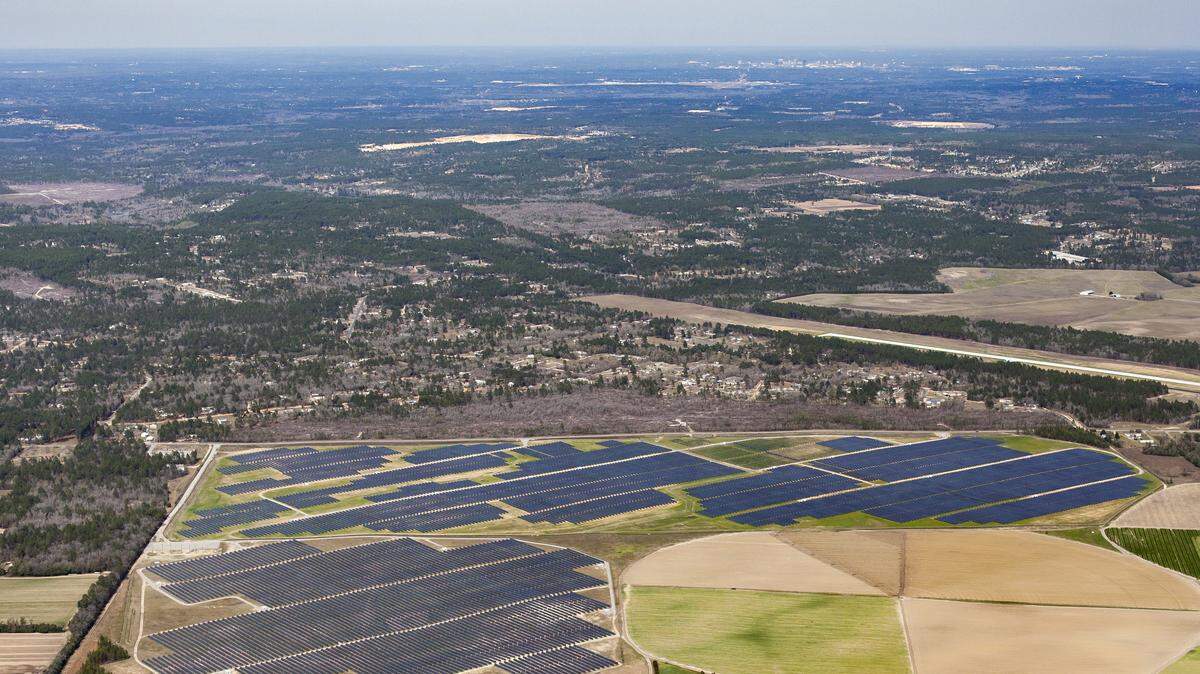
Despite financial and regulatory changes hitting South Carolina’s renewable energy sector, Richland County’s utility-scale solar production will likely more than double, Columbia Area Development Partnership announced last week.
A new 75 megawatt solar farm will be built in Eastover, a rural area of Richland County. The farm could power 8,460 homes, according to calculations by the Solar Energy Industries Association.
The created energy will be sold to Dominion Energy, Richland County Council Chair Jesica Mackey said.
But the future of solar power in the county and state could be shaky. The federal government has stripped renewable energy tax incentives and grants, which could make financing projects more uncertain, said John Brooker, energy policy director at Conservation Voters of South Carolina.
The state also placed more regulations on solar farms this year and put more responsibility on utilities to fulfill their solar plans in the future.
“The state-level bill really provided a lot more certainty for procuring this renewable energy,” Brooker said. “...This was all thrown into disarray with the reconciliation package.”
However, because solar is often affordable to operate and diversifies the energy grid, solar farms could still see future investment, said Kumar Venayagamoorthy, the Duke Energy Distinguished Professor of Power Engineering at Clemson University.
“It’s just that amount of profit you make out of it might be reduced,” Venayagamoorthy said. “But still, I think at the end of the day, it still will turn out fine.”
The new development will be Richland County’s second utility-scale solar farm, Mackey said. The new farm will be adjacent to the existing Eastover Solar farm and will be constructed by Pontiac Solar.
Carrie Turner, the marketing manager at the Columbia Area Development Partnership, said the project team at Pontiac Solar was unable to answer questions about the project at this point.
Local incentives
Despite federal funding cuts, local governments can still provide incentives for renewable energy projects. Richland County approved a fee-in-lieu-of-taxes incentive for the Pontiac Solar project during a July 8 meeting.
The incentive gives Pontiac Solar a fixed tax rate for the next 30 years. The fee will be determined based on the company’s investment in real and personal property, according to Mackey. Pontiac Solar has committed to investing $112.5 million, according to the agreement. The project will be constructed on a 462.6 acre site, according to the Columbia Area Development Council.
Mackey said the incentive is a win-win for the company and the county. Pontiac Solar will be able to budget based on a set tax rate, and the county will be able to count on the fee for the next 30 years, she said.
“This is a commitment for you to stay and commit to Richland County, and we’re committed to you as well,” Mackey said.
State and federal legislation
Two pieces of legislation have impacted utility-scale solar production in South Carolina: The state passed the “South Carolina Energy Security Act,” which includes new rules for clean energy, and the federal budget reconciliation bill stripped tax credits from the Inflation Reduction Act of 2022.
Since the Inflation Reduction Act, clean energy investment has risen in the U.S., according to the Clean Investment Monitor. The investment tracker is conducted by economic researcher Rhodium Group and the MIT Center for Energy and Environmental Policy Research. It shows that investment in clean energy is nearly 2% of South Carolina’s gross domestic product over the last four quarters, the fourth highest of all states.
Many of the tax credits created by the Inflation Reduction Act have a new expiration date. The budget reconciliation bill, known as the “One Big Beautiful Bill”, places new rules on the clean energy tax credits for wind and solar. Solar projects will only be able to receive the incentive if it begins construction by June 4, 2026, or goes online by the end of 2027.
This could mean solar farms already in progress may be completed over the next few years, but development of new solar farms may dwindle, Brooker said.
“I think you’re going to see projects for the next year to year and a half, maybe two years max, which is essentially what the federal bill allows to earn the tax credits,” Brooker said. “After that, I think there’s going to be a lull.”
The Pontiac Solar project is expected to be completed by the end of 2028. That means the project would have to break ground in the next year or go online a year ahead of schedule to receive the tax credit.
Before the budget reconciliation bill passed, the renewable energy sector had more stability thanks to the state’s new energy law, Brooker said. The law requires state-regulated utilities to follow through on procuring the renewable energy sources outlined in its resource plan.
“This provides more certainty for that cost-effective solar,” Brooker said.
The state legislature also placed additional rules on new solar projects in counties without existing legislation this year. For example, solar facilities need to build a buffer, like a fence or wall, between the farm and the road, homes, schools or churches. The facility also must work to minimize glare on the panels and the solar farms must be set 50 feet away from adjoining property lines and 200 feet away from schools, homes or churches.