
‘Extraordinary’ givers wanted. SC seeks donors for $104 million unpaid food benefits
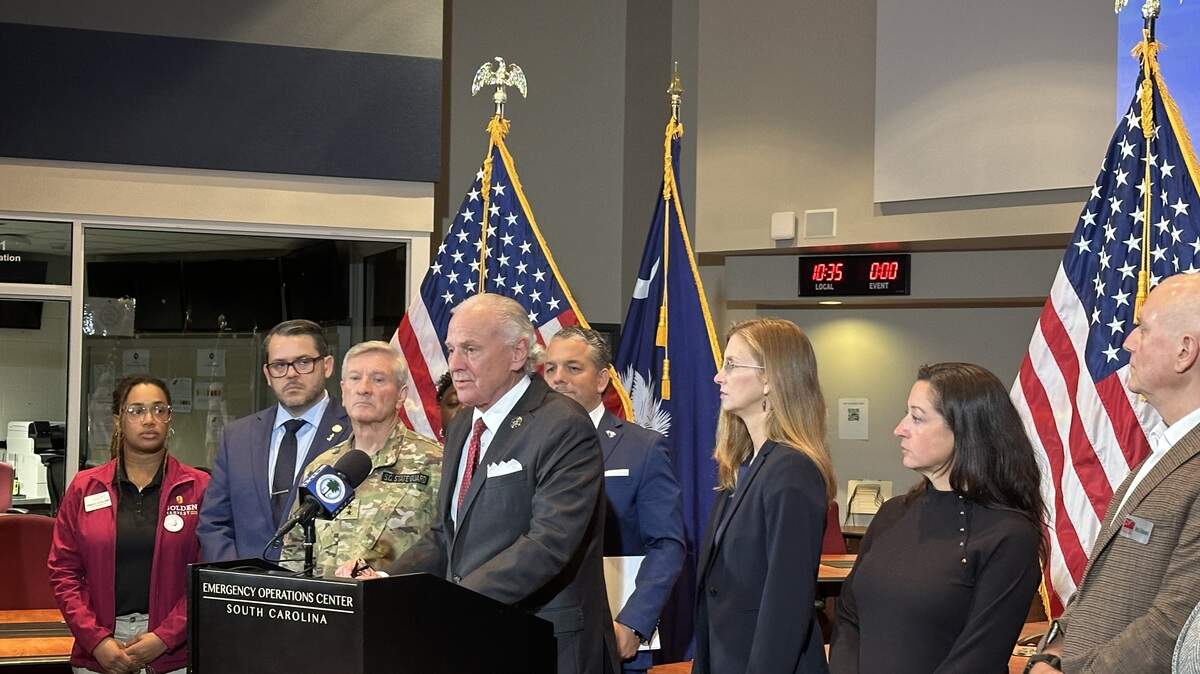
With over half a million South Carolina residents unlikely to receive their federal food benefits next month, Gov. Henry McMaster said the state will rely on food banks and other private entities to fill in the gaps.
“This is not a time to make a regular donation,” McMaster said. “This is not a time for regular help. This is time for something extraordinary. “
If the federal government shutdown continues next month, November food benefits will not be dispersed to families, the South Carolina Department of Social Services warned last week. It will leave about 1 in 10 South Carolinians without federal money for food.
The Central Carolina Community Foundation’s One SC Fund for hunger relief was activated Tuesday, said CEO Georgia Mjartan. The One SC Fund helps coordinate donations across the state during natural disasters, like Hurricane Helene and the COVID-19 pandemic.
In May 2025, the federal government gave South Carolina $105.86 million for the Supplemental Nutrition Assistance Program in benefits, according to United States Department of Agriculture data. Tony Catone, the director of the state Department of Social Services, said South Carolina received $103.8 million in September.
The One SC Fund hasn’t raised nearly $100 million for one disaster before, so it will be difficult for the activation to completely fill in for SNAP. In comparison, the fund raised $6.1 million in response to Hurricane Helene.
“We need people to step up and give in ways that they have never given before,” Mjartan said.
Democratic lawmakers said asking people to donate to the One SC Fund was not an adequate solution during a press conference Wednesday.
“It’s very important that everyone understand that that is not a solution. That’s almost like a Band-Aid on a bullet hole,” said state Sen. Russell Ott, D-Calhoun.
The money donated to the One SC Fund will be dispersed to food banks and other “local feeding partners,” McMaster said during a press conference Tuesday.
It will likely be impossible for food banks in the state to make up for missing SNAP payments, said Harvest Hope CEO Erinn Rowe.
“Honestly, $100 million per month is not something that we’ve ever seen philanthropy raise in a week,” Rowe said. “So, it’s a matter of having money to buy food. We will buy it as fast as we possibly can with the money that’s given to us. But once again, we’re limited by the amount of donations that we receive.”
The South Carolina State Guard will also assist with safety and distributions at food banks.
The federal government shutdown began at the beginning of the month after Congress failed to pass a spending plan for the next fiscal year, which began Oct. 1.
What could SC do to help?
U.S. lawmakers and other states’ leaders have made attempts to disperse SNAP benefits in November, even if the government shutdown continues.
U.S. Sen. Josh Hawley, R-Missouri, introduced a bill to pay SNAP benefits during the government shutdown, and it received support from 10 other Republican Senators and one Democrat. Neither U.S. Sen. Tim Scott nor Lindsey Graham co-sponsored the bill. The senators’ spokespersons did not immediately answer questions on whether the senators would support Hawley’s bill.
A coalition of 25, primarily Democrat-led, states sued the USDA Tuesday over its assertion that the federal government does not have the available funds to pay for SNAP. The state governors and attorneys general argued Congress has previously created multibillion dollar contingency funds that could be used to pay for SNAP. South Carolina did not join the lawsuit.
South Carolina Attorney General Alan Wilson did not join the lawsuit, but he sent a letter to Senate Minority Leader Chuck Schumer, D-New York, with 17 other state attorneys general Wednesday asking for an end to the government shutdown. South Carolina Democratic lawmakers also urged for an end to the shutdown Wednesday afternoon.
The USDA has made it clear to states it won’t hand out benefits in November without an end to the government shutdown.
On Oct. 10, the USDA told the South Carolina Department of Social Services not to disburse November SNAP benefits indefinitely, according to a Wednesday news release. The USDA also posted a message on its website that says “the well has run dry” on SNAP benefits, without an end to the ongoing government shutdown.
The federal government has also said states that try to pay for SNAP benefits in November will not be reimbursed, Catone said Tuesday.
State Rep. Hamilton R. Grant, D-Richland, called for McMaster to declare a state of emergency in response to the SNAP shortfalls Monday. But McMaster said a declaration would not help the state since it didn’t have any money available.
The General Assembly appropriating money for food benefits would be the only way for the state to pay for SNAP, which they would never be reimbursed for by the federal government, McMaster said. State Sen. Deon Tedder, D-Charleston, asked on Monday the General Assembly to reconvene in response to the SNAP benefit shortage.
As of Tuesday afternoon, no special session has been called for House lawmakers, a spokesperson for Speaker Murrell Smith, R-Sumter, wrote in an email to The State.
“That’s something that would take some time and some debate,” McMaster said.
State Rep. Todd Rutherford, D-Richland, said Wednesday the state legislature should do whatever it could to address potential hunger caused by SNAP shortfalls.
“We need to show that we are not Washington, D.C., that we are down to work for the people,” Rutherford said. “And if that means coming into session to figure it out, then we, as a body, as Democrats, are willing to do that, and we’d ask Republicans to do the same. “
How to give
Individuals and larger corporate donors can give to the One SC Fund on the Central Carolina Community Foundation’s website. McMaster said 99% of donations will be given to nonprofits, food banks and other feeding partners.
Mjartan also recommended people donate money and food to local pantries, faith organizations or community groups that give out food. McMaster said people could help one another while SNAP benefits are on hold.
“There’s a lot of ways without going through an official program or a charity, and that’s just helping your neighbor,” McMaster said. “If you know somebody needs help, go buy a basket of food, leave it on the front doorstep. Maybe put it up high, so the dogs won’t get it.”
Without the federal government stepping in before November, it will be difficult for the state and private sector to provide food to the roughly 1 in 7 South Carolinians that are hungry.
“Even with robust support, food banks can provide only a fraction of the nutritional assistance that feeding programs like SNAP provide,” said Nick Osborne, the president of the Lowcountry Food Bank.
This story was originally published October 29, 2025 at 5:00 AM.