A tornado tore up a federal prison in SC. Lockdowns, leaky cells and COVID-19 followed
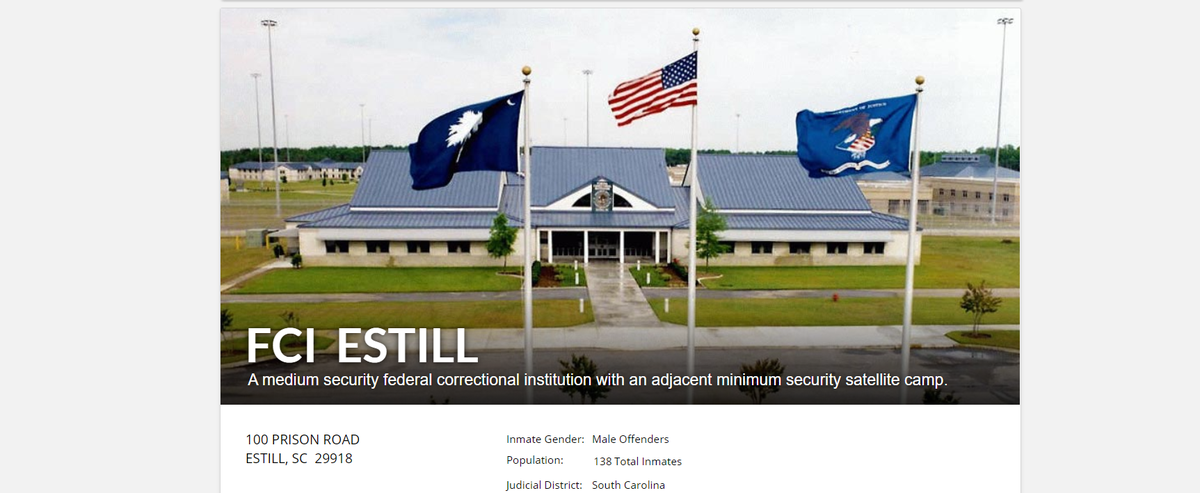
Inmates at the federal prison in Estill, S.C., thought they had it bad when a tornado pummeled their facility in mid-April.
“We didn’t know what was going on at first,” said Bob Rivernider, a former minimum-security inmate released from Federal Correctional Institution Estill on May 14. “Everything was flying around.”
He said the roof collapsed on the housing unit next to his, and the prisoners had to break confinement rules to run outside to safety.
Things were about to get a lot worse.
FCI Estill’s main facility held over 900 medium-security inmates. Its satellite camp held 188 minimum-security inmates.
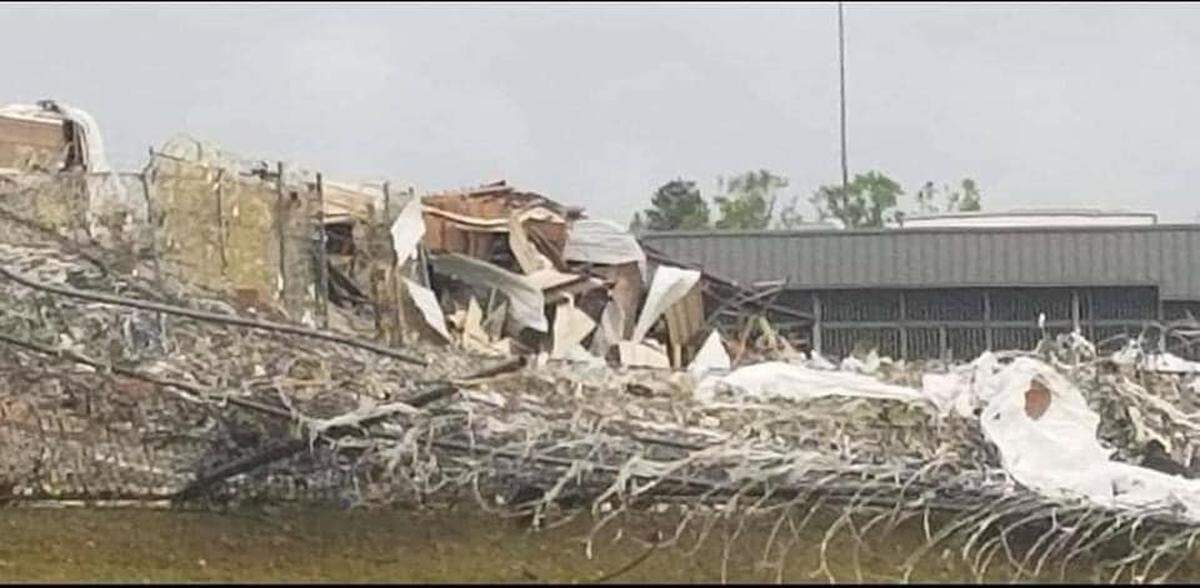
Both were heavily damaged when struck by the 175-mph tornado on April 13.
As a result, the medium-security inmates were sent to a prison in Pennsylvania that was more secure.
However, because the tornado rendered the satellite camp inoperable, its 188 inmates were moved to Estill’s medium-security prison, according to Emery Nelson, spokesperson for the Federal Bureau of Prisons.
The agency declined The Island Packet and Beaufort Gazette’s request to interview any officials at FCI Estill. They answered some questions in writing.
Now, five months after the tornado, 132 minimum-security inmates are still incarcerated in the medium-security prison. The number declined due to “normal attrition,” Nelson said.
Prisoners there said living conditions since the tornado and inmate transfer have worsened considerably. Fears of COVID-19, racial unrest and other problems have made it unbearable.
The difference is “night and day,” Rivernider said. “You’re locked in. They slam the metal door.
“In the medium, you’re no longer a camper.”
Major employer
In the early morning hours after the tornado hit, Estill Mayor Corrin Bowers III was driving to survey damage in the area surrounding his town.
Seven miles from FCI Estill, he found barbed wire from the prison’s fencing hanging from a tree.
“There were as big pine trees you’ll find in South Carolina just toppled over, snapped in half,” Bowers said. “Metal roofing from the prison (was) scattered all across the woods.”
The prison sits just 3 miles south of Estill’s town limits and was in the direct path of the tornado.
Built in 1993, FCI Estill serves as a major employer, customer, and even attraction for the town of under 3,000 residents.
Before the tornado, 114 corrections staff — which would make up nearly 4% of the town’s population — worked at the facility, according to the prison bureau’s Nelson.
Mayor Bowers, who was born in Estill and owns a farm, said local businesses depend on income from the prison population’s loved ones who travel to visit them.
Additionally, the prison is the town’s largest customer for water and sewer services, Bowers said.
With FCI Estill in disrepair and with significantly fewer inmates, Bowers said, “it would affect us greatly not to go back to the scale that they were.”
Security level
Before the tornado, inmates at FCI Estill’s satellite camp were mostly nonviolent offenders, many convicted of white-collar crimes.
They lived in dormitory-style housing, and many left the camp every day to go to jobs.
Sex offenders, inmates with a history of escape, and “those who otherwise pose a serious risk to the public are not permitted at minimum security federal prisons,” according to Christopher Zoukis, author and federal prison consultant.
That’s why the nonviolent inmates who were moved to medium security were shocked at the change in quality of life.
Their security and surveillance was ratcheted up to cell-based housing and a larger presence of guards.
Ceiling holes and mold
The conditions at FCI Estill’s medium security prison “weren’t very good before or after the tornado,” said Lary Lee Petty, an inmate previously incarcerated there and sent away after the tornado.
Petty lived in a unit with holes in the ceiling.
“We used to have to keep garbage cans placed strategically to catch the water” leaking in whenever it rained, he wrote in an email to a reporter.
The leaks also created a mold problem for the inmates.
“There was a lot of mold, especially in the drywall in the ceiling ‘patches,’” Petty said. “They didn’t fix the outer roof that was the cause of the leak; they just patched the insides.”
After the tornado, both problems got worse.
There were “as many as 48 garbage cans, mop buckets and cardboard boxes lined with plastic throughout the building,” according to Richard Bobka, a current inmate at FCI Estill.
He detailed the conditions as part of a writ of habeas corpus filed in U.S. District Court of South Carolina in July, seeking to be released.
Bobka said he is concerned for his health and fearful of falling ill due to the black mold that’s spread in the prison.
“The Black Mold is both on the ceiling and on the walls and both bubbling up from behind the paper portion of the drywall,” he wrote.
“Black Mold can be seen on the AC vents and in the ceiling where 80 ceiling tiles are missing.”
Evidence is mixed about the acute effects of black mold. But researchers have found links between indoor exposure to molds of all types and “upper respiratory tract symptoms, cough, and wheeze in otherwise healthy people,” according to the Centers for Disease Control and Prevention.
Asked about the full extent of the tornado’s damage, the federal prison bureau’s Nelson said only that the prison “sustained significant damage to roofs and several security aspects of the facility.”
More lockdowns
The specter of COVID-19 has made a rough situation for the inmates at FCI Estill more difficult.
“It looks like they are not going to let us out of our cells at all,” one current inmate wrote to his sister, who allowed The Island Packet to read his correspondence on the condition of anonymity because she feared retribution against him.
“They are so scared of the virus they don’t even come in the units, only to feed us through the door and then they are gone,” he wrote in the July 6 letter.
Based on a timeline established through interviews and court documents, inmates at the prison have had over two months of lockdowns since April.
That meant staying confined to a small cell with a roommate for 24 hours a day.
At the beginning, Bob Rivernider said, “they didn’t want us mingling with anybody because of COVID and because of the damage.”
In a court filing, Richard Bobka wrote that lockdowns began during the first two weeks after the tornado.
Then, on April 27, prisoners were allowed outside of their cells for one hour, three days a week, he wrote.
Bobka said that continued until May 18, when more than one month of total confinement ended briefly for those in Estill.
But it began again a few weeks later, when all 122 institutions run by the Bureau of Prisons went on lockdown during national unrest over police brutality.
That lasted June 1-9, said the bureau’s Nelson.
Like others in prisons across the country, the nonviolent inmates at FCI Estill had to return to lockdown again when coronavirus was suspected of entering the prison.
On July 2, a corrections officer “(who) was sick with Covid-19 came into the building and a 14 day lockdown would ensue, placing (me) in a locked cell with one other inmate,” Bobka wrote in a sworn affidavit on July 20.
Said the unidentified inmate to his sister: “Another boring day of lockdown. ... It’s Monday and we have not showered or been able to use the phone or computer since we last spoke.” He said the lockdown was due to fear of COVID-19.
Rivernider, who said he is in regular contact with four inmates at Estill, said the prison was on lockdown as recently as last week, and that all were on lockdown during August, though the Bureau of Prisons did not say so.
“The inmates at FCI Estill have remained on modified operations, following COVID-19 guidelines focusing on limited movement, social distancing, and other mitigation strategies to combat the transmission of COVID-19,” Nelson said.
FCI Estill has 12 staff members who have tested positive for COVID-19, according to the Bureau of Prisons website. No inmates reportedly have the virus, but 35 tests have been conducted.
Over-staffing?
Typically, the lower the security level, the smaller the number of staff needed to oversee the inmates, the Bureau of Prisons website shows.
As of April 11 — two days before the tornado — there were 114 corrections staff working at FCI Estill, according to Nelson. They oversaw the more than 900 medium-security inmates.
After those prisoners were sent away and the 188 nonviolent camp inmates moved in, the amount of staff stayed roughly the same.
There are now almost as many corrections staff as inmates: 105 staff members for 132 nonviolent inmates, according to Nelson. But the bureau did not provide an answer when asked the reason for the large amount of staff.
“FCI Estill’s Correctional Services staffing numbers have remained similar to levels prior to the tornado, with a slight decrease as a result of normal attrition (i.e., transfers, retirements, etc.). Staff members were not displaced due to the tornado,” Nelson said.
Having a surplus in corrections staff meant some were being sent to help at other prisons and then returning to Estill, the inmates said.
They allege it makes them a risk of spreading coronavirus in their prison.
FCI Estill “has been sending many dozens of its C.O.’s to hot spots for Covid-19 (Atlanta, Yazoo and others) to work for two weeks only to return to Estill to work, with a higher likelihood of being silent carriers of Covid-19,” said Bobka in his affidavit.
But as of Sept. 1, Nelson said, “FCI Estill has four staff members on Temporary Duty (TDY) status at another facility,” said Nelson.
He said anyone coming into the prison gets checked for PPE and has their temperature taken.
Any symptomatic or positive-testing staff is sent to quarantine at home.
End in sight?
May 14, 2020 is an important day for Bob Rivernider. It’s when he got out of FCI Estill on compassionate release for time served.
That day was so monumental that Rivernider’s email address begins with “Freedom51420.”
“Joy and happiness,” he said when he learned he was being released. And “a little shock.”
“It’s nice that my kids don’t have to take the once-a-year trip to visit for a few hours,” Rivernider said.
He served 80 months for mortgage fraud convictions. He now lives in Wildwood, Florida, with his father, and his children live nearby.
The federal bureau said there’s no timeline for when the inmates still at FCI Estill will return to a minimum-security camp.
That, according to a lawyer with the American Civil Liberties Union of South Carolina, is detrimental to the health of the inmates.
“Putting people who were in minimum-security camps and taking them into a medium-security environment for two or more months without a timeline or an end in sight is not only unfair for those who are incarcerated in Estill, (but also) has a lot of long-term effects,” said Shirene Hansotia, the ACLU lawyer.
The minimal human interaction caused by lockdowns and the increase in the security level is “devastating to their mental health and upon their potential success in re-entering society,” Hansotia said.
Even though he’s been released, Rivernider still worries about the people at FCI Estill.
He represents and files legal briefs on behalf of four inmates currently incarcerated.
“It was bad before,” he said, “but now with the tornado. ... They’re killing people by leaving them in there.”
This story was originally published September 15, 2020 at 4:45 AM with the headline "A tornado tore up a federal prison in SC. Lockdowns, leaky cells and COVID-19 followed."