
James ‘Jim’ Holderman, controversial USC president of 13 years, dies at age 85
James B. “Jim” Holderman, the 25th president of the University of South Carolina from 1977 to 1990 who had a storied and controversial life that included two stints in federal prison, died Saturday. He was 85.
“The University of South Carolina community is saddened to learn of former President James Holderman’s passing,” the school said Saturday in a statement. “The positive impact our university alumni continue to have in their communities is part of his legacy. We send our sincere condolences to his family and loved ones during this difficult time.”
A Machiavellian figure known for his charm, wide grin, infectious energy and non-stop working habits, Holderman was a master of networking in South Carolina and around the nation. During much of his presidency, he was praised for attracting high-profile people and events to USC, increasing fund-raising and lifting the university’s image from that of a party school to a more serious educational institution.
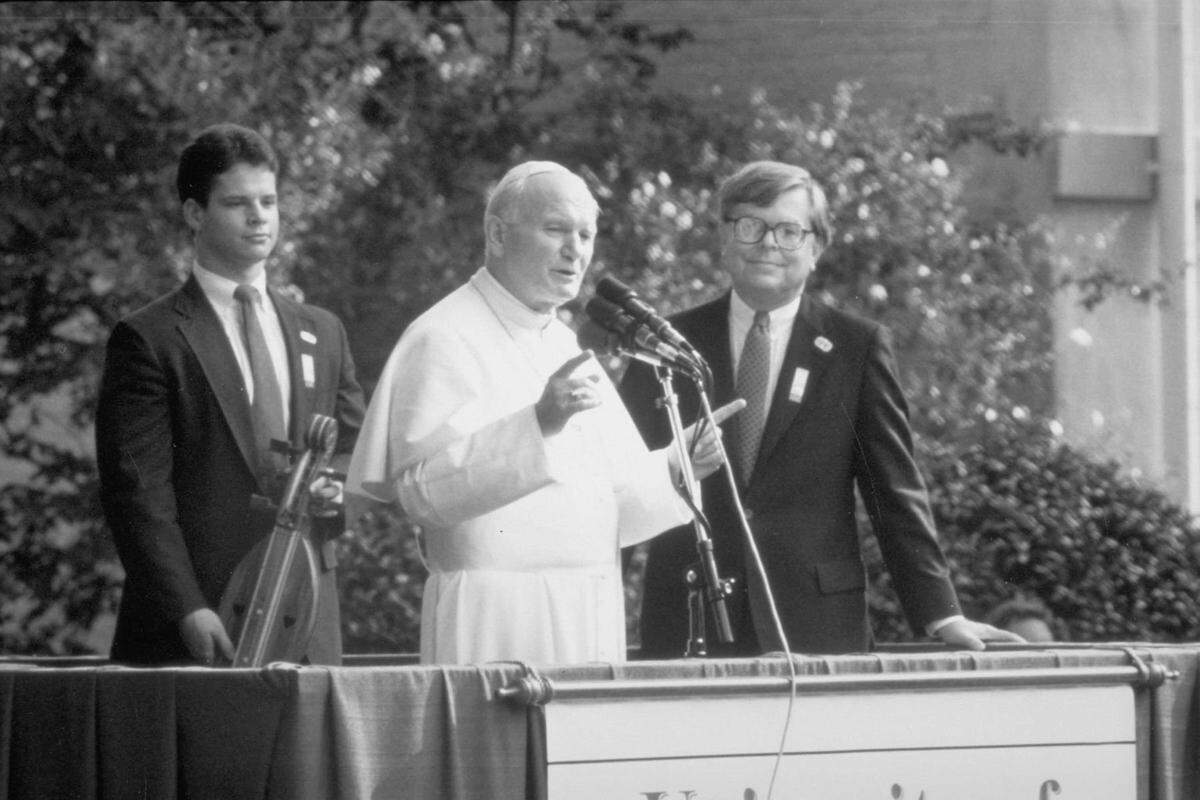
Over the years, Holderman brought President Ronald Reagan, the Archbishop of Canterbury, President George H.W. Bush and Pope John Paul II to campus, among numerous others. Holderman secured the beginnings of funding of what became the Swearingen Engineering Center and the Koger Center, Columbia’s premier performing arts center. He started the university’s Honors College. By 2001, Holderman was fond of telling supporters, USC would “roll off tongues” along with the names of Harvard, Princeton and Yale.
All of these successes, and Holderman’s gift for promotion, brought the university an increasing and nonstop stream of favorable publicity. On a personal level, Holderman gained increased clout as a person who could no wrong with South Carolina’s movers and shakers, who in that era included not only politicians but the heads of major law firms, banks and businesses.
But behind the scenes, Holderman had access to troves of public money in his university accounts. Each year, he spent hundreds of thousands of dollars on secret gifts to students, politicians and celebrities he brought to campus.
With this money, Holderman was also able to shower attention and lavish favors on a band of student interns he hired each year, taking them with him on dozens of non-public trips around the country, dining in elegant restaurants, riding in limousines and putting them up in first-class $700-a-night hotels in places like New York, Washington and Chicago. He gifted bathrobes and little gold crosses he said had been blessed by a cardinal to his interns, then made sexual advances to his favorites.
Questions about Holderman’s massive secret spending of public money led to his ouster in 1990.
The first question came in 1986, when Paul Perkins, a student at the USC School of Law and his fiancée Cheryl Forest, a Columbia lawyer, began wondering how much Holderman was paying to bring one celebrity, Madame Jehan Sadat, the former First Lady of Egypt, to USC to teach. They filed a Freedom of Information Act request with the university.
“They sent us a letter where they had blacked out the salary,” said Cheryl Perkins on Saturday. She later married Paul and is still a Columbia attorney. “So we decided to file a Freedom of Information lawsuit.”
Months later, they won their lawsuit. A state circuit judge ordered Holderman and the university to release spending records. The records showed Holderman had approved paying Madame Sadat — who wasn’t even a professor — more than $300,000 for a part-time teaching job over a year and a half.
The Sadat disclosure led investigative reporters at The Charlotte Observer and The Greenville News, both of which papers had Columbia bureaus in that pre-Internet era, to file their own Freedom of Information requests with USC to learn more about Holderman’s spending.
For the next five years, the newspapers revealed Holderman’s excesses little by little. He and his many supporters fought the papers at every turn, saying the reporters wanted to “tear down the university.”
At first, to protect Holderman, the University’s Board of Trustees invoked a rarely-used provision in the Freedom of Information Act that allowed public bodies to keep secret certain public spending. But as public pressure mounted, the board relented and allowed reporters to see thousands of documents related to years of Holderman’s spending.
However, USC did not reveal all of Holderman’s spending. As time went on, The Charlotte Observer, The Greenville News and the Associated Press all filed Freedom of Information lawsuits against USC. Freedom of Information lawsuits were also filed against a university foundation that was giving Holderman a salary supplement and money for expenses.
Eventually, however, the lawsuits and continued news stories took their toll on Holderman, the university’s image and the board of trustees. Holderman announced his resignation in mid-1990. Some critics questioned whether he was courting celebrities instead of spending more time trying to improve the school’s nuts-and-bolts academic side.
After Holderman left office, a headline on an 1990 article about Holderman’s tenure in The New York Times summed up his turbulent tenure this way: “Carolina Educator: Bold Leader or Big Spender?”
But there would be more to Holderman’s legacy.
Records found in landfill
In 1991, Holderman was indicted by a Richland County grand jury on state charges of illegally using his public position as president for personal gain and taking extra money through a state agency. Dozens of his supporters showed up at his guilty plea hearing where he pleaded guilty to the receiving extra compensation charge. He also pleaded no contest to an income tax evasion charge, according to news accounts. A judge gave him probation.
Also in 1991, adding to Holderman’s woes, financial records of the university foundation that had been sued by Greenville News and the Associated Press for concealing public records about payments to Holderman were dug up in a landfill by The Greenville News . The paper had gotten a tip that the foundation had tossed the records to avoid public scrutiny.
That wasn’t all. Later in 1991, The Charlotte Observer also published a story revealing sexual advances by Holderman to students during the dozens of out-of-town trips Holderman made with interns. Interns told The Observer Holderman liked to tell them they would be “the son I never had.” Holderman denied the allegations.
By 1992, the university had investigated and confirmed stories about Holderman’s sexual advances to students. The board of trustees stripped him of tenure.
In 1996, Holderman pleaded guilty to eight counts of bankruptcy fraud and sentenced to a year and a day in federal prison by U.S. District Judge Joe Anderson in Columbia. Federal officials had charged him with lying on his bankruptcy application, making false claims including that he had some $1 million in debts.
”We presented about two days of information about Dr. Holderman’s diminished capacity and mental illness issues at the time. We were hoping the court would find it was an excusable accident,” said Columbia attorney Joe McCulloch, who represented Holderman at the bankruptcy fraud hearing with attorney Jack Swerling.
In 2003, after being arrested in an FBI video sting where agents posed as Russian mobsters, Holderman received three years in prison for scheming to launder drug money and illegally get visas.
In its statement Saturday, USC remembered the good times.
“He presided over a period of growth and recognition for the university, including the foundation of the South Carolina Honors College, donation of the Movietone News Collection from Twentieth Century and campus visits from world leaders such as U.S. Presidents Ronald Reagan and George H.W. Bush, First Lady Barbara Bush and Pope John Paul II.
A plaque on USC’s Horseshoe outside the president’s house memorializes the 1987 visit of Pope John Paul II to USC which Holderman, against all expectations at the time, made happen.
“It is wonderful to be young,” the Pope told the students during his visit, according to the plaque. “It is wonderful to be young and to be a student. It is wonderful to be young and to be a student at the University of South Carolina.”
Attorney McCulloch, who considered Holderman a longtime friend as well as a client, said, “He was a person of human imperfections who accomplished some superior things. It’s not exactly an epitaph but it’s the truth.”
This story was originally published April 3, 2021 at 11:28 AM.