
SC’s ubiquitous sow thistles are scraggly relatives of dandelions with their own rich history
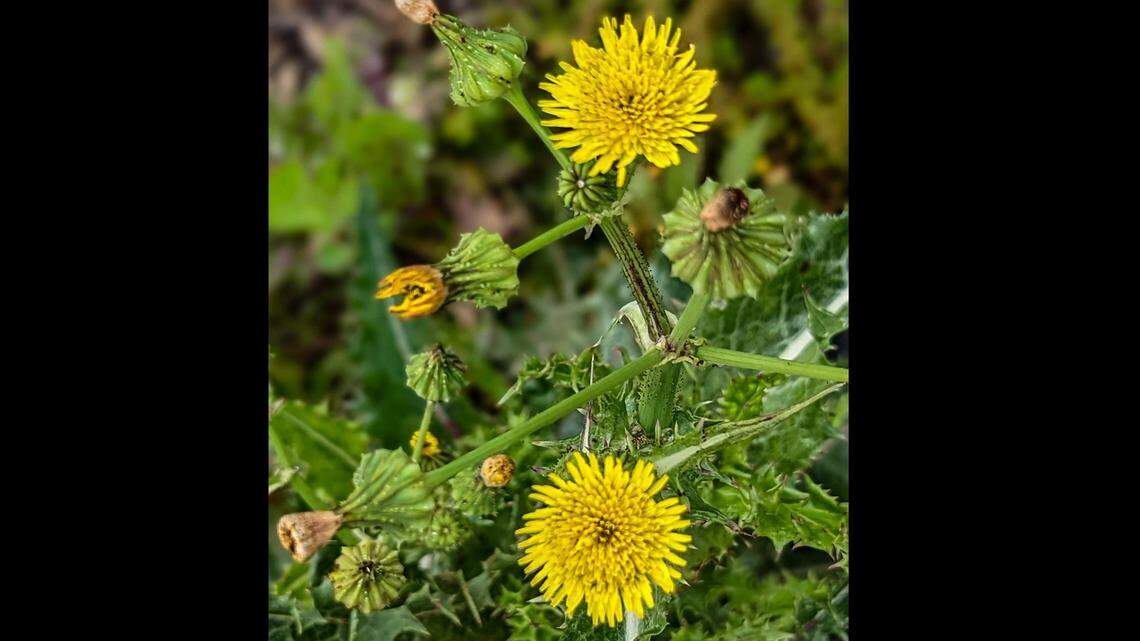
Sow thistles look rather like scraggly dandelions with prickly leaves. They’re neither dandelions nor thistles, though all three belong to the same family (Asteraceae), along with asters, daisies, sunflowers, artichokes, and many other familiar plants.
Worldwide there are some 50 species of sow thistle (Sonchus). Most are native to Europe, Asia, and Africa, though some have become widely naturalized elsewhere, including several common species in the U.S.
Here in the Lowcountry, they’re common but often unnoticed weeds in fields, gardens, abandoned lots and roadsides. I’ve seen the occasional sow thistle seedling taking root even in a sidewalk crack.
As a group, sow thistles have irregularly lobed leaves that typically form a basal rosette on the ground but also grow along (and clasp) the plant stem. As in dandelions, what looks superficially like a single yellow flower is actually a tight cluster of minuscule, ray-shaped flowers (florets), surrounded and supported by green, leaf-like structures called bracts.
Unlike dandelions, which have just a single flower head per stalk, sow thistles usually produce several heads on a single stem.
Once pollinated, each floret gives rise to a tiny, single-seeded fruit equipped with a hairy parachute that sends it traveling far and wide in the wind.
Sow thistles contain a milky latex, and in fact were once fed to lactating pigs with the belief that this would enhance their milk production. Aphids are fond of sow thistle “sap” and can be abundant on some plants. Sow thistle leaves are also food for other insects, including the caterpillars of several kinds of moth.
Humans in various cultures have eaten sow thistle leaves, too, and the roots can be roasted and ground to make a beverage. Some species are reputed to have medicinal properties, yet to be fully investigated.
Because of their general vigor and capacity for rapid spread, sow thistles are often considered invasive weeds. Some, in fact, can produce seeds in staggering numbers — as many as 25,000 per plant.
But sow thistles also help to colonize waste areas and other habitats inhospitable to many other plants. In this way, they play an important ecological role in plant succession by paving the way for the growth of other species.
This story was originally published April 7, 2022 at 9:59 AM with the headline "SC’s ubiquitous sow thistles are scraggly relatives of dandelions with their own rich history."