Panel rejects changes to St. Helena Island protections after vocal residents turn out
Members of the Beaufort County Planning Commission rejected a change to a special zoning that protects St. Helena Island from gated communities and large golf courses, concluding the rules as written have worked to preserve the heart of the Gullah-Geechee Nation for more than two decades.
The Planning Commission’s unanimous vote comes as a developer proposes a housing development and 18-hole golf course on nearly 500 acres of St. Helena Island that’s sparked an outpouring of opposition, including from Gov. Henry McMaster.
The vote was only a recommendation — the County Council will have the final say. The text amendment, along with the Planning Commission recommendation, goes next to the Community Service and Land Use Committee. It is tentatively scheduled to be heard by the County Council Jan. 23.
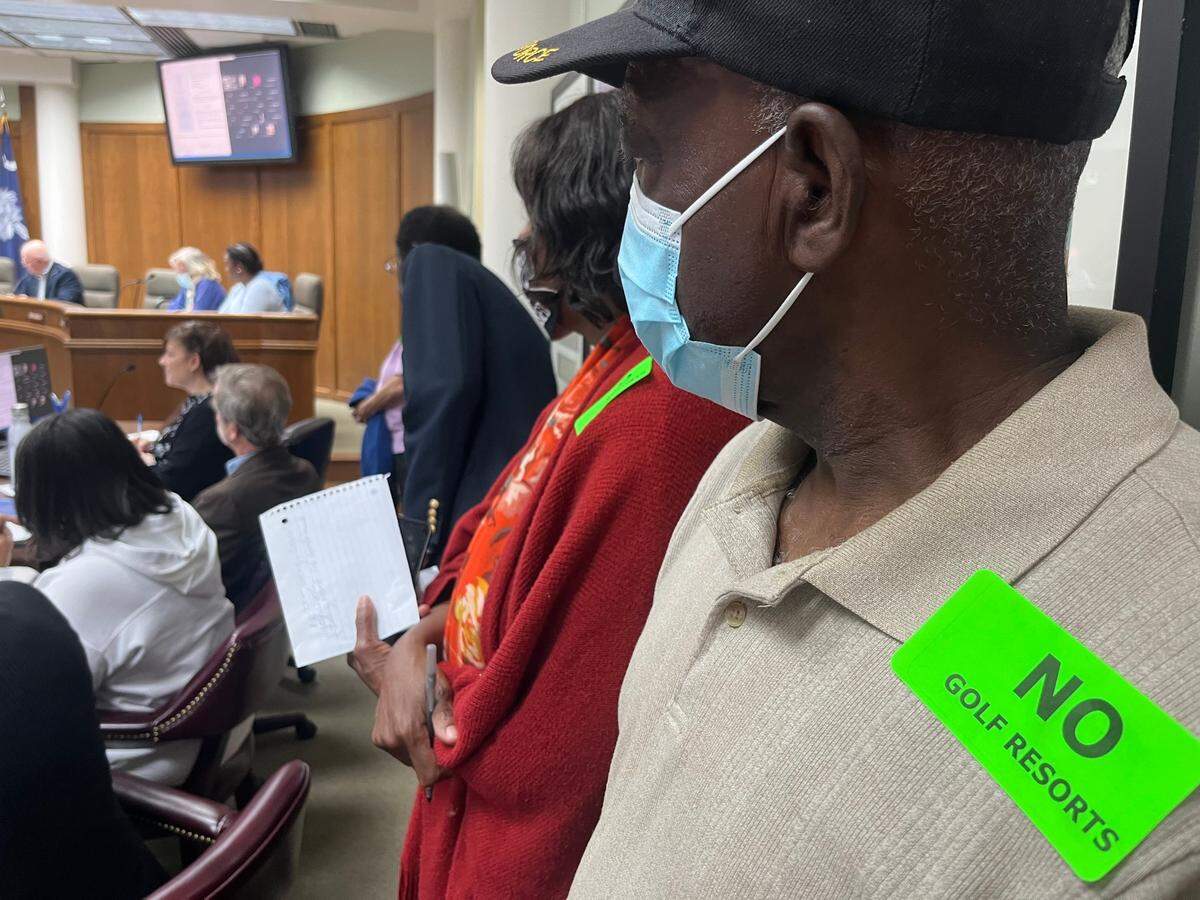
Still, the Planning Commission recommendation brought applause from the 120 residents who packed into the Commission chambers, with many staying for the entire three-hour meeting that included emotional testimony and testy exchanges.
At issue is a special zoning designation known as a Cultural Protection Overlay (CPO). Its purpose is to protect the environment and historic, rural and cultural landscape of St. Helena, the epicenter of Gullah culture and once the home of 55 plantations and 10,000 enslaved Africans. The CPO was crafted 24 years ago by a committee that included descendants of those slaves, and it applies to the entire 64-square-mile island.
County staff proposed adding additional language to the CPO that would allow gated communities, resorts and larger golf courses — which are not allowed now — if a parcel has at least 50 acres of highland and a development agreement is reached between the developer and the county that provides more protections required in the CPO.
County Administrator Eric Greenway argued the amendment would, in fact, improve the rules and bolster the county’s legal standing if the county is ever sued over the protections, which Greenway said may be overly broad.
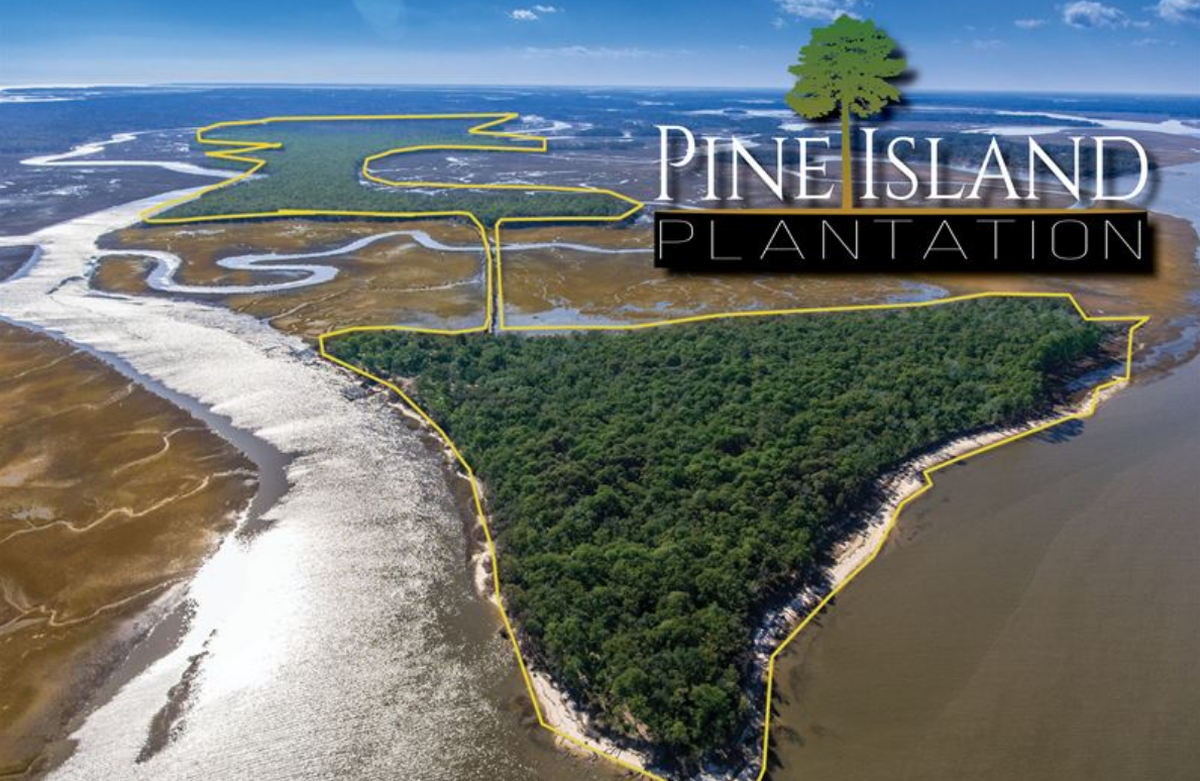
But critics countered the proposed changes would water down the rules and questioned the timing since a developer is already proposing to build homes and a golf course on the water’s edge of what is known as Pine Island Plantation. They worry that an exception to the CPO will lead to more development on the rural island.
“If we let it go, it’s gone,” Tim Joy of Beaufort, an environmental advocate with Citizens Climate Lobby, said of St. Helena Island and its unique ecology and culture. “It’s never coming back.”
On Nov. 2, Elvio Tropeano of Boston, on behalf of Pine Island GC, LLC, applied for a zoning map amendment that would allow housing construction and an 18-hole course in what is described as a “world-class legacy development” on the 479-acre Pine Island Plantation including the 77-acre Pine Island and a larger parcel called St. Helenaville — two parcels that are on the National Register of Historic Places and owned by the Hannah family. It’s one of the last large undeveloped tracts of land on St. Helena Island.
Gated communities, golf courses over eight holes and resorts are prohibited in the CPO.
The amendment, if approved by the full council, would exempt the 479 acres from the CPO and permit construction of an additional 10 holes of golf beyond the eight holes that already would be permitted under the rules. The land, the developer argues, has been continuously used as a private recreation destination and investment property since the late 1800s.
County says it’s trying to avoid legal challenges
Tropeano’s request for the zoning map amendment was actually not on Thursday’s Planning Commission agenda, even though the Commission chambers were so full with opponents of that project that they had to stand outside in the hallway or sit in another room and watch the proceedings on television.
It was the county’s proposed change to the CPO that was up for discussion, but Greenway insisted it had nothing to do with the Pine Island project. Updating language of zoning rules, he said, is standard practice as issues arise.
“While everybody thinks this is related to the Pine Island issue,” Greenway said, “this is not being driven by the Pine Island request.”
The current CPO, Greenway said, has loopholes that could prompt legal challenges, which prompted the proposed change.
And if the county loses those challenges, Greenway added, it could end up leading to the entire CPO being found invalid for the 64-square-mile area currently under its protections. As an example, Greenway pointed to the ban on golf courses over eight holes. If it is OK to have an eight-hole course, he noted, why would adding one more hole have a negative impact?
“A court may say that’s an arbitrary requirement,” Greenway said. The CPO also outright prohibits some uses — such as gated communities — but allows other uses, such as shopping centers, Greenway noted.
Chuck Atkinson, an assistant county administrator who heads the Development & Recreation Division, said “there’s a hole in the boat” and the county is trying to fix it. The requirement for development agreements, he added, would allow better vetting of proposals and more public input.
Planning Commission members rejected the arguments for changing the CPO. Tinkering with it, Kevin Hennelly said, would only lead to problems.
“That law as written,” Hennelly said, “has stood for 20 years.”
And some Planning Commission members criticized county staff for not including a committee that’s recently been formed to study the future of the CPO. When he found out about the proposed text amendment, Chairman Ed Pappas said, “I wondered, ‘What’s going on?’”
“It feels like, to me, you’re threatening people with a lawsuit to the county,” added Cecily McMillan, another commission member.
Brittany Ward, a deputy county attorney, said the proposed change was not meant as a threat. A lawsuit, she added, could be filed by a developer.
Members of Gullah-Geechee community speak
Some 60 people filled out forms to testify. Not every one of those people spoke but many did, often with passion about protecting St. Helena Island and preserving its way of life and the Gullah-Geechee culture.
Faith Rivers James, the head of the Coastal Conservation League, one of the state’s leading conservation organizations, urged the council to reject the text changes, arguing that allowing an 18-hole golf course in an area with high archaeological value in the heart of the Gullah-Geechee corridor would “drive a dagger” in the culture the CPO is supposed to protect. The proposal, she said, could expose up to 5,000 acres of land on the island to resorts and gentrification.
Others argued if the county is concerned about the language about golf courses larger than eight holes it should just ban them all together.
Sharon Holmes, a life-long resident of St. Helena, said that she had no idea about the proposed development until Thursday and said the proposed changes seem to her as if they were being made for a developer, not the entire county or the protection of the Gullah people. In regard to possible legal challenges to the CPO in the future, council members, Holmes said, the county should not “always jump.”
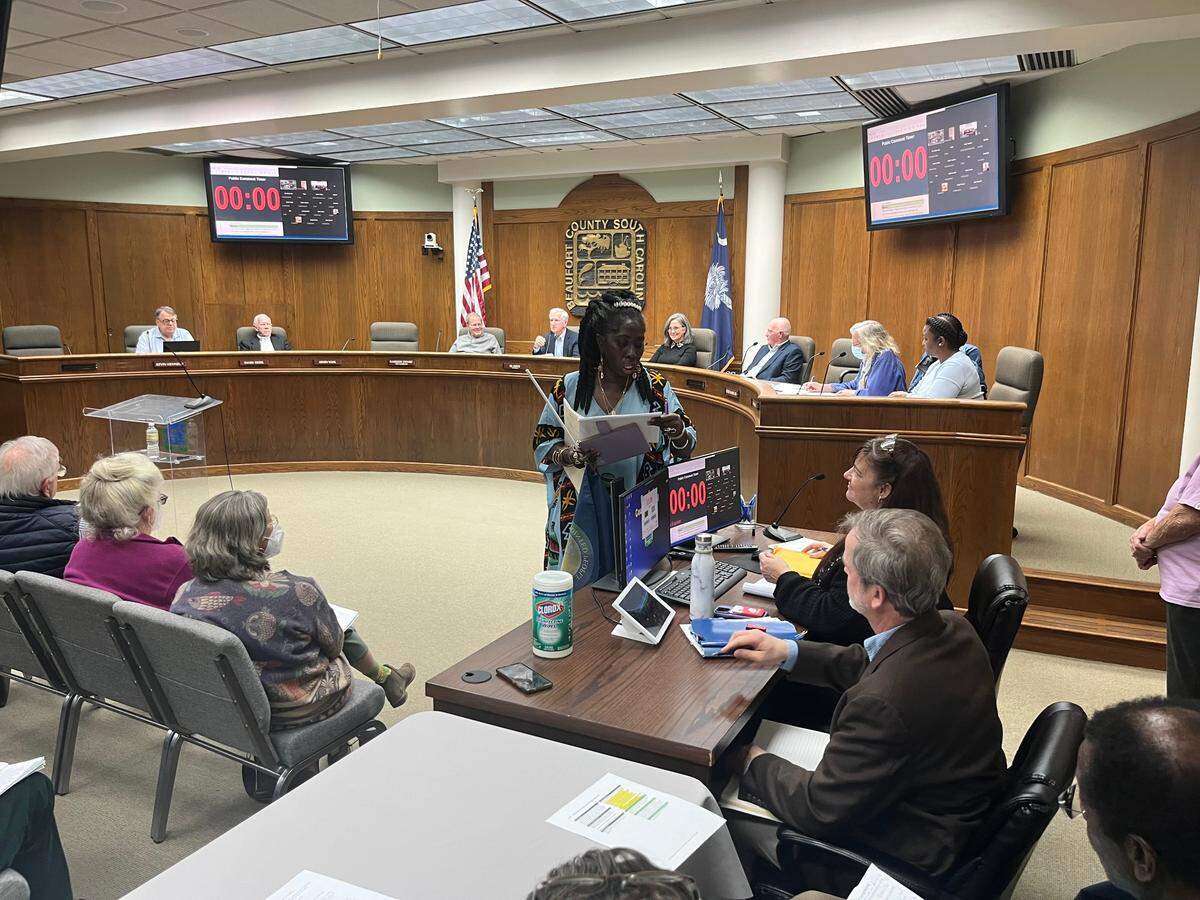
“I am a Gullah-Geechee,” Holmes said as she concluded, before changing to the Gullah native language. “I bin-yah (I’ve been here). And I guh stay yah (I’m going to stay here).”
Chief Se’ Khu Hadjo Gentle of the Yamassee Indian Tribe, traveled from Allendale, S.C., to attend the meeting.
“This land is originally my people’s land,” the chief said.
The heritage of the Gullah-Geechee, Gentle added, “is our heritage as well but we’ve been forgotten.” He urged the county to preserve what’s left of his people’s land, including archaeological resources.
Some people who spoke suggested that some of the $100 million in additional taxes that voters OK’d in November for a green space program be used to acquire the Pine Island Plantation property.
“Let’s buy Pine Island and let’s give it to the lineages of St. Helenaville and Pine Island,” said William Smith, a member of the Beaufort County School Board. “And let’s not just buy it and preserve it, let’s find the lineages of this land and allow them to use it.”
“Lets stop pimping the Gullah culture, the African American people,” Smith added, “and putting our money where our mouth is and actually get things done.”
Chairman Pappas recommended the issue of any changes to the CPO proposed by the staff be referred to the committee that’s been created to study land protections.
This story was originally published January 6, 2023 at 3:41 PM with the headline "Panel rejects changes to St. Helena Island protections after vocal residents turn out."