
Trump is safe after a deadly shooting at a campaign rally, but the nation is not | Opinion
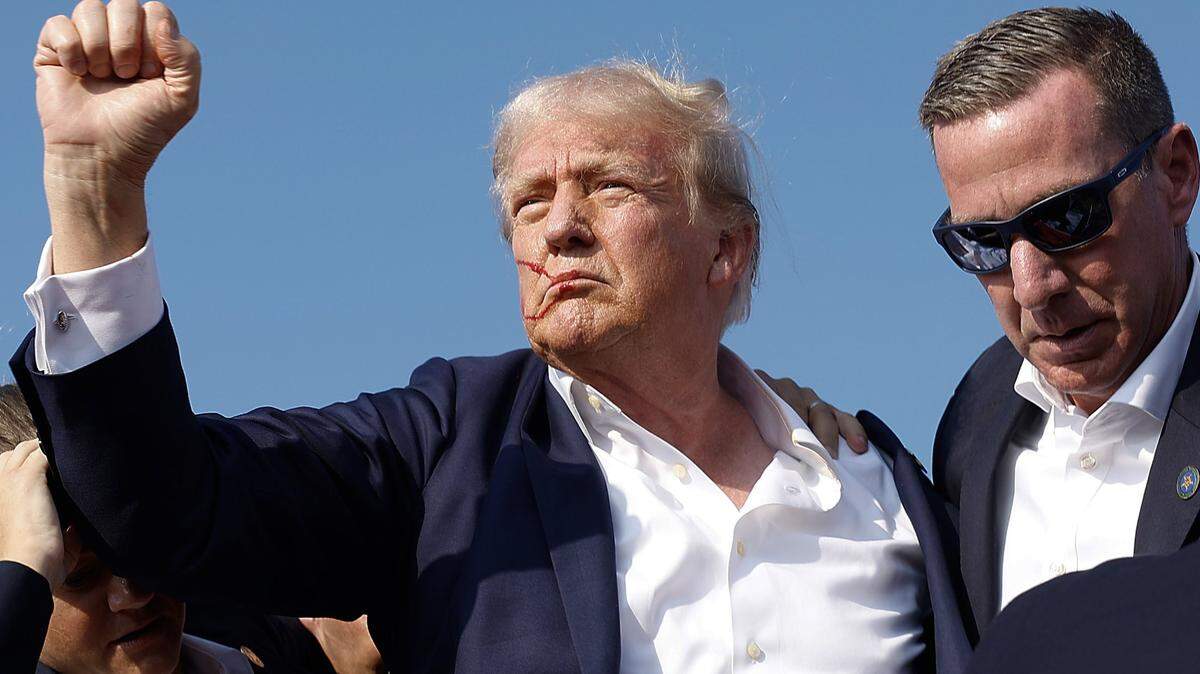
Political violence has no place anywhere in the world. It is horrible. It is dangerous. It is all too often deadly, as it was in the U.S. Saturday. It is an attack on us all, on the American way of life. No one should commit or condone it.
Everyone should condemn it.
Yet it is also nothing new in the United States. Our nation was born in blood when its founders overthrew the British government by killing thousands of its soldiers. Worse than war, four of our 45 presidents have been assassinated, most recently in 1963. President Ronald Reagan was shot in 1981. Candidate Robert F. Kennedy was shot and killed in 1968. Candidate George Wallace was shot and paralyzed from the waist down in 1972. Candidate and former President Theodore Roosevelt was shot in 1912 but removed a bullet-ridden, 50-page speech from his bloodstained shirt and gave a shorter version.
But that’s all history. It happened in older generations or to our ancestors who have long since left this earthly stage. It happened in less sophisticated societies when security measures were not what they are now, in slower news cycles, which gave Americans more time to think or take a breath, more time to comprehend and assess the crossroads the violence created for our country.
Yet here we are: Former President Donald Trump was shot Saturday night as he addressed a crowd, days before the Republican National Convention in Milwaukee, and during a breathless two-week stretch since a presidential debate escalated red-hot political rhetoric
What happened at Trump’s rally in Pennsylvania was horrifying: a bullet he said pierced his upper right ear, inches from his brain; bullets that killed one spectator and wounded at least two others; return fire from Secret Service agents that killed the shooter.
What makes the apparent attempted assassination so horribly different than historic cases is that Americans watched it unfold live or in its entirety soon after, heard the gunfire and the screams, saw Trump bloodied, raise a fist and seem to say, “Fight,” surrounded by the Secret Service, as the crowd erupted in chants of “U.S.A., U.S.A..”
The video will play on a loop in our minds for a long time. The shock will last longer.
The Secret Service responded very quickly on Saturday. They instantly protected the former president, earning acclaim from Trump, other politicians and everyday Americans. They rushed him to his motorcade and got Trump safely to a medical facility, where he thankfully pronounced himself OK and could surely feel people’s prayers.
In a statement, Trump said, “It is incredible that such an act can take place in this Country.” He extended his condolences to the families of the person killed and to those wounded, and closed with a message in all caps: “GOD BLESS AMERICA!”
Now federal authorities and others will look into the background of the shooter, try to figure out what happened and how it was allowed to happen, pay tribute to the victims.
Now we are left to process the imagery and the import in real time, and to wonder what it means for our deeply divided nation, for the vitriolic tenor and tone of our politics, for the safety of our highest leaders, for the future of their campaigns. Will they become more subdued or super-charged? Will more violence be attempted? Will America rise to the challenge? Will new security measures work? Will collective fears somehow ease?
Are we a sick country? A country in chaos? Can patriots — Republicans, Democrats, third-party people and independents — show that we are the United States of America?
And what role do our nation’s journalists play in all this? Are we ready for this moment?
The road ahead is fraught, unclear, bumpy to say the least. But there is an opportunity for leaders and followers to lower the temperature of their rhetoric and their rooms, every room, newsrooms, across the country. Maybe that’s naive. But the moment is at hand, and we will experience it all together, with the phones that can connect us and the news diets that divide us. What’s certain is we will no longer be huddled in front of three TV anchors as the nation was when John F. Kennedy was killed in 1963, or glued to respected cable TV channels and newspapers as when Reagan was shot in 1981.
On Nov. 22, 1963, UPI White House reporter Merriman Smith was in the front seat of the wire service pool car, six cars behind Kennedy’s vehicle. When he heard the gunfire, he grabbed the car’s phone and began dictating to the Dallas bureau.
When more details emerged, Smith’s subsequent teletype flash shocked a nation that didn’t yet have all the facts: “Kennedy seriously wounded.”
On March 30, 1981, CNN anchor Bob Cain in Atlanta interrupted a taped report about education in China to say, “Shots reported fired outside the hotel where President Reagan spoke a short while ago,” and introduced Bernard Shaw in Washington.
“Bob, as you can understand, details are very sketchy,” Shaw said. “We don’t know precisely what happened.”
That’s how slowly and carefully news spread at those times as the nation drew together. Now, it’s almost always quick and hot takes on social media and empty time on cable TV and unread newspapers.
In South Carolina, not long after the shooting, all nine members of Congress offered prayers for Trump on X. Some offered prayers for others at his rally or America. Only Rep. Jim Clyburn and Rep. Joe Wilson condemned political violence. Clyburn wrote, “There is no room for violence of any kind in this country,” and Wilson wrote, “Violence is never acceptable,” four words that everyone should be saying.
A little over an hour later, President Joe Biden addressed the nation, saying just that, “There is no place in America for this kind of violence. We cannot allow for this to be happening, We cannot be like this.” Asked if he thought this was an assassination attempt on Trump, Biden said: “I have an opinion, but I don’t have any facts so I want to make sure we have all the facts before I make some comment, any more comments.”
It’s the right message to send the country as it sits on a razor’s edge.
Let’s all share what we know and not uninformed or incorrect statements or, worse, hostility. Let’s all remember what we learned in kindergarten: Violence is unacceptable. Let’s all condemn all kinds of violence, especially political violence, today, tomorrow, forever and ever.
This story was originally published July 13, 2024 at 11:54 PM.