
A closer look at USC’s Desegregation Monument shows just how impressive it is | Opinion
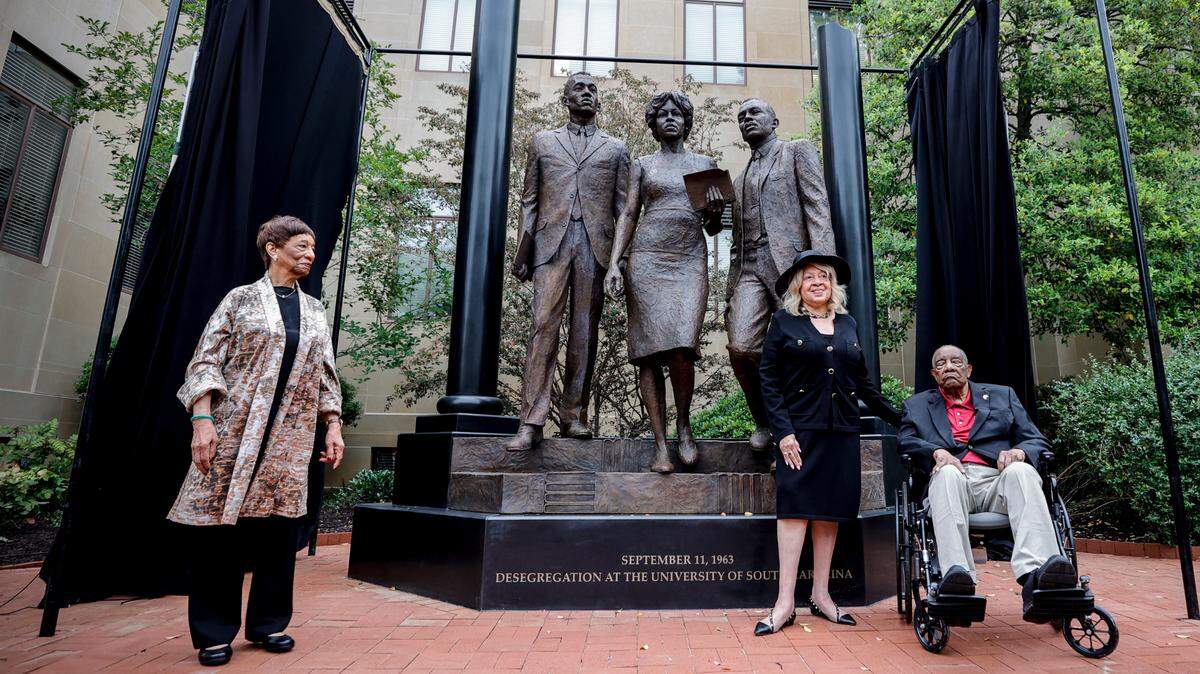
This month, South Carolinians celebrated the anniversary of the desegregation of the University of South Carolina. In September 1963, Robert Anderson, James Solomon Jr. and Henrie Monteith refused anything but full admission to the university, and they became the first Black students to enroll since the end of Reconstruction in 1877. To ensure everyone recognizes their story, the university placed a desegregation monument featuring statues of the students next to the Visitor Center in the heart of the Horseshoe in April.
As someone who has just started as university historian, I think what’s most impressive about the monument is its hieratic scale. That’s not a common term, so let me quickly explain. Hieratic scale refers to the proportion of the main features in a work of art. What is most important to the artist is biggest and tallest, and what matters less will be smaller and shorter.
I learned about hieratic scale from James Loewen, a sociologist who scoured the United States documenting public monuments. Loewen found that many sculptors interpreted history based on their use of hieratic scale. For example, the Theodore Roosevelt Equestrian Statue that once stood outside the Museum of Natural History in New York City, had a hieratic scale that elevated Roosevelt and diminished the two figures by his side. Loewen would say that its hieratic scale was off-balance and unjust because it symbolized unequal power.
Thankfully, the same cannot be said for USC’s Desegregation Monument. Crafted by the world-renowned sculptor Basil Watson, the monument is balanced, just and a symbol of equality. Watson based his carving of Anderson, Solomon and Monteith on a well-known photograph that captured the three students descending the steps of the Osborne Administration Building on Sept. 11, 1963.
But Watson could have displayed the three trailblazers in any number of ways. He chose to represent them with an equivalent hieratic scale.
So what? What does it matter how Anderson, Solomon and Monteith stand next to each other in a monument? Why is it important that their posture is straight, their heads are uplifted and their stride is carrying them forward?
Consider another historic photograph from that same day. We see Monteith and Anderson registering for courses — the exact moment when USC desegregated.
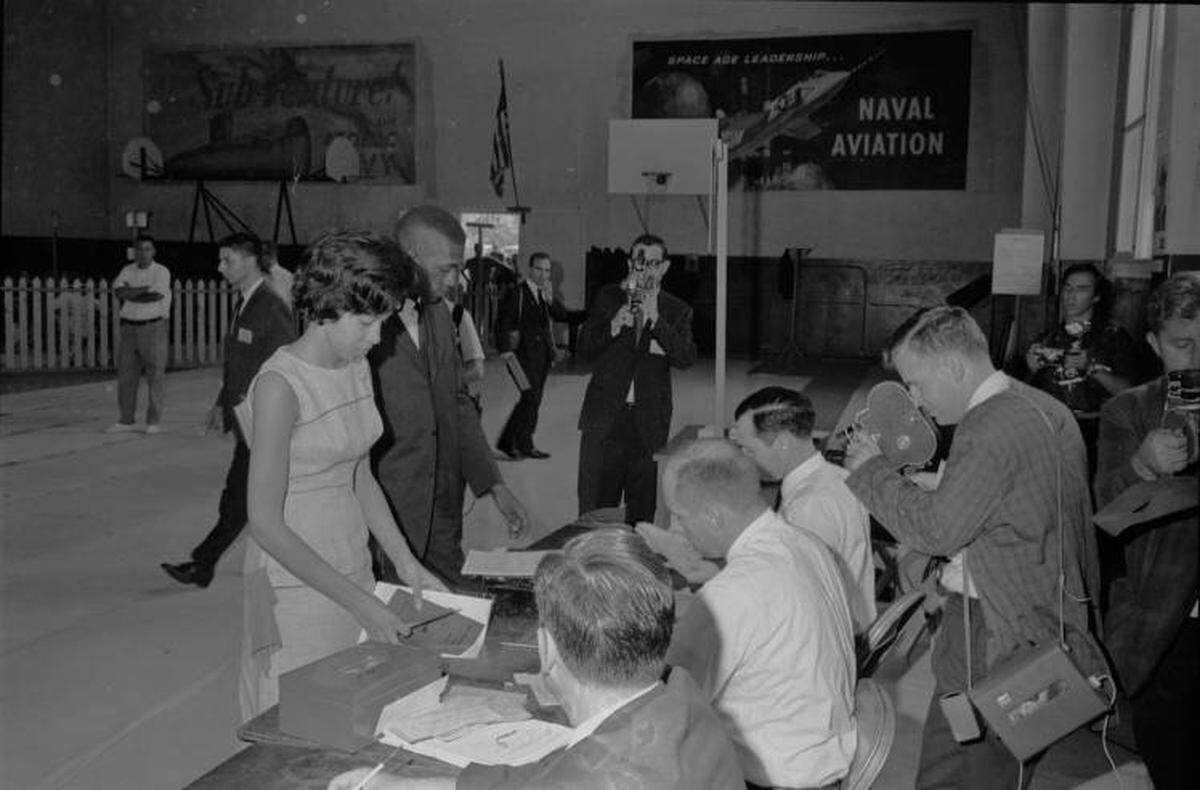
Why was this image not instead translated into a monument? Because while the photograph captured an important moment in time, its hieratic scale would have been off. Monteith and Anderson are looking down. Three white men look over their records, while at least another four white men with cameras document the moment. When we look at the image, we can almost see the calm confidence inside Monteith and Anderson. But it wouldn’t do as a monument.
Basil Watson’s Desegregation Monument works because its hieratic scale works. The three subjects are equal, balanced, moving ahead. They have just broken down a racial barrier that existed for over eight decades. They aren’t smiling in the statue, even though they appear to be in the photograph on which it is based. But that’s another deliberate choice by the artist. A monument isn’t a carbon copy of the past. It’s a lesson for today.
If you look closely at the statue, you’ll see something unusual. Within the steps, stacks of books are literally built into the path. The artist is sculpting the past to shape the future. “The three Black students look and step ahead as they enter the institution,” Watson said, “which is built on the foundation of knowledge, and this is represented by the books in the steps.”
“When we invest in art,” Watson told The Daily Gamecock at the unveiling, “it is an investment in the promotion of our values and the opening of minds, especially the minds of our young.”
Monuments are about more than just representing a historic event. They depict the past, but they are really about the present. Hieratic scale, if done right like with the Desegregation Monument, teaches us right from wrong.