
GOP strategist: Here’s how Trump’s tariffs actually undermine capitalism
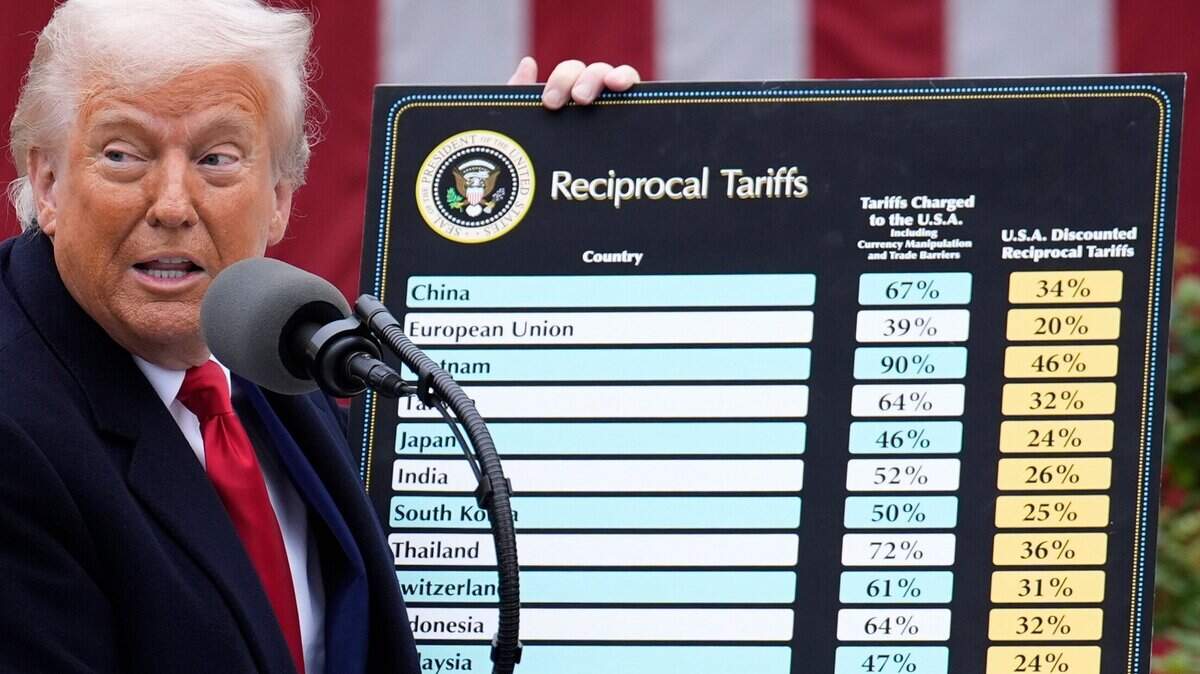
Depending on your point of view, Trump’s tariff turmoil was either a carefully laid trap set for China or a self-inflicted economic mess with no clear exit plan. It was either a masterclass in “The Art of the Deal” or a reckless act of market manipulation bordering on insider trading. A brilliant display of 4-D chess or a chaotic game of 52-card pickup.
One thing, though, is undeniable: Trump’s tariff policy proves that he “could stand in the middle of Fifth Avenue and shoot somebody” and not lose support from the Republican base. In this case, the victim wasn’t a person — it was America’s commitment to the free market.
Trump’s tariff policy, announced on what he called “Liberation Day,” contradicts the bedrock principle conservatives have long held: that America is the land of opportunity, where prosperity is earned through hard work, innovation and free enterprise — not government interference.
Yet when Trump imposed sweeping tariffs, many Republicans — not just die-hard MAGA loyalists — stood behind him. To them, the past week wasn’t about fears of global economic fallout or a looming recession. It was political theater — a chance to watch the media and the left melt down, failing to understand that it was all part of a calculated, high-stakes master plan.
That’s why many Republicans didn’t see their support for tariffs as an abandonment of conservative, free-market principles. In their minds, it wasn’t a betrayal — it was a brief, tactical detour on the road to the golden age of America.
But in taking that detour — and placing their trust in Donald Trump above all else — they risked eroding the very foundation of free-market conservatism.
The irony is hard to miss. Ronald Reagan quipped that the nine most terrifying words in the English language were: “I’m from the government, and I’m here to help.” Today, the healthy skepticism of government power has been replaced by a troubling loyalty to a personality.
To their credit, there were a handful of Republicans that began to show signs of having a backbone. Legislation was introduced to curb Trump’s tariff powers. Some spoke out. Some pushed back against the erosion of long-standing conservative principles.
But instead of being applauded for trying to reassert Congress’s role as a coequal branch of government, they were attacked. They were ridiculously branded as RINOs, targeted for primary challenges, and treated as traitors for daring to put the Constitution and their convictions above personal allegiance to Trump.
There’s no denying that tariffs can be effective as a negotiating tactic. And while more than 70 countries are said to have reached out to the White House to negotiate, let’s be honest: When you impose something as economically reckless and anti-free trade as sweeping tariffs on the global economy, of course a lot of countries are going to reach out. That shouldn’t surprise anyone, and it certainly shouldn’t be spun as proof that Trump’s gamble worked.
In many ways, Trump’s tariffs and the approach that the Department of Government Efficiency (DOGE) has taken to addressing a bloated government go hand in hand. Both are sledgehammer strategies — loud, chaotic and disruptive. They generate more confusion than clarity, more spectacle than substance. The chaos doesn’t give the American people a better understanding of what’s happening. The chaos obscures it. And both approaches undermine the stability, predictability and reliability any healthy government needs to function effectively and maintain public trust. Honestly, I’m not sure how any of this makes America great again.
The simple truth is this: Tariffs are a massive tax on the American people.
As a long-term economic policy, they are a tool of socialism — replacing innovation and competition with central planning and political favoritism. Tariffs don’t strengthen capitalism, they undermine it. And the longer Republicans in power pretend otherwise, the further Republicans drift from core conservative principles.
Right now, it feels like the only thing that was truly liberated on “Liberation Day” was our common sense.
This story was originally published April 11, 2025 at 6:00 AM.