
What USC students and Columbia residents can learn from Jane Goodall | Opinion
Jane Goodall, an English anthropologist specializing in living with and studying chimpanzees and other great apes, passed away on Oct. 1 at the age of 91.
She encouraged everyone to support the environment and all the animals and other creatures living on Earth. She taught us that chimpanzees and humans have nearly identical chromosomes. That we are family.
Chimps learn from one another how to use tools, have healthy babies, and care for and teach their children. They know how to take care of one another with minimal disruptions, have food and places to live, and have good relationships with their families and others in their community.
Sometimes, like us, they do get upset with one another. It’s in the genes.
Unlike many humans, chimps learn to work together for the benefit of their society.
This is in contrast to what we see today among our fellow chaotic human societies around the world where the objective is to drop bombs on people and places in cities or countries, on land or at sea, or to ban and rid society of people they do not like or who do not look like them.
There is one major difference between us and chimps. Chimpanzees do not want, have or use cellphones.
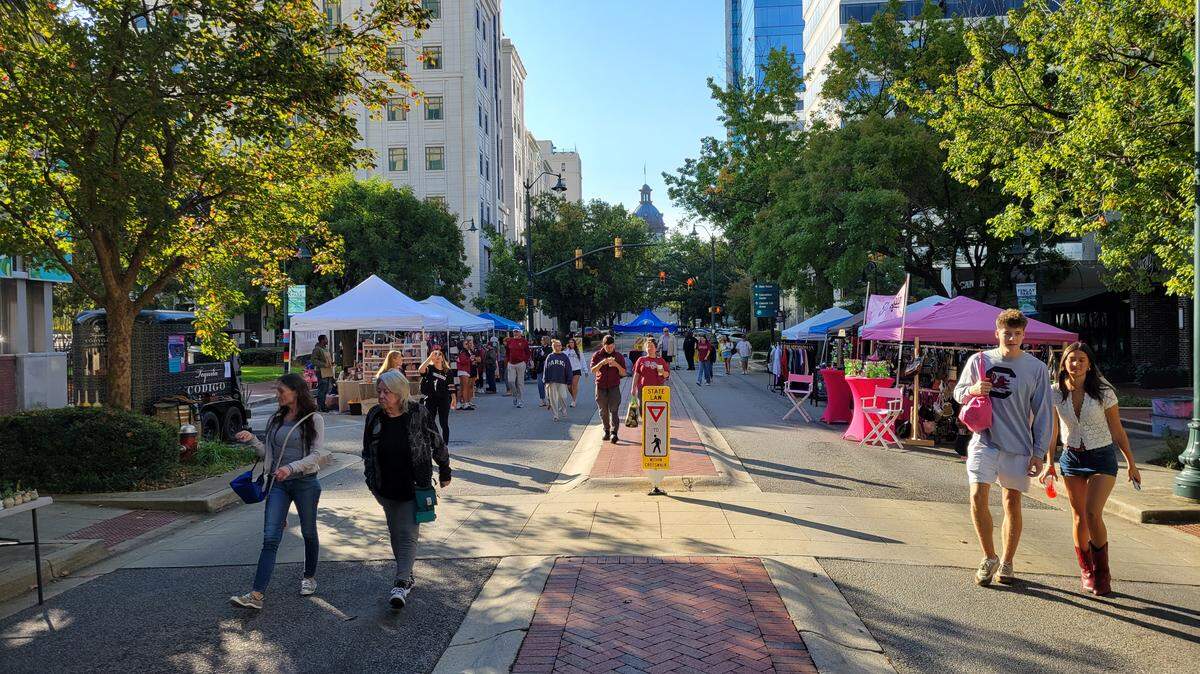
Anyone on or near the University of South Carolina Columbia campus will see students with their backpacks walking slowly while holding and looking down at a cellphone, wearing earbuds or headsets, oblivious and unresponsive to other humans and social life surrounding them, unaware of passersby or vehicles when crossing a street.
Public school students in South Carolina K-12 are not allowed to use cellphones during the school day, which encourages them to listen to teachers and one another. This teaches them how to live, work, and play with friends, family, and people in their neighborhoods.
They learn to improve their lives, consider the future, and live with others, creating peaceful surroundings. They learn to look up at the sky, see the trees around them, hear the birds sing, and pet dogs and cats along the way.
We have what is called “social media” on the internet, intended, some say, to allow friends and families to have conversations online when they are not together in person.
But social media are also used to post messages to make false accusations or just say, in written words or video, bad things about people, ideas, books and places.
Many people become addicted to social media and have few interactions with other humans. Some establish a warm relationship with an AI “human” voice and have no full social relationships with humans.
There are many opportunities for people in our society to isolate themselves.
Before long, cellphone service will be available everywhere on Earth on land or sea, and in outer space. Cellphones will work very well wherever we go.
What do we want to happen in the world and in our lives?
There should be many opportunities for everyone in any society to build and maintain social relationships at home and abroad.
In the 1950s, as a third-grader in Reinhardt Elementary School in Dallas, my classmates and I were given the names and addresses of children in European countries. We wrote letters to those children.
Then we had to go to the post office to see what the postage would cost. We carefully glued stamps to the envelope and mailed our letters. We waited. Later we received letters with news, comments and questions from these overseas students. And the envelopes had very interesting European postage stamps. We had to learn each other’s language to read the letters. Relationships began. More letters were written.
Over time, there were student visits between countries.
Rotary Clubs in Columbia, across in the U.S., and abroad participate in a program called Rotary Youth Exchange. Our Columbia clubs send US students 15 to 19 years of age to a foreign city and welcome foreign students to Columbia for up to a full academic year.
In South Carolina, a group of us funded a program to send our girls’ soccer teams to play in Europe and have girls’ soccer teams from Europe come to play our South Carolina girls’ soccer teams.
My wife Kathy and I recently traveled to Hamburg, Germany to visit one of these German soccer players and her family. The soccer player, Lena, was 15 years old when she played on the German girls’ soccer team in Columbia. A few years later, Lena returned to Columbia to attend graduate school in the Institute of Mind and Body at the University of South Carolina. In Hamburg, Lena, now 35, helped us translate German conversations. She is now a psychologist with the German women’s soccer association.
Within Columbia and elsewhere in the United States, we all need to create and maintain relationships within our family, our neighborhood, our place of worship, our community, business offices, in education, and when we dine and shop to assure that we can build and maintain lasting relationships wherever we go.
Like the chimps, we must learn to work together, for the benefit of our society.
Surprise people on Main Street sidewalks by just saying hey or simply smile.
Emerson Smith is a Ph.D. sociologist with Metromark Research and a Clinical Research Assistant Professor of Internal Medicine at the University of South Carolina School of Medicine Columbia.