
SC State legend Sam Goodwin remembered as strong, faithful, inspirational to the end
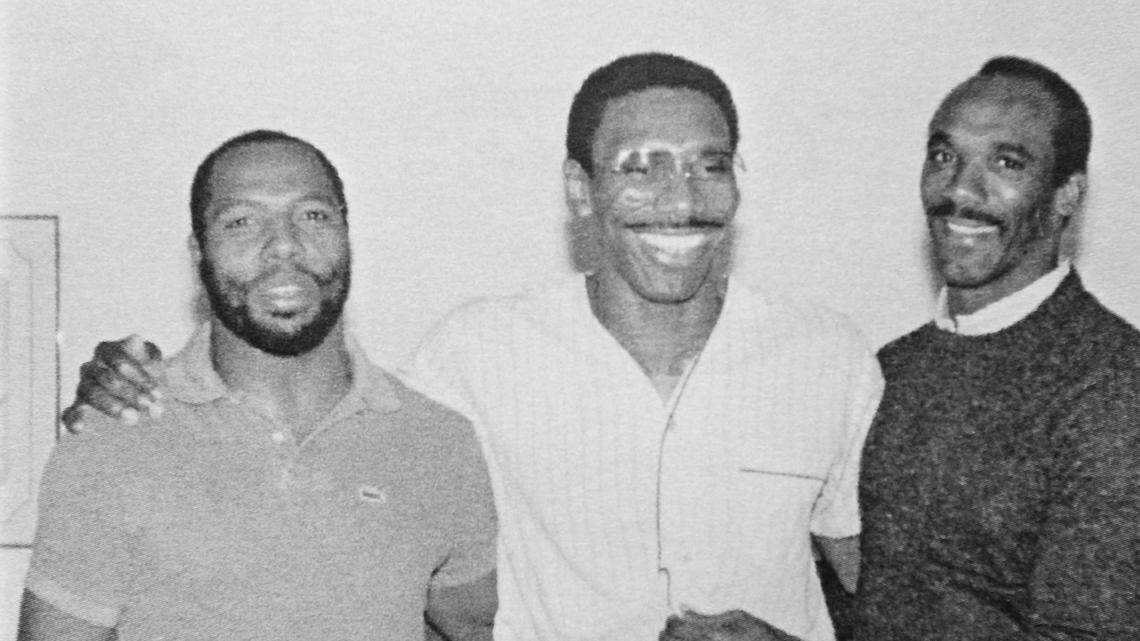
Harry Carson chuckled this week when asked to recount a favorite story about Sam Goodwin, his linebackers coach for three seasons at South Carolina State. Goodwin died early Wednesday after an extended illness.
To put his remembrance in perspective, consider: Carson, now 66, was an All-Mid-Eastern Athletic Conference star during his playing days (1972-75), then went on to a Hall of Fame career with the NFL’s New York Giants as a 6-foot-3, 237-pound wrecking ball of a linebacker.
This is not someone used to being overshadowed in the physicality department. Yet talking about Goodwin, Carson says that, in the 1970s, he sometimes felt ... well, a bit outclassed.
“I remember clearly walking across campus at South Carolina State,” he said, “and when I was walking with him, people thought I was the coach and he was the player.” Carson laughed. “He took great pride in that.”
Indeed. When your nickname since high school has been “Herc” — short for Hercules — much of your self-identity is about being big, strong and, above all else, muscular. And Sam Goodwin was all that, even into his mid-70s (he was 76 at his death) — but that description extended to much more than any physical gifts.
For nearly two decades, Goodwin was a football coach, one of the best produced by South Carolina: head coach of a state-championship team at Booker T. Washington High (1968, in the pre-integration era); linebackers coach and (of course) strength coach during S.C. State’s 1973-78 heyday, when the Bulldogs under legendary head coach Willie Jeffries were 50-13-4 and played in four straight bowl games; and an assistant coach at Wichita State and USC from 1979-82.
Before becoming a coach, Goodwin was a three-time all-conference player for S.C. State (1962-64), who, legend has it, dispatched several teammates to the infirmary during brutal practices — and who also excelled in basketball, playing at the high school and college level. In 2018, Goodwin was elected to the South Carolina Athletic Hall of Fame, as an athlete rather than as a coach.
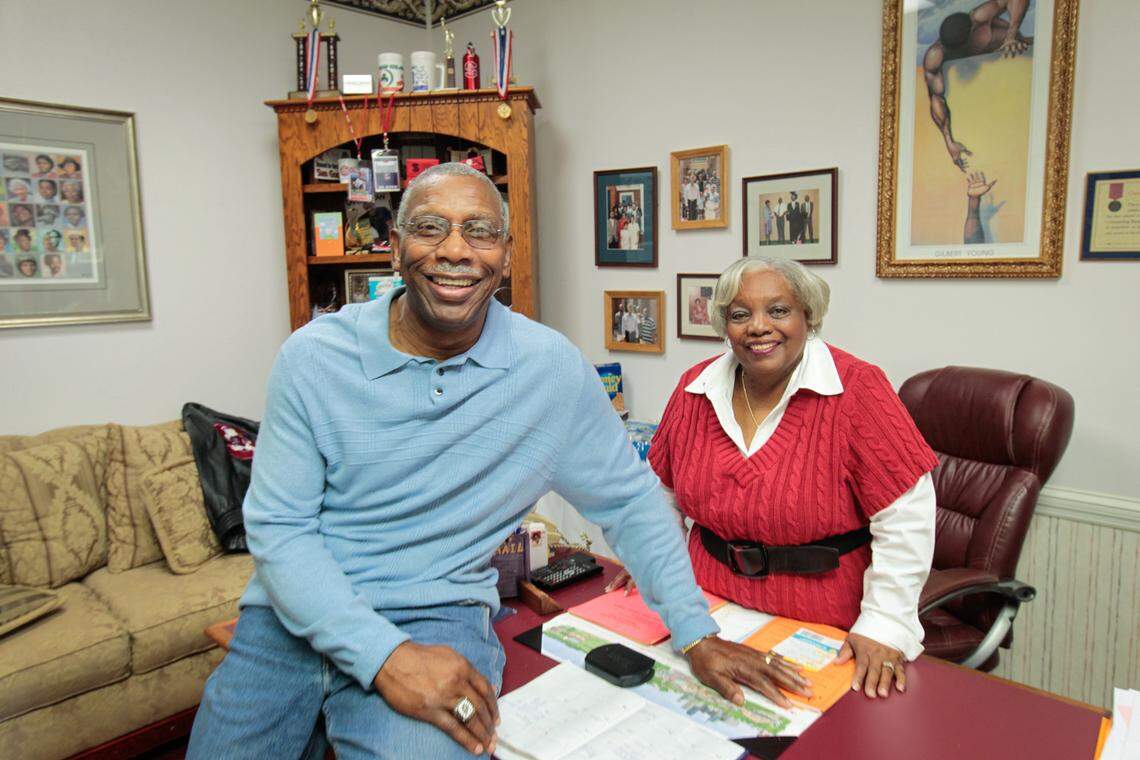
Yet for longer than all that time — for 37 years, from 1983 until his death — he was founder and pastor of Stedfast Christian Center on Fairfield Road in north Columbia. There, he practiced a form of “muscular Christianity” that enforced his faith and entranced and inspired his congregations.
Though his wife, Fannie, said in 2013 that he had mellowed over the years, standards remained. “If you’re ushering for First Sunday, you wear a suit, or a dress,” Goodwin, a noted sharp dresser, said then. “If you don’t, you don’t usher.”
He was a stickler for punctuality, too. Worshipers who arrived even minutes late for services had to wait to be seated. Cassandra Elliott, a retired speech pathologist, church board member and family friend, said in 2013, “There’s a level of accountability at Stedfast you have to get used to, and some can’t do it.”
That “accountability” began with the man at the pulpit. Despite battling various forms of cancer since 2008, Goodwin was almost always at his post each Sunday. He was not superhuman; he and wife Fannie and daughter Valerie admitted to his bouts with depression and self-doubt during chemo treatments — but ultimately, he always bounced back, until this final time.
Goodwin set high standard
None of that came as a surprise to me, having known “Herc” for more than 40 years.
In 1976, my first year as sports editor at Orangeburg’s Times & Democrat newspaper, I covered Jeffries’ third S.C. State team and arguably his best. The Bulldogs went 10-1, losing only to arch-rival North Carolina A&T, 15-14, on controversial officials’ calls. (S.C. State would avenge that in 1977, beating A&T 52-0.) The ’76 team posted six shutouts and allowed just 12 points in their final eight regular-season games.
Those Bulldogs’ calling card was a hammering, physical defense. And the man Jeffries said then and now was most responsible for that was Goodwin. Away from the field, he was engaging, friendly and loved to laugh — but with football, it was all business.
“We played a game vs. Alcorn State (in 1974), and they were tough, tough, tough,” Jeffries said. “Back then, the MEAC didn’t quite measure up to the SWAC (Southwestern Athletic Conference). They beat us 14-0, and afterward Sam said they had pushed us off the ball. He said, ‘Coach, that will never happen again.’
“He got the weight room squared away, worked (players) through stations after practice, and those players would tell you they could make it anywhere after his workouts. The next year when we played Alcorn, it was 7-7; (in 1976) we won 7-6.”
In S.C. State’s last two seasons with Goodwin in charge of conditioning, the Bulldogs dominated Alcorn, 31-7 and 16-0.
“(Goodwin) made it possible for the success of all those teams in the 1970s,” Carson said. “Coach Jeffries brought a different mindset to the team in terms of aggressive play, but Sam was the guy pulling the strings, making sure everyone was in shape.”
Those Goodwin-conditioned defenses produced a string of All-Americans — Carson, Donnie Shell, Robert Simms, Leonard Duncan, Phillip Murphy — and future NFL players (those five plus Rufus Bess, Dexter Clinkscales, Angelo King and more).
“Any player who played for Sam Goodwin would say when they went into a game, they never got tired,” Carson said. “He was the guy making sure we all were physically fit to get on the field and play to a certain level.”
Goodwin held himself to that standard, too, even long after his playing and coaching days were done. Dressed in a suit and tie on Sundays, his physical conditioning was apparent to anyone. One of the worst parts about cancer, he said in 2013, was not being able to maintain the levels of his weight-lifting workouts. At one point, he said he was “only” able to lift 135 pounds, which he compared to lifting a notebook.
And woe be to any Bulldog alum, even years after his playing days, who’d let himself go conditioning-wise. “Every (former) player knew if you walked up to Sam, he’d take a look at you, analyze your appearance, and dump on you if you weren’t in good shape — in a tactful way,” Carson said.
“He’d say, ‘Hey cat, what’s up with the gut?’ He’d needle you in a fun and respectful way, but it would resonate with you: ‘Man, I need to get back in the gym.’”
That, in a nutshell, was Sam “Herc” Goodwin: a man for whom strength meant muscles ... and message.