USC, Clemson games with social-distancing rules? Crowd size, and more, to be affected
The questions around college sports and the coronavirus pandemic spiral outward.
Will there be games? When will there be games? And will there be fans in the stands when such games actually happen?
South Carolina’s Williams-Brice Stadium sits empty at the moment, even as construction that began in December changes some seating arrangements. Clemson’s Memorial Stadium is mostly quiet, save for some routine maintenance.
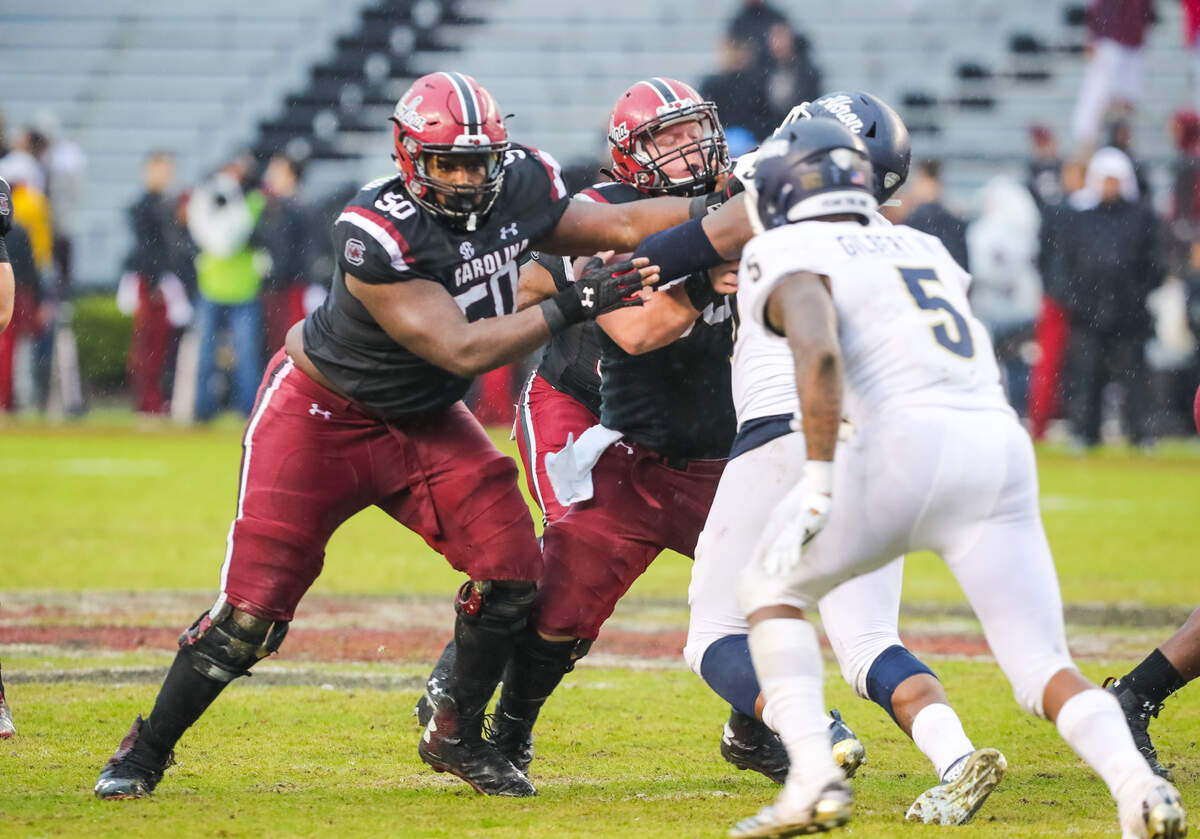
If these venues that can fit more than 80,000 have games this year with fans in attendance, a key question emerges: In a world where social-distancing regulations could be in place for some time, what does attending a college football game in the Palmetto State look like in 2020?
If current estimates hold true of stadiums running at 15% to 35% capacity to address safety concerns, that means anywhere from 12,000 to about 30,000 fans cheering at Gamecocks and Tigers home games this fall. And how colleges determine who gets in and how to allocate those tickets are anyone’s guess.
“It’s not a fun situation for athletic departments or any sports team to be in,” said Steve Stonehouse, head of U.S. markets for 3D Digital Venue, a company that specializes in helping venues maximize ticket revenue. “This whole situation is a giant onion that, as you peel back the layers, you reveal first of all many layers and you reveal a really smelly, rotten core. There’s no good conversation that comes out of this topic. Everywhere you look at it, it’s bad.”
In the current environment, 3D Digital Venue is helping create seating efficiency plans under various social-distancing scenarios.
A plan for a socially-distanced football stadium is one of the many issues that colleges such as South Carolina and Clemson are wrestling with behind the scenes. USC on Wednesday announced students can officially return to campus in the fall, a big first step to having a fall sports season. Clemson President Jim Clements has acknowledged a “goal of a return to on-campus learning and activities” for the fall but has not yet announced a formal plan.
USC President Robert Caslen, in a letter to students, faculty and staff, promised the school “will follow clear public health protocols, including social distancing within classrooms, lecture halls, meeting rooms and sports venues, with strong encouragement of proper social distancing off campus.”
The football discussion is critical because the sport’s revenue makes up the bulk of so many athletic departments’ budgets.
“The finances associated with college football as it relates to the remainder of the athletic program, it’s way out of balance,” Clemson AD Dan Radakovich told radio host Mark Packer in a recent Sirius XM interview. “So the ability to play college football is really important for the athletic department, the athletic program and then as an extension of the institutions as well.”
Colleges are bracing and planning for a disrupted football season that could include an altered game schedule. But there are still more questions than answers about how things will unfold, especially as it relates to plans for spectators.
“It is likely that social distancing will be in place at Williams-Brice and our other venues,” Gamecocks AD Ray Tanner said Wednesday night in a university town hall. “We are running models currently to determine what kind of attendance we could have.”
Groups spaced 6 feet apart?
To find the fewest fans to pack Williams-Brice Stadium in recent memory, one only has to go back to early December of 2018.
A game against Akron was held to replace another game lost to a hurricane. It had only been announced a month before, and things had to be put in place without the usual long run of scheduling and planning.
To boot, it was a cold and rainy afternoon, and only 20,548 tickets were scanned in (with an announced attendance of 53,420). That stadium and Clemson’s have also held high school state championship games, which also could give a picture of more sparse crowds, albeit less densely packed.
“We have to be able to understand, given where you are within the country, how safe is that and where is that line drawn as to how we can do that in a way that keeps us socially distant or keeps us in a very protective manner, but allows us to have have the activities that we all certainly desire,” Radakovich said in the radio interview.
The NFL’s Miami Dolphins acknowledged in an interview on ABC’s “Good Morning America” show that the team’s Hard Rock Stadium (capacity 65,000) could max out at 15,000 for the 2020 season.
Tanner, in multiple radio interviews Thursday, suggested Williams-Brice Stadium could max out somewhere in the 15,000-capacity range. He also acknowledged that his early estimate “might not be accurate at the end of the day.”
Many teams are already consulting their own experts behind the scenes, breaking down how crowds might be distributed across stadiums to match health guidelines.
On the extreme end, all fans might have to sit 6 feet apart, which could mean stadiums at only 15% capacity. But in reality, pairs quarantining together or families of three or four could raise that percentage.
“It’s a moving target based on the variables that we received from our clients,” 3D Digital Venue’s Stonehouse said. “When you start building in these larger groups, you can get into the low to even to the mid-30s it, but it’s gonna depend on different factors.”
There are even small factors, he pointed out, such as if the 6-foot radius starts at the middle of a seat or person, rather than something like the edge of the seat. Perhaps using the middle of the seat to define distance makes fans feel less comfortable, and uncomfortable fans are less likely to attend.
Don Barnum is the lead architect with DLR Group’s global sports studio, which designs stadiums across the country. His company is also working with clients to answer the questions of what exactly crowds look like in a social-distancing world.
“It has a lot of variables, and those would revolve around, what are the recommendations going to be from the CDC?” Barnum said. “And then, what are the states and cities going to frankly implement out of that?”
His company has spoken to three or four colleges about options, he said. It was involved with a football stadium in Charlotte and baseball stadiums in both Carolinas.
The models are all built on a range of assumptions, and some of those keep changing, he said. Individual schools or teams might be talking to their conferences, leagues or even larger organizations, which might have their own regulations and guidelines.
What happens to such pregame traditions such as tailgating, as well as the Gamecock and Tiger walks, also remains an unknown.
“Right now we’re approximately four months away from kickoff so we still have a little bit of time to answer some questions,” Tanner said.
Dividing tickets, no-contact food service and more
The financial realities are such: College athletic departments need football to keep the machine going. That likely will be the case even if there’s a hit to ticket and concession revenue.
“We’re gonna go and keep moving as far as we can as fast as we can to make sure that we have this season,” Radakovich said in the radio interview. “We do want to get back to business as usual. We do want to have a campus that has students on it, has student-athletes, has activities and specifically athletic activities.”
At South Carolina, tickets and concessions accounted for at least $23 million of the $65.4 million the program brought in last season. That first number doesn’t account for the contributions associated with buying tickets, and the program’s contributions total (which includes some other sources) came in at $11.95 million.
Clemson extended its season-ticket deadline from April 1 to May 15 and changed the deadline from June 1 to June 30 for donations to IPTAY, the school’s athletic fundraising organization. The Tigers made more than $27 million a season ago off football tickets and concessions from a total football revenue intake of $62.6 million.
Barnum, with with DLR Group, pointed out the math could mean minor league teams, ones more reliant on ticket and concessions, could make decisions to not play. College or pro teams with television money factoring in for revenue could make different choices about fan policies.
The Gamecocks have already sold slightly over 47,000 season tickets, similar to last year’s numbers at this time on the calendar. This Friday (May 8) is the renewal deadline for ticket holders.
A greatly reduced stadium capacity leads to a series of sticky questions about season tickets and who exactly is let in for games.
College teams have different constituencies, various gradations of season-ticket holders — and then there are students, the band and visiting fans to consider. There also are wide variances in demand for certain college games: South Carolina’s tilt against Georgia or Clemson’s home game against the Gamecocks is much more of a draw than a date with an FCS or Sun Belt opponent.
“How does the university deal with that?” Barnum asked.
Not much is settled, Tanner acknowledged in his radio interviews. In a Thursday evening appearance with SportsTalkSC’s Phil Kornblut, Tanner suggested mid-July as a possible time when things might come into focus in regards to capacity and ticket distribution.
“We certainly haven’t made any decisions on how that happens,” he said. “Is it going to be from a booster standpoint, or your fans, your students, the band, faculty and staff? We haven’t engaged in that. We are prepared to move forward, but we haven’t done that yet. We’re just planning for a lot of different scenarios.”
Stonehouse guessed that some schools might subdivide tickets into smaller packages, perhaps with a lottery system to determine who gets to see which games.
The State was told that Clemson has had discussions about potential lottery systems, using IPTAY points acquired with donations or splitting season tickets into multiple packages.
And beyond the seating, social distancing could affect structural elements of how fans experience games.
Creating distance within a concourse is a high-level challenge. Concession lines, bathrooms and just getting to and from seats are all situations that have to be considered. In some cases, this might push forward certain technological aspects, where online food ordering might go from an amenity to a requirement.
“These are places where you can order food on your phone, and either go pick it up or have somebody bring it to you,” Barnum said. “So far the purpose of those was to get better, faster service.”
There’s also the question of, will seats within 6 feet of aisles be used? There could be requirements for mobile tickets only, and Barnum suggested fans might end up scanning their own tickets to get in.
There’s always a crowd as fans enter at a stadium’s gates. Stonehouse imagined sheets of plexiglass between lines to enter, with those lines spacing out farther away from the gate to follow distancing rules.
Barnum said tickets might have times on them so fans can enter in waves, and exiting might be done by row to minimize crowding when a game ends.
A person with knowledge of the situation told The State that Clemson is already looking into mobile-only ticketing and prepackaged food that can be ordered by app to limit person-to-person interaction. The school is also looking at acquiring a large number of face covers and setting up hand sanitizer dispensers throughout the stadium.
Could every fan who enters Memorial Stadium be given masks to wear over their face in order to attend a Clemson game? It’s possible, a person with knowledge of the situation said.
“Everyone’s gonna attack it a little a little bit differently,” Stonehouse said. “The fans are going to have to understand that things will be different. They won’t be able to necessarily buy tickets the same way. And everything will change. The primary market, the secondary ticketing market, everything will be different when it comes back, and they will need to adapt and, hopefully, do so pleasantly and without complaint.”
This story was originally published May 7, 2020 at 5:00 AM.