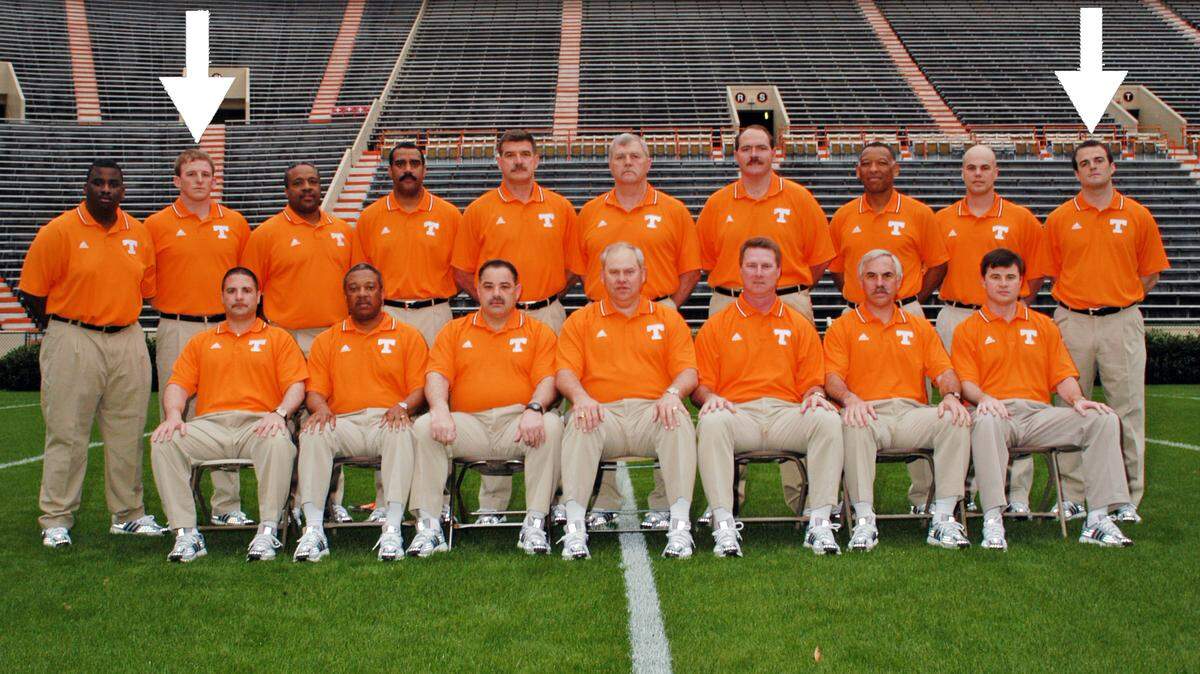
Shane Beamer (top row, far right) and Marcus Satterfield (top row, second from left) were on the same staff at Tennessee during the early 2000s. Beamer coached on defense, while Satterfield worked with the offense.
UT Athletics photo
John Chavis’ coffee order hasn’t changed much in 40 years of coaching.
The Dillon native isn’t a latte or cappuccino guy. A macchiato doesn’t cut it either. Chavis has his own java-fueled drink: “Creamy brown.”
The mixture for “creamy brown” isn’t complicated, Chavis says. It’s black coffee with enough cream that the dark brown color of the concoction flutters ever so slightly into that lighter, cream color. It amounts to two creams and three sugars.
South Carolina head coach Shane Beamer knows the order by heart.
“I’d say, ‘OK, it’s time for ‘creamy brown,’ ” Chavis recalled through a laugh.
Now in his first year in Columbia, Beamer’s past coaching stops span 21 years and seven different schools. After a stint at Georgia Tech, Phil Fulmer hired Beamer at Tennessee as a defensive graduate assistant in 2001 for his second college coaching job. Marcus Satterfield — now South Carolina’s offensive coordinator — joined Beamer in Knoxville one year later.
Seventeen-plus seasons on from their time at Tennessee, the pair return to Neyland Stadium on Saturday navigating South Carolina up the Tennessee River and onto Rocky Top for a crucial Southeastern Conference tilt.
Before that, though, Beamer, Satterfield and those in Knoxville during the early 2000s reflect on the late nights, regular coffee runs and intense golf matches that marked the inceptions of their coaching careers.
“I mean, you’re living in Knoxville, Tennessee — it’s a great college town,” Beamer told The State over the summer. “Satterfield and I weren’t married at the time, so it was a lot of playing golf and Kenny Chesney concerts at Neyland Stadium.”
Beamer and Satterfield land at Tennessee
Walking through the halls of the Tennessee football offices before the 2001 season, Volunteers administrative graduate assistant Brad Pendergrass spied a 24-year-old Beamer donning a suit and tie.
The son of legendary Virginia Tech coach Frank Beamer, Shane connected with Fulmer when he traveled with his father to the 1998 East-West Shrine Bowl. Shane still had one more season to play with the Hokies as a receiver and long snapper, but he had aspirations of a career in coaching. Fulmer came off impressed with their discussions that week and assured he’d help Shane if he could.
After a spell as a weight room assistant, among other responsibilities, at Georgia Tech under George O’Leary, Fulmer brought Beamer in to interview for one of just two graduate assistant jobs on Tennessee’s staff.
“You could tell that he was prepared and I mean obviously a little bit of nervousness,” Pendergrass said. “But you could also tell he was very prepared, very dialed in.”
“He had coffee made when you got there and was last one to lock up the doors,” a lighthearted Fulmer added.
Satterfield, like Beamer, grew up the son of a coach in East Tennessee. His father, Bill Satterfield, spent 24 years coaching at Greenback High School, where he took home the 1987 state championship and won almost four games for every one loss.
His uncle Larry also played with Fulmer at Tennessee in the early 1970s, while Marcus spent fall Saturdays in his youth perched in section Q, row 19, seats 21-23 at Neyland Stadium.
Marcus parlayed his productive high school career at Greenback into a chance as a receiver and punter at East Tennessee State. He then secured a graduate assistant job at UT-Chattanooga under Buddy Green in 1999. After Donnie Kirkpatrick became the head coach in 2000, he made Satterfield the Mocs’ wide receivers coach the following season at just 25 years old. Then a job as an offensive graduate assistant at Tennessee opened up.
Entering the facility on his first day with the Volunteers, a nervous Satterfield spotted Fulmer walking toward him down the hall. Rather than face the fearsome head coach, he dipped to the left and tucked into an offshoot room away from the hallway to avoid conversation.
“I was scared to death,” Satterfield conceded. “... I was like, ‘I’m too nervous. I can’t do this.’ ”
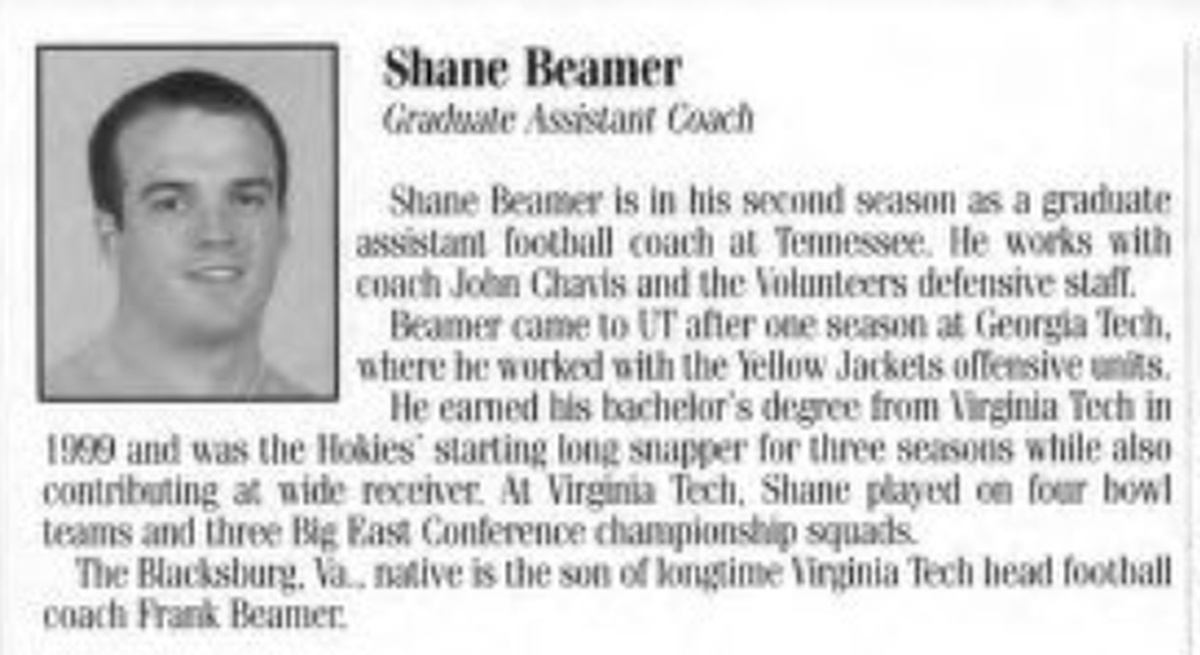
Shane Beamer’s biography in the 2002 Peach Bowl Program. Beamer was in his second year on Phil Fulmer’s staff at Tennessee at the time. University of Tennessee-Knoxville Library
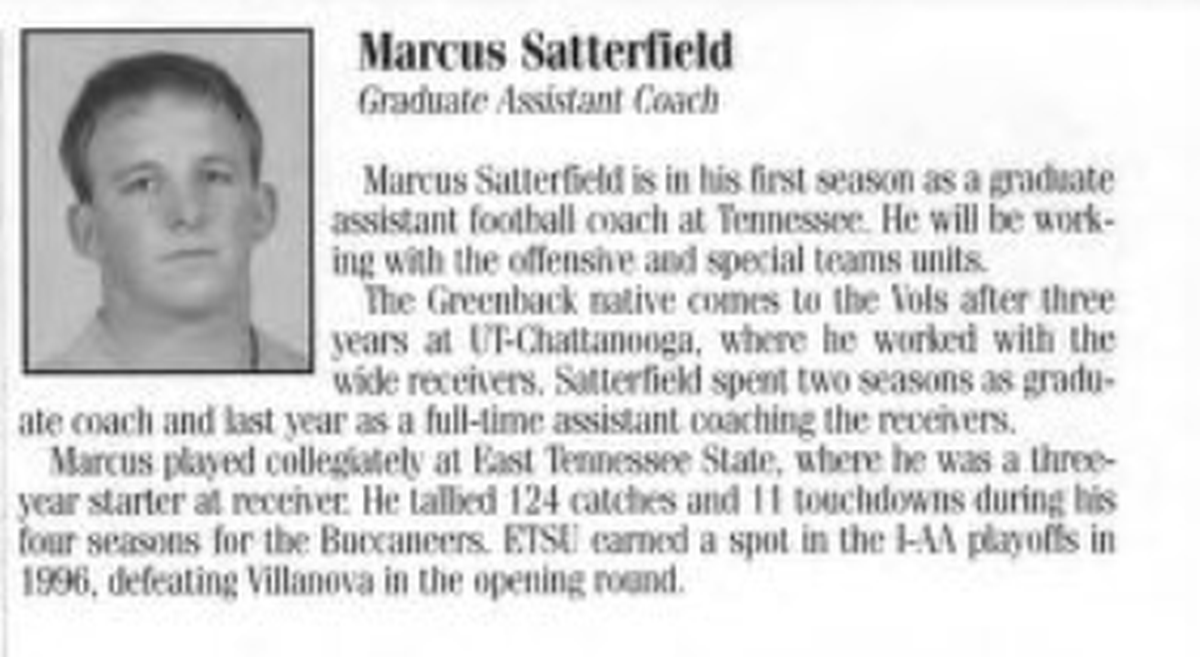
Marcus Satterfield’s biography in the 2002 Peach Bowl Program. Satterfield was in his first year on Phil Fulmer’s staff at Tennessee at the time after three years at UT-Chattanooga. University of Tennessee-Knoxville Library
Responsibilities as Volunteers graduate assistants
College football staffs in the early 2000s looked wildly different from modern day.
South Carolina, for example, now employs dozens of staffers devoted to recruiting, graphic design, on-campus visitors and film breakdowns. In 2002, Tennessee had just two graduate assistants — one on either side of the ball — two staffers in high school relations, another in player relations and one person in a football operations capacity.
“It was much more restrictive than it is now, that’s for sure,” Fulmer told The State. “But we had some unbelievable guys.”
Beamer, Satterfield and Pendergrass quickly became friends. All three were sons of football coaches and had aspirations of sticking within the weaving world of college football coaching.
Days were spent picking up coffee or, as Beamer was tasked, scooping up McDonald’s on Tuesday mornings for staff meetings. Sixteen-hour days filled with film breakdowns, dipping in and out of meeting rooms and even some on-field coaching made up the bulk of the fall.
Offensive coordinator Randy Sanders remembers Satterfield being tasked with drawing up a handful of trick plays each week for him and Fulmer to comb over. Beamer, too, worked with the kickers almost daily given his background as a long snapper at Virginia Tech.
“Hell, I was young, too,” South Carolina offensive line coach Greg Adkins — who was on Fulmer’s staff from 2003 to 2008 — said through a chuckle. “... But I just remember their energy that they had, their work ethic at that time, their knowledge of the game at a young age and their recruiting aspirations were both extremely high for young, young coaches.”
Nights not in the film room or on the practice field entailed bouncing in and around Knoxville. The Copper Cellar on Cumberland Avenue earned ample patronage. Beamer, Satterfield and Pendergrass even headed over to Greenback — or, “The Nation,” as it was nicknamed — on Friday nights to watch Marcus’ father coach when the schedule permitted.
When the on-field coaches hit the road to recruit in the spring, the younger staffers were largely left to their own devices. The trio took that as more time on the golf course at Egwani Farms, just 11 miles from Neyland Stadium and where a buddy of Satterfield’s worked in the pro shop.
On the busiest of days, the graduate assistants knocked out 18 holes in the morning at Egwani Farms, grabbed lunch, then headed another 40 minutes down the road to Rarity Bay Golf and Country Club for an afternoon session on Tellico Lake.
Pendergrass jokes no one had fixations on the PGA Tour, but each boasted respectable handicaps in the 10 to 13 range.
“We were pretty even,” Satterfield said of Beamer. “But I’d say he’s more consistent. He probably got me more times than I got him.”
Marcus Satterfield takes a swing during the Birdies with Beamer golf tournament on Thursday, July 29, 2021 at Woodcreek Country Club. Tracy Glantz tglantz@thestate.com
Developing as coaches in Knoxville
Satterfield and Beamer both had crucial recruiting responsibilities at Tennessee given the mom-and-pop nature of early 2000s college football staffs.
There were no Hudl videos or online recruiting databases in those days. Beamer and Satterfield instead spent hours on the phone recruiting the West Coast, calling high school coaches from Arizona to Washington.
Beamer was charged with checking out clips of Reggie Bush and Marshawn Lynch. It was Satterfield, though, who picked out the arm that would maintain Tennessee’s perch atop college football in the post-Peyton Manning era.
Flipping through film, Satterfield spotted a 6-foot-6, 200-pound gunslinger from a small town outside Portland, Oregon. The film jumped out. The kid had strength and arm talent in his upper half. He torched just about every defense shown on the clips. The kicker? He was the nephew of two-time NBA champion Danny Ainge.
Satterfield eventually brought the clips to Sanders, UT’s offensive coordinator. Adkins — who was then in charge of recruiting the West Coast — eventually got a look. Fulmer, too, got his own peek.
Sanders and Satterfield were taking a deeper dive into Ainge’s tape when Fulmer moseyed into the meeting room and inquired about the signal-caller on tape. The group watched as Ainge drilled a receiver on an out route across the field. Satterfield perked up.
“You know what they call that, coach (Fulmer)?” an emboldened Satterfield said.
“What’s that, Marcus?” Fulmer said.
“A f— rope,” Satterfield jibed as the room erupted in laughter.
Ainge committed to the Volunteers in December 2003. He earned freshman All-American honors from Sporting News in 2004, was thrice named SEC Offensive Player of the Week in 2006 and received the 2008 Outback Bowl MVP. Ainge was later selected in the fifth round of the NFL Draft by the New York Jets, where he spent three seasons before retiring due injuries.
“Everybody in the room kind of cracked up and laughed,” Sanders, now the head coach at ETSU, told The State. “But that’s who (Marcus) was and he was absolutely right.”
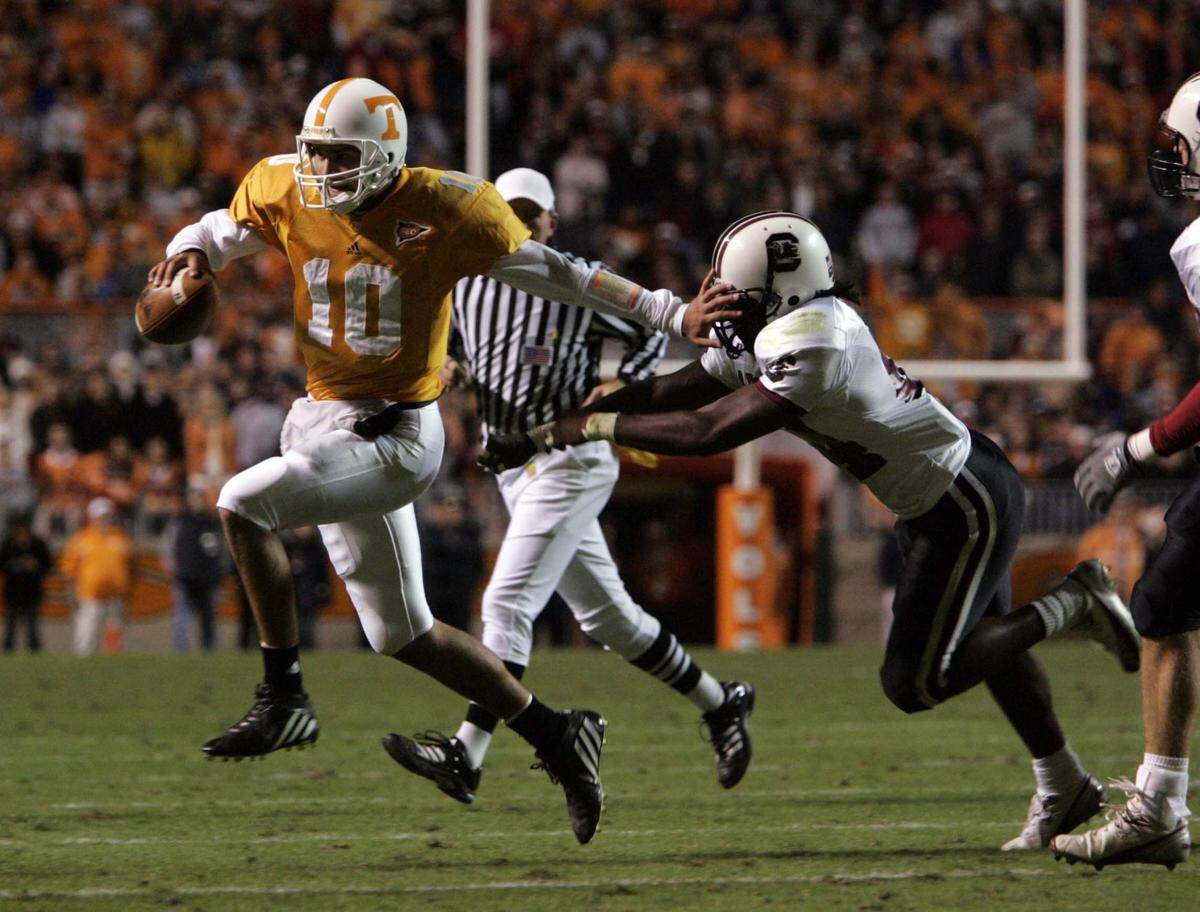
October 29, 2005: Tennessee QB Erik Ainge stiff-arms USC LB Mike West. THE STATE
Returning to UT and joining forces at South Carolina
Beamer flashes a grin when looking toward the helmets adorning the second shelf on the wall behind his desk in the Long Family Football Operations Center.
Three South Carolina helmets reside in the middle of the mantle. Head coverings from Georgia Tech, Mississippi State, Georgia, Oklahoma and, of course, Tennessee also have their places on the shelf. Each represents a past job Beamer has held in the time prior becoming the head coach at USC.
“I learned a lot of football from Coach Fulmer in my time (at Tennessee) and made a lot of great friends,” Beamer, who owns a master’s degree in sports management from UT, said during his Tuesday press conference.
Leaving Tennessee for a job as the offensive coordinator at Mississippi State in 2005, Volunteers assistant Woody McCorvey told Bulldogs head coach Sylvester Croom he’d come on one condition: that he could bring Beamer, Pendergrass and current New York Giants assistant Freddie Kitchens with him. Croom agreed.
Beamer and Pendergrass soon headed to Starkville, where they overlapped for three more years and where Beamer would meet his wife.
Satterfield left Tennessee after the 2003 season to become a wide receivers coach at Richmond. Stops at UT-Martin, Western Carolina, UT-Chattanooga, Temple, Tennessee Tech, Baylor and the Carolina Panthers followed before he’d land back with Beamer in Columbia.
“Whatever they have gotten, they earned it,” McCorvey, who’s now the chief of football administration at Clemson, told The State. “They put the work in and made it happen. And because of that work ethic, that’s why Shane and Marcus are in the situation they’re in now.”
Saturday, Beamer and Satterfield will return to Knoxville almost two decades after their coaching careers began in earnest. Pendergrass, too, will be there to see his old buddies. He wouldn’t miss it for the world.
Beamer and Satterfield have both graduated from coffee orders. If need be, though, Beamer still has one particular order seared into his memory: Two creams and three sugars.
This story was originally published October 7, 2021 at 5:00 AM.
Ben Portnoy is The State’s South Carolina Gamecocks football beat writer. He’s a 10-time Associated Press Sports Editors award honoree and has earned recognition from the Mississippi Press Association and the National Sports Media Association. Portnoy previously covered Mississippi State for the Columbus Commercial Dispatch and Indiana football for the Journal Gazette in Ft. Wayne, IN.
Get one year of unlimited digital access for $159.99