How ‘rebel quarterback’ Steve Taneyhill gave the Gamecocks hope as SEC era began
On Sept. 4, 1992 — a day before South Carolina would play its first-ever SEC football game — 100 folks gathered outside Williams-Brice Stadium, forming a circle around a witch doctor from Blythewood named Archibald Thibeaux.
The 37-year-old Thibeaux, wearing a tall, black top hat, began an exorcism, throwing six ingredients — including chicken feathers — into his cauldron. Smoke began to billow. The Chicken Curse was dying.
“The Curse is gone,” Thibeaux proclaimed. “We will be victorious. Call me if it doesn’t work, but we will win.”
Forgive the witch doctor for leaving out the most-crucial caveat: That his concoction needed six weeks of maturation for the spell to take hold. Because that would be as good an explanation as any for what happened next.
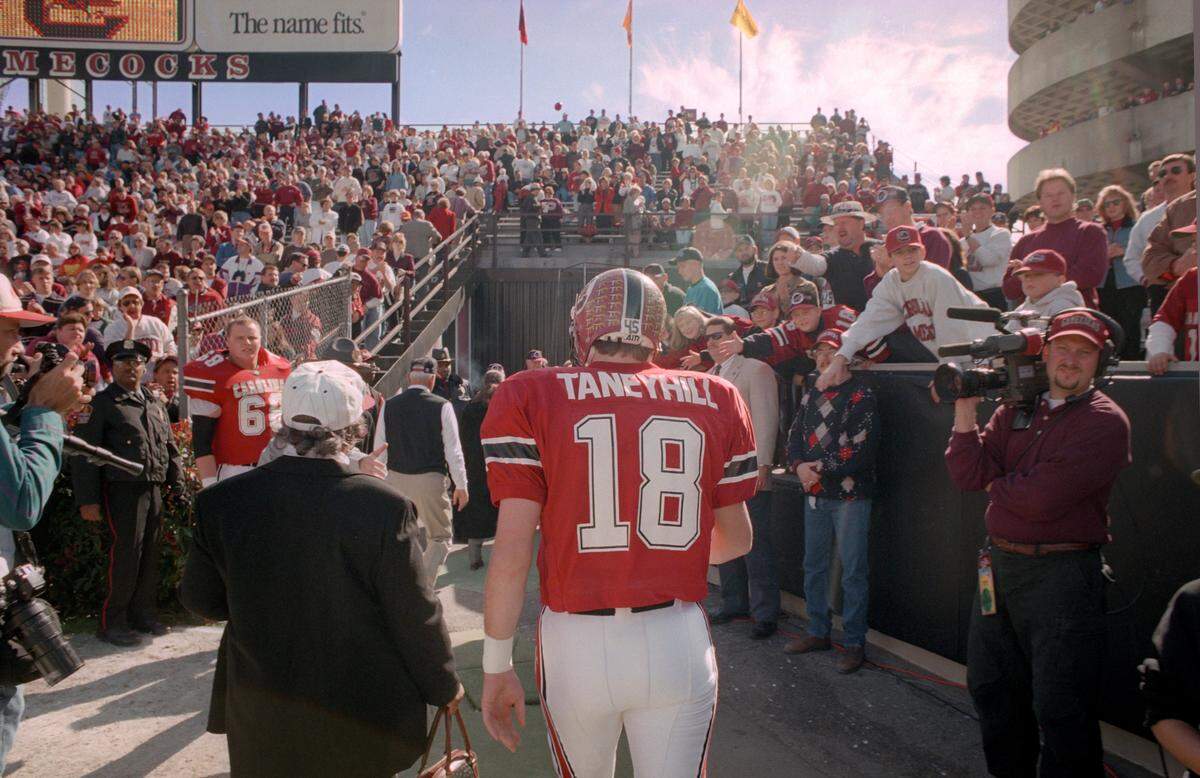
How — in the middle of an 0-5 start to the 1992 season, a week after a locker room revolt where players voted 62-24 to ask head coach Sparky Woods to resign — quarterback Steve Taneyhill, the mullet man from Altoona, Pennsylvania, emerged to become one of the most beloved players to ever suit up at South Carolina.
Taneyhill, South Carolina’s quarterback from 1992 to 1995, died Monday at the age of 52. He had been battling cancer, but few details were publicly known about his diagnosis.
His wife, Tabitha, released this in a statement after his death: “Steve fought a rare stage 4 malignant Insulinoma cancer for more than four years. He fought longer and harder than expected because that was who he was—strong, determined, and unwilling to give up on the life and people he loved.”
“I was in touch with Steve a few times in the fall,” said Boomer Foster, a teammate of Taneyhill’s at South Carolina, “and not once did he ever mention that he was sick.”
“It was jarring, for sure,” Kurt Frederick, another former USC teammate, said about the news of Taneyhill’s passing. “I had heard that he was having some health problems, although I didn’t know to what extent he was sick. From everything that I’ve learned, even today, he was pretty private about that stuff.”
It was another reminder that there was the persona of Taneyhill ... and then there was the man behind the scenes.
The brash freshman who, before he took a single snap, showed up to campus driving a black Mustang GT with a license plate that read “USCQB.” The 18-year-old kid who seemed to have no intentions of assimilating to the South, walking in with a blond mullet and earrings.
“He just defined this rebel quarterback,” former Gamecock running back Rob DeBoer told The State on Monday.
For a school needing something to rally around, Taneyhill was the perfect figure at the perfect time. In no time, he refined what was possible at South Carolina and, in doing so, made it cool to be at South Carolina.
“That was very palpable,” said former kicker Marty Simpson, whose locker was next to Taneyhill’s for three years. “It became very different very quickly.”
There was the winning — that was certainly different. But Taneyhill won by staying the same person. He won while being overly confident, outspoken and eager to celebrate — which that made life more joyful for those around him.
“Honestly, I’d been there two-and-a-half years and I hadn’t had fun yet,” Simpson added. “Steve Taneyhill made playing for South Carolina fun.”
He was the guy who taunted opposing players. Who riled up student sections. Who had teammates throw him fake pitches so he could hit fake monster home runs after touchdowns. He was the man who signed the paw after beating Clemson in 1992, the man always proud of never losing in Death Valley — whether the variant was at Clemson (2-0) or LSU (1-0).
There was Taneyhill’s persona, the sort of details that made him more wrestling heel than college quarterback. But, beyond all that, was a guy who loved, loved, loved football.
Brad Scott inherited Taneyhill — who ended up throwing more touchdown passes than any other Gamecock (62) — when he became South Carolina’s head coach in 1994. Scott arrived in Columbia having never met his new quarterback, but he heard enough stories to scare him.
“I kind of went into this thing thinking, ‘Whoa boy, how am I going to react to Steve?’” Scott told The State on Monday. “But I was trying to think today: I never had a discipline issue with him. ... He loved to play.“
And, perhaps because he was the son of legendary Altoona women’s basketball coach Art Taneyhill, he bought into the process of being great. There are many stories about Taneyhill hanging around Five Points, at establishments like Pug’s and Group Therapy (which he bought in his adult years), but there were plenty of late nights he spent alone at the football facility.
“He did it the hard way, the coaches’ way,” Scott said. “He was up there watching the 16 millimeter film and preparing for those games.”
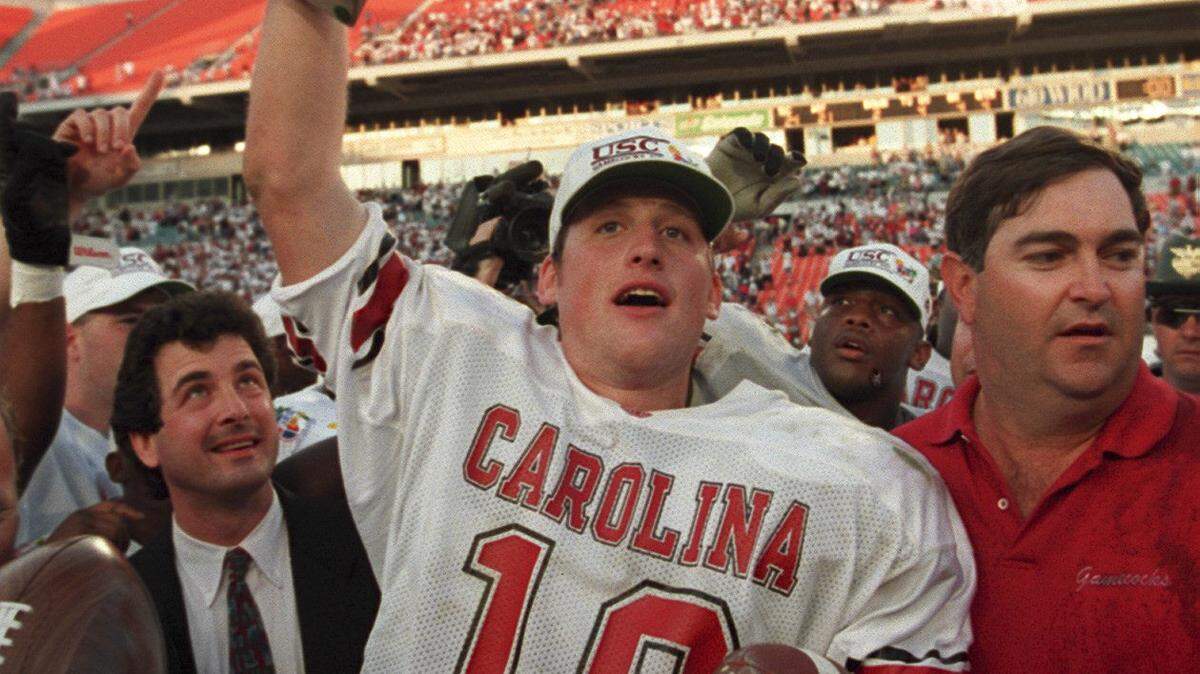
Like his first start against No. 15 Mississippi State, when he led the Gamecocks to their first SEC win and first victory of the season. Or that magical game against Clemson a few weeks later, when Taneyhill and the Gamecocks broke the Tigers’ four-game winning streak and The State photographer Tim Dominick captured Taneyhill with head up and his arms outstretched, as if he was a worshiping in a world he owned.
Or, perhaps, a game like the 1994 Carquest Bowl, where Taneyhill led South Carolina to its first bowl victory and, as Thibeaux had predicted years earlier, ended the Chicken Curse.
South Carolina entered the SEC in 1992 as a transplant.
The Gamecocks’ football history included one real season of success (1984), and even that had its painful moments. They had no edge. No identity. No swagger.
And then — poof!
“What Steve provided was a spark,” Foster said. “He was brash, confident — and he backed it up.”
In his three-and-a-half years as a starter, Taneyhill completed over 60% of his passes for over 8,700 yards and the school-record 62 touchdowns. And while the Gamecocks only had one winning season under Taneyhill (1994), he gave USC hope and became the program’s first SEC-era superstar.
“Steve was not the most-talented quarterback in our quarterback room,” Frederick said. “He didn’t have the strongest arm. He certainly wasn’t the fastest. ... He just had the thing — whatever that thing is that makes some guys successful.”
Added DeBoer: “He had the ‘It’ factor. ... At the end of the day, it was the intangibles that made Steve Taneyhill who he was.”
This story was originally published December 15, 2025 at 5:47 PM.