What drives Ty Harris, the quiet senior and link between USC’s past and future?
There’s a moment before every South Carolina women’s basketball game.
The teams are on the floor about 40 minutes or so before tip-off, taking shots before retreating to their locker rooms one final time. Fans are starting to filter in, pregame music is blaring, basketballs are flying all over the place.
And Tyasha Harris is sitting courtside in one of the seats meant for fans, usually with a ball in her hands, not doing much of anything.
The senior point guard dribbles under her legs occasionally but mostly looks to be deep in thought, far from the arena. She waits until her teammates take their final shots and then finally steps on the floor, shooting a few and usually ending with a long 3-pointer before jogging off to rejoin her squad.
“We do all this stretching, we do all this shooting, we’re running around getting up a sweat, but you really don’t have time to just sit down and be calm before the storm comes, like before the game comes,” Harris said.
It’s a brief moment that stands out for a player who so often can blend in if you’re not watching carefully — Harris is the “consummate” point guard, coach Dawn Staley is fond of saying. Her first instinct on the basketball court is to set her teammates up to score, not score herself. Off it, she can be reserved, less open or gregarious than other star players Staley has had.
But as she prepares for the final few games of her South Carolina career, there’s no denying the impact Harris has had — from the crucial role she helped play as a rookie in the program’s first national title, to the steady hand she’s provided in the current team’s rise to No. 1 and emergence in the championship discussion.
During those quiet moments before the game, however, Harris isn’t thinking about her legacy.
“I just think about the game, putting myself in situations, our game plan, going over that again and kinda just get ready for the game, mentally preparing for the game,” Harris said. “And then I’m usually the last person to shoot, so I wait for everybody to get done shooting and then I shoot my last shots.”
A homebody from Indiana
Harris didn’t have that pregame routine in high school, when she helped Heritage Christian School in Indianapolis win three state titles. And though the young point guard had offers from top programs across the nation, she didn’t have the accolades every high school star craves — she wasn’t a McDonald’s All-American, she wasn’t invited to the Jordan Brand Classic, she missed out on Indiana’s prestigious Miss Basketball award.
Ranked 28th in her class by ESPN, Harris admits that she felt a little slighted.
“A lot of kids played on the (Elite Youth Basketball League) team, the Nike team, and I kind of stuck with my homegrown team that we built,” Harris said. “And I’m just like a very loyal and family-oriented person, so when the Nike team was trying to get me, I didn’t feel like it was right for me to just leave for my own good. I had my little sisters that I grew up with, my day ones, that also played basketball, and I wanted to get them attention, too. … And I feel like in some aspects that kind of hindered my rankings.”
That didn’t stop Staley, one of the great point guards of all time, from wanting her. Though for a long time, Harris didn’t seem to reciprocate the interest.
“She didn’t talk. She wasn’t one that we had constant communication until her senior year, like the fall of her senior year is when she really picked up and started talking to more coaches,” Staley said.
Said Harris: “Honestly, I didn’t know where I wanted to go. So that’s why it took so long. I just didn’t ... I’m very (much a) homebody. And I was like, uh, I’m not ready to leave yet, I wasn’t ready to go to college.”
Off to a late start, Harris’ recruitment dragged on far longer than most into the spring of her senior year. She was considering Iowa, where she had a strong connection with the coaching staff; Michigan State, where her mother had her while still in school and raised her; and South Carolina.
For a self-professed homebody from Indiana, the Gamecocks were the non-Midwestern outlier in her finalists. And, indeed, she said she originally planned on staying close so her parents could be nearby and watch her play.
But the old cliche about parents not wanting their children to move too far away for college was actually reversed here — Harris’ parents convinced her she didn’t need to stay.
“They were just like, ‘You need to explore, you need to branch out, can’t be a homebody forever,’ ” Harris said. “I mean, sooner or later, I’ll have to grow up and leave home, so it’s not going to be that bad.”
South Carolina had a family atmosphere Harris liked. She didn’t grow up watching Staley during her playing days, but as they began to talk more and develop a chemistry, she looked up some highlights. And in April, she finally made the call to Staley — she would be a Gamecock.
And when she made the actual call, another person just so happened to be with Staley, finding out she was about to have a new teammate: A’ja Wilson.
“I was actually in the room when Ty committed to South Carolina, which was pretty cool. I don’t think I was supposed to be, but I was just kind of there, just checking up with the coaches and stuff, and it was pretty cool to get that call and have her join our team,” Wilson said.
’I was timid and scared’
Her parents had convinced her to leave home, and South Carolina’s coaches assured her she would be far too busy to miss Indiana. And for the most part, Harris said, that was true.
But there were little moments, lying in bed at night or alone on campus when her teammates drove or took short flights home during breaks.
“I couldn’t really take fights like that, because I have other siblings that (my parents) have to care for. So like, I’d kind of just be in an apartment by myself and I’d be like, ‘Dang, I wish I could go home,’ but it wasn’t bad,” Harris said.
And as a freshman, Harris was stepping onto a team with national title aspirations. A’ja Wilson, Alaina Coates, Kaela Davis and Allisha Gray all went on to become first-round WNBA draft picks, and Bianca Cuevas-Moore rounded out a starting five with a wealth of experience.
“I was super quiet, and I was timid and scared,” Harris admitted.
Then, halfway through the season, Staley made the decision to elevate Harris to the starting lineup. The quiet young point guard didn’t talk much, but when she did, she impressed Staley.
“Ty asked really good questions that made me aware of her intellect and her ability to think the game, because of the type of the questions she asked as a freshman,” Staley said.
Harris was happy to have Staley’s trust, but she felt pressure to prove herself to her teammates and not let her coach down — “I was scared of messing up, I was scared of just not fitting in with the thing,” she said.
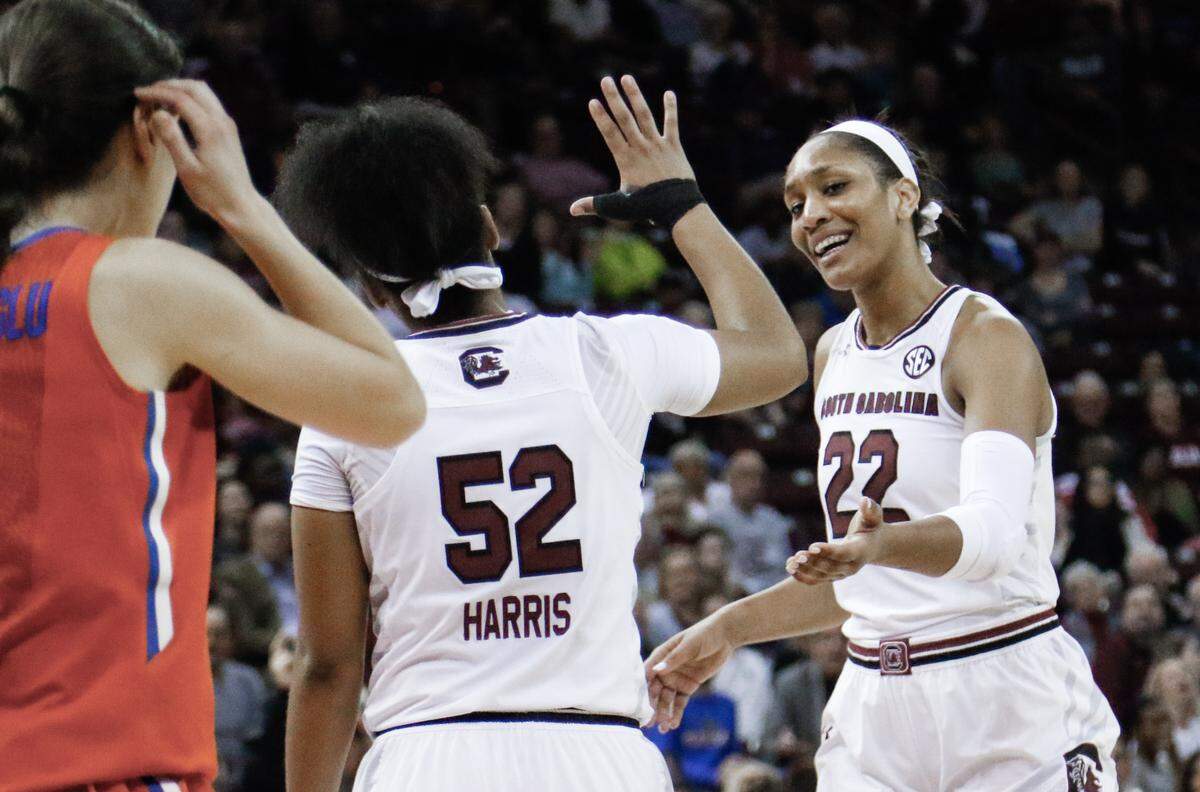
In those times, her relationship with Wilson proved key. A’ja and Ty are fond of referring to themselves as “twins,” and both say they formed a close connection almost immediately. But in those early days, Wilson was more big sister than anything else.
“’She kind of took me under her wing because she knew how it was. She was a big-time freshman player, too, even though she was coming off the bench, she still was that go-to person. And then she knew I was a leader, and she had a good connection with Coach Staley, and she helped me build my relationship with Coach Staley,” Harris said, remembering how Wilson would urge her to go and talk to Staley at times.
“Coach Staley is a great coach, but there’s times when it can get tough,” Wilson said. “And that’s when you gotta kick in ... and when the upperclassmen kinda help you come along and bring you up with them, and I think that was my goal with Ty, to make sure that she understood that when I left, when all of us left that was on that national championship team, it was her turn to carry this team and carry the legacy and the standards we all had.”
And it extended beyond basketball — the pair bonded over shopping and as “two college girls trying to make it,” as Wilson put it.
After the Gamecocks won the program’s first national championship, with Wilson as the Final Four’s Most Outstanding Player and Harris as the floor general, they had one more season together. As Wilson demolished the competition en route to unanimous national Player of the Year honors, Harris was once again right behind her, dishing out a program-record 220 assists, leading the SEC in assists per game and earning second-team all-conference honors.
Then, Wilson was gone for the WNBA, and Harris, elected a team captain as a sophomore, was in charge like never before.
“When I was picked captain in my sophomore year, I mean like, yeah, I was a captain, but you also had the big sister, A’ja, everybody knows that whatever she says goes, and I could lean on her a lot,” Harris said. “But as soon as she left, that’s when I had to pick up the slack more.”
Bridging the gap
Before Wilson had even left, Staley was saying that Harris needed to step up to become a scoring option in her own right. She had the talent to attack the basket or pull up in the midrange, but her natural style was to pass first, not shoot. Staley wanted to change that, to bring out some aggression.
As a junior on a team that struggled to find its identity at times, Harris’ scoring numbers barely increased, while her shooting percentage and assists went down slightly from her sophomore year. The result was a season that, while not exactly a disappointment, fell short of the program’s lofty standards.
Then came the 2019 recruiting class. Rated as the best in the country with four players in the top 11 nationally, the newcomers have immediately elevated South Carolina back into national title conversation. As freshmen, they have accounted for nearly 45% of the team’s scoring, with three starting every game so far.
But time and time again, Staley has credited Harris, as well as fellow senior Mikiah Herbert Harrigan, with being key to the team’s success. Not only have they provided the veteran leadership to keep the team calm in trying moments, they’re also producing more than ever.
Harris in particular is on pace for career bests in points per game, rebounds per game, field-goal percentage, 3-point percentage and assist rate. She feels more comfortable than ever calling her own number and scoring when needed, she says, and is on the verge of becoming the 20th player in program history to score 1,300 career points, while having already broken the school record for career assists. In a recent WNBA mock draft from ESPN, she was projected to go in the first round.
And just as Wilson looked after her when she was a freshman, she’s looking after the youngsters, bridging the gap between two eras of the program.
“I’m usually the youngest person, like one of the youngest in my classes and stuff like that,” Harris said. “But now this is my first time ever actually being the oldest on any team ever. And I mean, I like it, just because I’m the motherly figure, stuff like that. And they lean on me a lot, and everything that I used to do with A’ja, they do with me, so it’s kind of what goes around, comes around.”
‘It takes a while for me to trust’
Just before Christmas, South Carolina was playing South Dakota, leading at the end of the first quarter when Harris launched a 70-foot buzzer beater that somehow went in. It topped SportsCenter’s Top 10, got a lot of buzz on social media, earned her a few headlines.
But flashy plays and Twitter acclaim aren’t typically Harris’ style. She’s a top contender for SEC Player of the Year by virtue of leading the nation’s top team both emotionally and with her play, but her stats don’t necessarily stand out against some of her competitors. And without looking too closely, she can sometimes seem all business, even stone-faced.
“When I was younger, I feel like people used to say I look scary, or I look mean, because when it comes to basketball, or I’m getting in the gym or I’m walking into the gym, I just have like a straight face. Like it’s kind of really hard to read me,” Harris acknowledged.
“I think that’s a good and bad thing. So like I just kind of have a serious face on, just walking around or something like that, but as soon as you start talking to me, that’s when I have my big smile, and then they know like, ‘Oh yeah, she’s really nice.’ I smile all the time, I laugh all the time, I’m goofy. But it’s not until you talk to me.”
Harris said she wouldn’t call herself an introvert — once you to get know her, she says, she’s very friendly. But she likes to keep that circle of friends tight.
“I kinda really don’t like letting people in too much, or feeling like getting attached too much. I don’t know why,” Harris said. “I feel like I’m just like an enclosed person, and it takes a while for me to trust you, because just ... our generation, a lot of, I’m not gonna say fake, but a lot of people just like to hop in on the train or leave and stuff like that. And once you get big time or you get a little claim to fame, people try to hop back on and they’ll be like, ‘Remember?’ And I’m like, ‘No I don’t remember that.’”
Still, she knows the importance of connecting with fans, and her father has stressed the importance of showing more of her personality on social media. She’s tried to take a few pages out of Wilson’s book in that regard — “She’s really good at branding herself, she’s really out there,” Harris said. “I try to copy her ... kind of.”
When fans meet her in person, Harris said, they’re always surprised by how lighthearted she can be. She and Herbert Harrigan are close friends and are both “so goofy” together off the court.
On it, though, Harris is locked in on the pursuit of another national title. In 2017, she got a tattoo on her left forearm, “XVII,” the Roman numeral for 17, to celebrate the championship. And if the Gamecocks can hoist the trophy once more, and if she can go from scared freshman to self-assured senior guiding a new group of youngsters to the top, she has a plan.
“If we win it again,” Harris says with a smile, pointing to the corresponding spot on her right arm, “2020! 2020!”
This story was originally published March 1, 2020 at 5:00 AM.