‘WBB vs. Everybody’: The electrifying power of Dawn Staley’s legion of fans
They’re nicer than Gamecock football fans, louder than baseball fans, more numerous than men’s basketball fans and prouder than arguably any other fan base at the University of South Carolina, and maybe in the country.
USC women’s basketball fandom — diverse, loyal, deeply engaged and notoriously well-traveled — might be one of a kind in college sports today. And it’s helping grow popularity for the sport far beyond the stands of Colonial Life Arena, which, by the way, regularly hosts more fans than any other NCAA women’s basketball arena in the nation.
Fans of coach Dawn Staley’s perennial powerhouse team have become fans of the WNBA, and they follow the competition among other college teams all season long.
Are the Gamecocks and their fams — er, fans — single-handedly driving the growth of women’s basketball? That’s a stretch. But there’s no denying the influence Staley and the legion of loyal fans behind her are having on the sport.
“I can only speak for our fams and what they’ve created here,” Staley told The State earlier this season. “They are knowledgeable, like they know about women’s basketball across the country. They are loyal. They are possessive. They’re fighters, they fight our battles. They fight our social media battles. They’ve created friendships when they come and they’ve been around each other over the past few years. It’s a pretty cool development of how things have turned out this way.”
As the heat turns up ahead of Sunday’s No. 1 vs. No. 3 showdown against LSU, fans are crowing about the sellout crowd at Columbia’s 18,000-seat Colonial Life Arena. Some resale tickets were going for as high as $1,100 apiece late in the week.
Beneath the glow of two national championship banners — and humming with hunger for more — a crowd of old and young, male and female, diehards and newcomers swells with passion and pure love for the 14 young women in garnet on that Colonial Life hardwood.
“Electrifying,” said Lisa Gadson, a Columbia resident and University of South Carolina graduate who attends most every home game.
Fans line up outside the arena more than an hour before games. They wear T-shirts that say “Worth,” in recognition of the team’s 2021-22 theme, and hoodies that say “WBB vs. Everybody,” meaning it’s the Gamecocks against the world. They erupt as one in fits of elation and anger. They stay in the stands ‘til the end of the game.
“Oh, it’s hot. It’s very high energy,” said Robert Reese, who works concessions at the arena. “And the fact that you talk about sellouts ... and you see people outside with signs saying, ‘I need tickets.’ It’s energetic, and the top players want to come here now because ... the fact that they’ve been seeing on this scale if you work hard, produce hard, play hard, this is what you can achieve.”
Years ago, it would have been laughable to imagine crowds and an atmosphere like today’s at a women’s basketball game in Columbia.
Reese and others working at the arena say they remember when fans numbered in the mere hundreds in the pre-Staley and early-Staley eras.
“Oh yeah, I’ve worked here when we had other cultures, and we had about 200 people in the seats or so,” said Angela Webster, who has worked at Colonial Life Arena since it opened 20 years ago, and at the Carolina Coliseum before that. She works USC football and baseball games, too, and nothing compares to the women’s basketball crowds, she said.
These days, a women’s basketball crowd can outshine the audience for any other USC sport — save for football in the 77,000-seat Williams-Brice stadium — nearly any day of the week.
The Gamecocks have led the nation in fan attendance every year since the 2014-15 season — discounting the 2020-21 COVID year. The average attendance this season is almost 12,500 fans, or 2,000 more tickets sold per game than their counterparts on the USC men’s team.
The fans buying those women’s basketball tickets, their tenor, their personality, are not like other USC fans.
“I think our crowd looks much different than any crowd that attends any sporting event here on campus,” Staley said. “That’s a really cool thing.”
The differences in the fans are “hard to explain,” said Webster.
“This feels very much like family, like buddies and friendly, and everybody wanting the same thing,” Webster said. “Football, to me, is not a friendly atmosphere. But baseball is not as intense as this; it’s more laid back, and it’s an older fan base, but it’s also a very mild atmosphere. ... (At women’s basketball games), I can see how many people got to know each other, and they go on these buses to away games, and they’re all together. ...
“This is just fun.”
Staley made the difference
Ask anyone how the fan base grew to be this way, and all fingers point to Staley, the founder and the center of the culture.
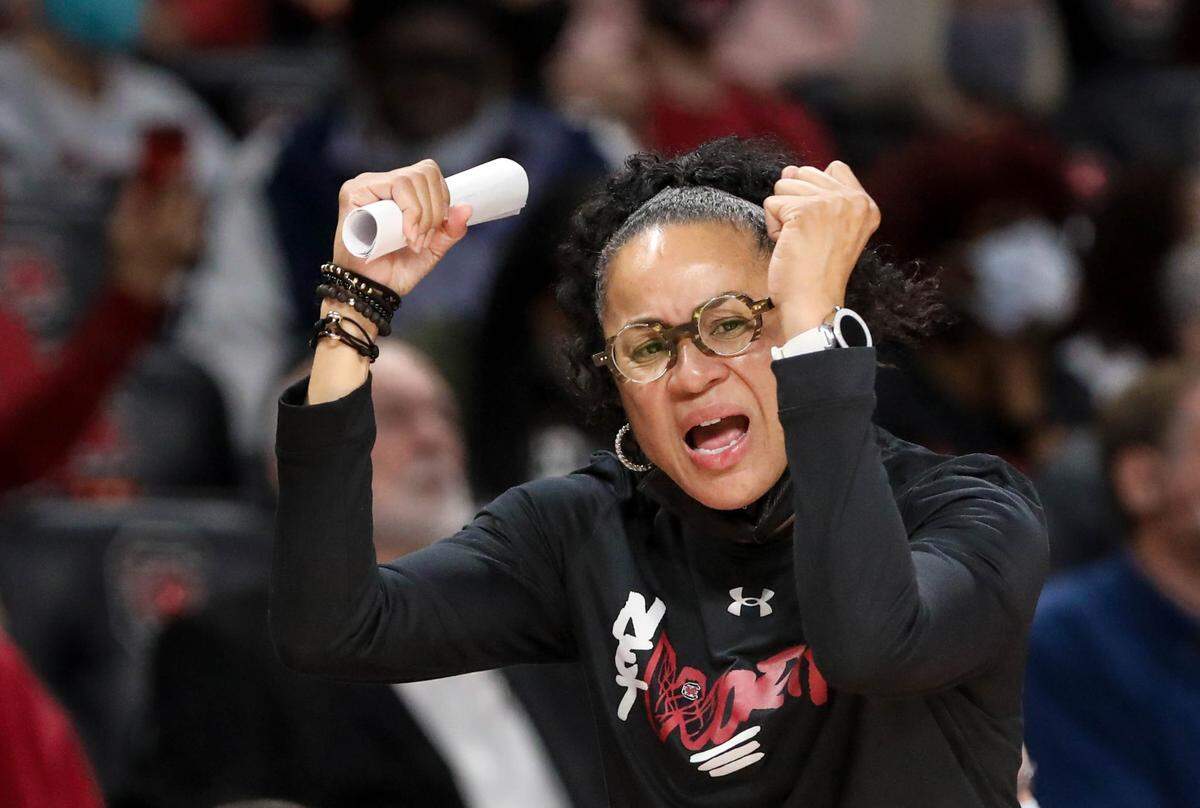
A Hall of Fame player and coach, Staley was the change agent inside Colonial Life Arena, taking a team that went 17-16 in the 2007-08 season before her hiring and turning it into two-time national champions.
“She changed the atmosphere and the culture. It took time, of course, and the support the university gave to her. It gave her that freedom and room to grow,” said Michelle Yeater, a season ticket-holder from Prosperity who attends games with her partner, Susan Jordan, and their three kids, Christian, Kaleigh and Jesse.
“She is iconic, she is epic, and she is the epitome — I mean, her reach is just global,” said Columbia’s Gadson. “All the accomplishments of what she’s made. She’s extremely humble, and she’s extremely down to earth, and she makes you feel like you are a family with the team.”
Before Staley, Gadson said she didn’t know anything about women’s basketball. Now, she’s not just a Gamecocks fan. She’s watching WNBA games to follow “our A’ja” — A’ja Wilson, the Columbia native and former USC star who just won a WNBA championship with the Las Vegas Aces. A statue of “our A’ja” stands outside the Colonial Life Arena’s main entrance.
At the same time, the WNBA recorded its most-watched season in two decades in 2022, The Associated Press reported, with media coverage, viewership and sponsorship deals on the rise across the sport.
It’s harder for a women’s sport to grow a fan base of this magnitude; even the fans themselves acknowledge that fact.
“They’ve got to get their name out there to get the crowds in, whereas the guys, the crowds come automatically,” said Yeater, a fan who also works with girls’ sports. “The expectation is the men’s program is going to always be there; there’s always going to be fan support there. … Women’s sports, we’ve got to prove ourselves. We’ve got to make a statement, and that’s what Dawn has done. So that’s the big difference.”
Before the success of Staley’s program, many of today’s die-hard USC fans, like Gadson, say they never cared to watch the sport at all. The team’s personality and intention to connect with the community beyond the court have been as important as wins — and the Gamecocks have delivered many of them in recent years, amassing a 390-105 record under Staley.
It’s about much more than the wins for the fans. It’s the way Staley speaks to fans, draws them in, walks beside them. The way she calls them family.
The payoff is evident in the stands.
Pride of the community
USC women’s basketball fans have staked a claim on Columbia as a city whose identity is increasingly built on the fame of a women’s sports team. Few places in the United States could say the same.
“We’re part of this community,” Staley said. “The community feels like they are a part of our team. And that’s pretty cool. When it’s a mutual feeling like that, it produces something that’s organic and probably envied to a certain degree.”
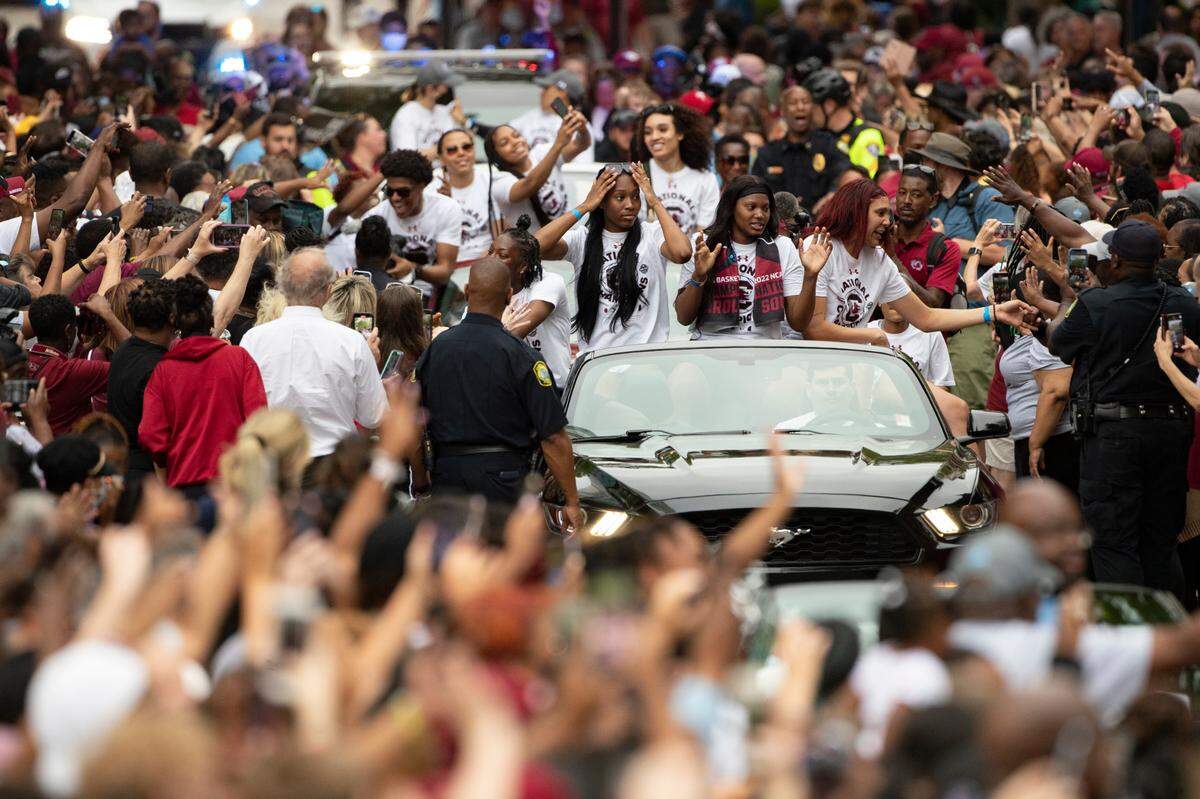
Columbia Mayor Daniel Rickenmann was one of the thousands of cheering admirers who filled Main Street last April to celebrate Staley, her team and their second national championship. The calls for a celebration parade began just moments after the championship game buzzer, the mayor said, and all of Columbia tingled with anticipation for days leading up to the team’s parade through the heart of the city.
The moment that still sticks with him most from that afternoon came after the parade, Rickenmann said, as he watched Staley take picture after picture with fans, hug after hug, handshake after handshake.
“And everybody is trying to get her away, but she kept on doing it and kept on doing it,” Rickenmann remembered. “And she made people feel like they were a part of that success, and thanking those fans for being there and cheering them on.”
The team’s place in the city at large soon will be cemented at a prominent corner of downtown Columbia, where a statue of Staley is planned to be erected about a year from now across the street from the S.C. State House. It will be a visible statement of the value of women’s basketball in the capital city, and “a reminder to every young girl that, ‘I have the ability and I have an equal value, and nobody should forget about that,’ ” Rickenmann said.
The unusually broad spectrum of support for the team in Columbia lifts the entire city, he added.
When downtown swells with women’s basketball fans for Sunday’s sellout game against LSU, those fans and the national audience tuning in on television will get a chance to see the best of Columbia, the mayor said.
One high-profile game after another, their influence across Columbia and the nation only looks to grow larger.
“When you have players who acknowledge their fan base like these young ladies do, and they put their best foot forward every time, people appreciate that,” Rickenmann said. “They want to be part of that. And I think as long as they continue to do that and they acknowledge that fan base, it’s going to stay that way.”
Jeremiah Holloway and Dwayne McLemore contributed reporting.
This story was originally published February 11, 2023 at 7:00 AM.