South Carolina WBB’s depth is a coach’s dream. Why it’s also a challenge for Dawn Staley
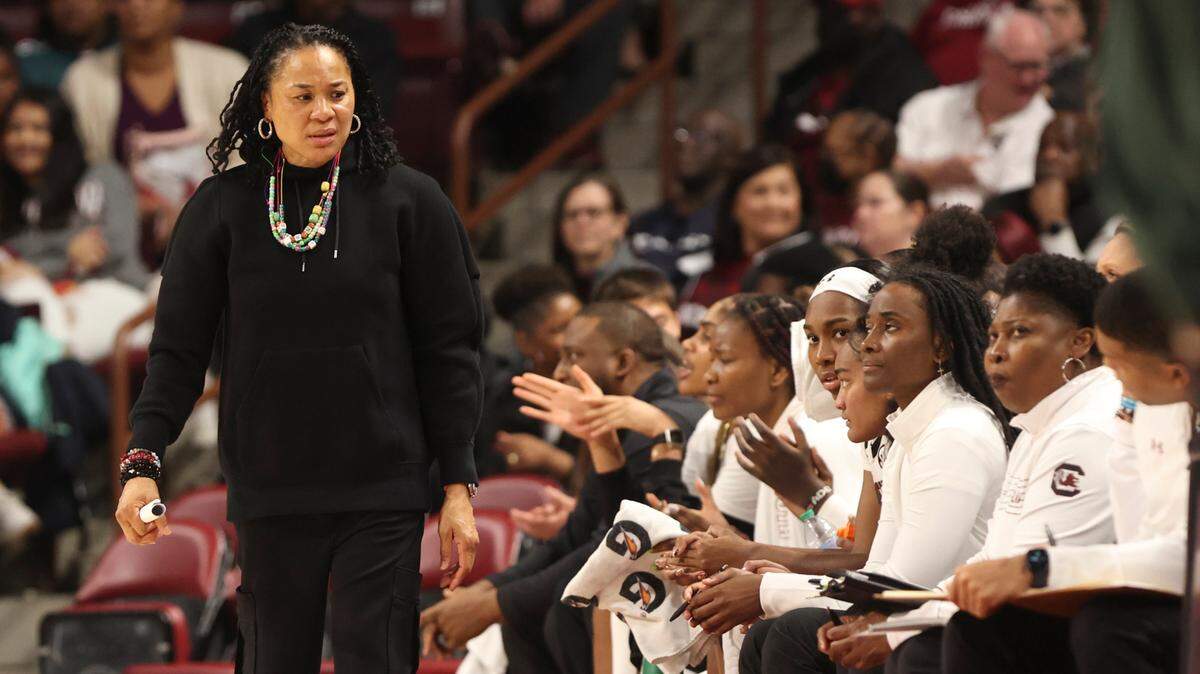
Having a deep bench can be a blessing and a curse.
When you have a plethora of players all with the talent to see the floor consistently, it’s hard to get them all the amount of minutes they might want or need. After all, there are 200 minutes to divvy up in each game.
That’s the struggle that South Carolina women’s basketball head coach Dawn Staley has faced this season.
The No. 3 Gamecocks’ challenge lies in finding just the right mix without bruising egos.
Junior Chloe Kitts has already felt that crunch this season. In Sunday’s win over South Florida, hot hands elsewhere meant her minutes dropped — from about 20 minutes per game to 17 against USF.
Forwards Sania Feagin and Joyce Edwards both had their best scoring performances of the season. Riding the hot hand is something Staley focuses on, so both players got extended minutes, leaving USC to adjust.
“If someone’s got it going on, more times than not we’re going to play them ‘til the cows come home,” Staley said. “That means somebody’s minutes are shrinking.”
Staley at halftime noticed that Kitts had only played seven minutes. So, she played Kitts longer than normal in the third quarter (six minutes) to make up for it.
Balancing minutes isn’t just about rotations — it’s about psychology. Staley explained that younger players often interpret fewer minutes as a personal failure.
“You really have to explain to young people that that’s how it is, or else they’re going to think, ‘I’m not doing what I’m supposed to do. I’m playing bad.’ And that’s the furthest from it,” Staley said.
At the Fort Myers Tip-Off in November, Kitts struggled with this exact mindset. She believed her coach had lost faith in her, Staley said at the time. But USC’s coach insisted the adjustment was in the interest of letting other players get more minutes.
The minutes tug-of-war applies at other positions, too. Staley used guard MiLaysia Fulwiley as an example: When she gets more playing time, it means fewer minutes for other players such as Bree Hall, Tessa Johnson or Te-Hina Paopao.
With 10 of 13 players consistently seeing the court, the Gamecocks’ depth is a rare luxury. Against USF on Sunday, 10 players logged at least 14 minutes — a testament to Staley’s ability to deploy waves of talent.
The team’s roster depth is so strong that Staley can sub out all five players at once if a lineup isn’t performing. That kind of depth — capable of full-platoon switches for a brand new five — is practically unheard of, even at the highest levels of basketball.
Last year’s national championship roster, which mostly utilized a nine-person rotation, had four players at or above 25 minutes per game. This season, Paopao is the only Gamecock at that mark 11 games into the year.
With the good comes the bad, however. Even with a wealth of talent, the balancing act is tricky.
Staley likens it to a moving target. What earns a player more time one night might not be the same the next. It changes based on who steps up or how players perform in different situations.
“It’s a healthy competition. It’s a healthy thing that’s happening to our team,” Staley said.
South Carolina WBB roster playing time
Sorted by average minutes per game
- Te-Hina Paopao 25
- Raven Johnson 22
- Bree Hall 21
- Tessa Johnson 20
- Chloe Kitts 19
- Ashlyn Watkins 19
- Joyce Edwards 19
- MiLaysia Fulwiley 17
- Maddy McDaniel 16
- Sania Feagin 15
- Maryam Dauda 6
- Sakima Walker 4
- Adhel Tac 4
This story was originally published December 16, 2024 at 10:23 AM.