Did South Carolina WBB get lucky or unlucky with its NCAA Tournament draw?
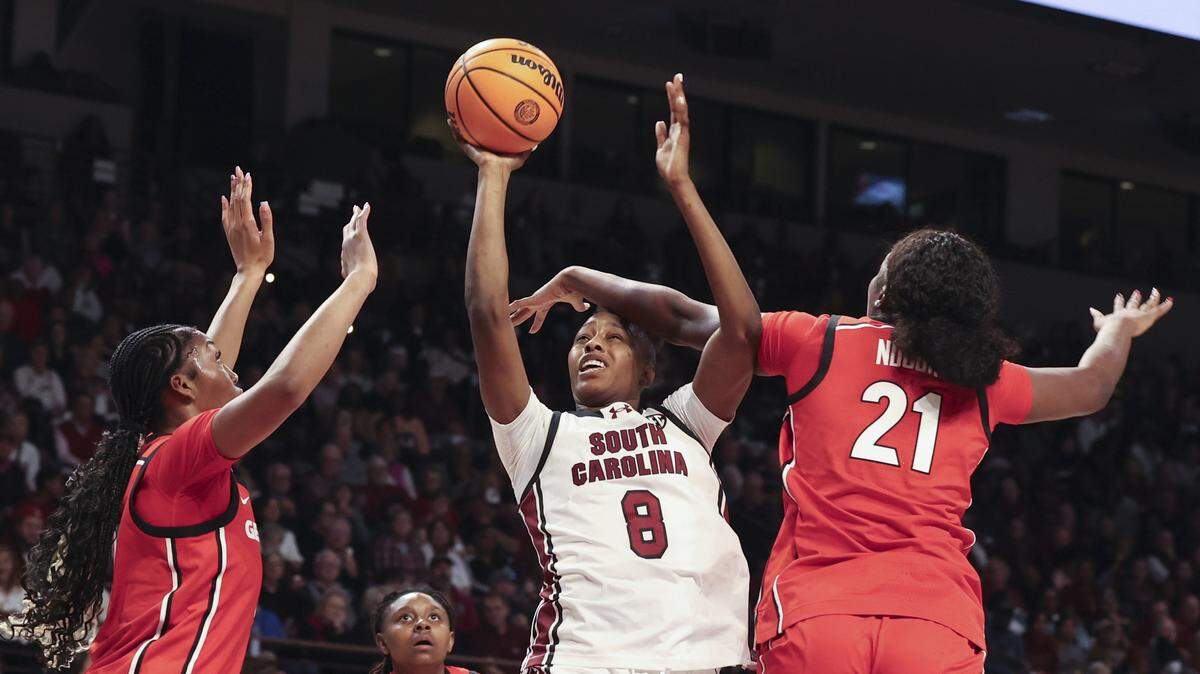
South Carolina’s path to a potential sixth-straight Final Four in Phoenix is set.
The Gamecocks are the fourth overall No. 1 seed in the 2026 NCAA Tournament. At first glance, it appears Dawn Staley’s squad has a favorable slate of opponents on their side of the bracket in Sacramento Region 4.
South Carolina will play its first game of March Madness this Saturday at 1 p.m. against the winner of a First Four game between No. 16 seeds Southern and Samford. Barring the literal second-ever upset of a No. 16 seed over a No. 1 seed (highly unlikely), South Carolina will play in the Round of 32 on Monday.
The Gamecocks would face the winner of the game between No. 8 seed Clemson and No. 9 seed Southern Cal. The Trojans are currently favored by 6.5 points, per ESPN.
National championship odds
South Carolina (15%) has the second-highest odds of winning a national championship this year, according to ESPN Analytics. UConn, by far, has the highest odds with a 48% chance to win.
No. 1 seeds UCLA and Texas have a 14% and 13% chance, respectively. No. 2 seed LSU has a 7% shot, per ESPN Analytics.
South Carolina’s region is matched up with Fort Worth Region 1 for the Final Four. That means the Gamecocks would likely play No. 1 overall seed UConn in the Final Four, should both teams advance that far. That would mean USC would have to win a rematch of last year’s national title game in order to advance to a second-straight championship game.
UConn probably has the best path. The Huskies should get by streaky teams like either No. 8 seed Iowa State, No. 5 seed Maryland or No. 4 seed North Carolina in the Round of 32 and Sweet 16 with relative ease. All signs point toward a potential clash between UConn and No. 2 seed Vanderbilt in the Elite Eight.
UCLA has looked dominant all year long and should breeze to the Final Four barring upset bids in the Elite Eight from what projects to be either No. 3 seed Duke or No. 2 seed LSU.
Texas looks primed to make another Final Four this year, but a potential Sweet 16 matchup with what projects to be No. 5 Kentucky or No. 4 West Virginia could be intriguing. A fight with No. 3 Louisville or No. 2 Michigan for a spot in Phoenix could be a possibility as well.
All season there’s been a clear divide between the top four teams in the country — UConn, UCLA, Texas and South Carolina — and everyone else. So there’s a solid shot fans could see the first Final Four made up of completely No. 1 seeds since the 2018 Tournament this year.
A look at Sacramento Region 4
Although South Carolina is the fourth overall seed, the Gamecocks look to have a pretty good path to the Final Four (at least on paper). The biggest challengers in the region project to be No. 4 seed Oklahoma (who beat South Carolina this season), No. 2 seed Iowa and No. 3 seed TCU.
There are four common opponents for South Carolina in the region in Clemson, Southern Cal, No. 4 seed Oklahoma and No. 7 seed Georgia. The Sooners are the only team from that list to beat South Carolina this year.
Here’s everything you need to know about the teams in USC’s region of the bracket:
No. 1 South Carolina
South Carolina is a No. 1 seed in the NCAA Tournament for the sixth consecutive year. The Gamecocks have been a No. 1 seed in March Madness 10 times now in program history. South Carolina (31-3) enters the tournament off a loss to Texas in the SEC Tournament championship.
The Gamecocks are powered by a starting five that all received All-SEC recognition this season, marking a tie for the conference record. Star sophomore Joyce Edwards leads the way with 19.6 points per game. Senior forward Madina Okot averages a double-double with 13.4 points and 10.9 rebounds. Ta’Niya Latson and Raven Johnson bring lethal offensive capabilities to the table. Veteran guard Raven Johnson was named the SEC Defensive Player of the Year and is enjoying an offensive renaissance in the final year of her career.
No. 2 Iowa
Second-year head coach Jan Jensen has the Hawkeyes back hosting the first two rounds of the NCAA Tournament after being a sixth seed in her first year. Iowa comes into the tournament 26-6 after falling to UCLA in the Big Ten Tournament title game.
Iowa is led by an All-Big Ten one-two punch in the post from 6-foot-5 sophomore Ava Heiden and 6-foot-2 senior Hannah Stuelke. Hedien leads the team with 17.4 points per game and is second with 13.4 points per game. Stuelke leads in rebounding with 8.5 per game and is second in scoring with 13.4 points per game.
No. 3 TCU
The Horned Frogs are back in the NCAA Tournament for the second-straight year after missing out on March Madness the prior 14 years. TCU is 29-5, marking the second-most wins in program history, and was upset by West Virginia in the Big 12 Tournament championship game.
TCU is led by Big 12 Player of the Year Olivia Miles. The graduate guard transferred in after a successful four seasons at Notre Dame, where she was a two-time All-American, and made an immediate impact for the Horned Frogs. Miles is averaging a career-high 19.6 points per game and leads TCU in assists with 6.4 per game. Another All-Big 12 First Team player to watch at TCU is senior Marta Suarez, who averaged 17.2 points.
No. 4 Oklahoma
The Gamecocks lost to two teams this season, and Oklahoma was one of those teams. The Sooners beat South Carolina 94-82 at home in January after a big push in overtime. Oklahoma comes into the tournament 24-7 with its most recent game ending in a big loss to LSU in the SEC Tournament quarterfinals.
The Sooners are powered by National Freshman of the Year candidate Aaliyah Chavez and All-SEC forward Raegan Beers. Chavez leads the team in scoring with 18.4 points per game, while Beers is averaging a double-double with 15.7 points and 10.4 rebounds per game.
No. 5 Michigan State
Michigan State started the year 17-1 and reached as high as No. 12 in the Top 25 this season but lost seven of its last 12 games to enter the tournament at 22-8.
The Spartans have four players who are scoring double-digit points a game in Grace VanSlooten, Kennedy Blair, Rashunda Jones and Jalyn Brown. VanSlooten leads the way with 15 points and is second on the team in rebounding with 6.6 per game. The senior forward, who started her career at Oregon, was an All-Big Ten second team member this year.
No. 6 Washington
Washington has earned its best seeding in the NCAA Tournament since the Huskies were a No. 3 seed in 2017. Washington is 21-10 entering the tournament, its second-straight March Madness appearance.
The Huskies are led by All-Big Ten first teamer Sayvia Sellers. The junior guard averages 18.5 points per game. Avery Howell is another name to watch for Washington. THe sophomore nearly averaged a double-double this year with 13.7 points and 8.3 rebounds per game.
No. 7 Georgia
The Bulldogs are making their first NCAA Tournament appearance since 2023, head coach Katie Abrahamson-Henderson’s first year at the helm of the program. Georgia enters March Madness at 22-9 but off a loss to Kentucky in the second round of the SEC Tournament.
Sophomore guard Dani Carnegie, who transferred in from rival Georgia Tech, is the best player on Georgia’s roster. She was an All-SEC First Team member this season after averaging a team-high 18.1 points per game. Carnegie is second in rebounding (5.3 per game) and assists (3.2 per game).
No. 8 Clemson
Head coach Shawn Poppie has Clemson dancing for just the fourth time since the 2000 NCAA Tournament. The Tigers are making their first March Madness appearance since 2019. Clemson enters the tournament 21-11, marking the first time the program has won more than 20 games since the 2000-01 season.
Clemson’s signature win of the season came over then-No. 9 Duke in the final weeks of the regular season. However, the Blue Devils did bounce Clemson from the ACC Tournament in the quarterfinals.
The Tigers are led by All-ACC Second Team member Mia Moore. The senior guard leads the team in scoring with 13.5 points per game and is third in rebounding with 5.4 per game.
No. 9 Southern Cal
This season has been a bit of a rebuilding year for Southern Cal. The Trojans were a No. 1 seed in the last two NCAA Tournaments but took a step back this year in the absence of generational talent Juju Watkins (ACL injury). Southern Cal peaked at No. 8 in The Associated Press Top 25 poll during the second week of the season and has been unranked since the second week of January.
Still, Southern Cal flaunts a talented roster. The Trojans are led by National Freshman of the Year candidate Jazzy Davidson. The 6-foot-1 guard leads the team in points (17.6), rebounds (5.7) and assists (4.2) per game. Davidson was an All-Big Ten First Team member and was named the conference’s Freshman of the Year.
No. 10 Virginia (First Four)
Dawn Staley’s alma mater is back in the NCAA Tournament for the first time since 2018. Virginia snuck in on the bubble after finishing the year 19-11.
The Cavaliers are led by All-ACC First Team member Kymora Johnson. The junior guard is averaging a team-high 19 points and 5.9 assists per game. Seniors Tabitha Amanze and Paris Clark are also players to watch. Both average just below 10 points per game, respectively.
No. 10 Arizona State (First Four)
Molly Miller has taken Arizona State back to the NCAA Tournament in her first year as head coach. This is the Sun Devils’ first March Madness appearance since they were a No. 5 seed in the 2019 NCAA Tournament.
Arizona State is led by Gabby Elliot and McKinna Brackens, both of whom earned All-Big 12 Second Team nods this season. Elliot, a junior guard, leads the team with 16 points and 2.5 assists per game. Brackens, a sophomore forward, averaged 14.6 points and leads ASU with 6.3 rebounds per game.
No. 11 South Dakota State
Head coach Aaron Johnston has turned South Dakota State into a lethal mid-major program during his 22 years leading the program. Johnston, SDSU’s only head coach in program history, has taken the Jackrabbits to 14 NCAA Tournaments in the last 18 years.
SDSU (27-6) clinched its fourth-straight appearance after winning a fourth-consecutive Summit League title. The Jackrabbits are led by two All-Summit League First Team members in Brooklyn Meyer and Madison Mathiowetz. Meyer led with a whopping 22.4 points and eight rebounds per game. Mathiowetz averaged 13.6 points per game.
No. 12 Colorado State
Colorado State is back in the NCAA Tournament after the 27-7 Rams clinched their first Mountain West Conference Tournament title since 2016.
Senior guard Lexus Bargesser, an Indiana transfer, earned the Mountain West’s Newcomer of the Year Award this season. Bargesser led Colorado State with 15.2 points per game and was second on the team in rebounds (5.8) and assists (2.7) per game. CSU also has two talented sophomores in Brooke Carlson and Kloe Froebe, who both averaged double-digit points per game this season.
No. 13 Idaho
Head coach Arthur Moreira has the Vandals in the NCAA Tournament for the first time since 2016. This is the highest Idaho has been seeded in March Madness since they were a No. 5 seed in the 1985 NCAA Tournament. Idaho enters the tournament 29-5 and fresh off a Big Sky Conference Tournament (aka Starch Madness) championship win over Montana State.
The Vandals are led by Hope Hassmann, Kra Gardner and Debora dos Santos. Hassmann — a Big Sky First Team member alongside Gardner — leads the team with 14.2 points per game. Gardner, a Washington State transfer, was also named the Big Sky Newcomer of the Year after averaging 12.8 points per game. Dos Santos averaged 11.3 points and 8.4 rebounds off the bench, earning her the Big Sky Top Reserve award.
No. 14 UC San Diego
Head coach Heidi VanDerveer is taking the Tritons to their second NCAA Tournament in the program’s sixth year in existence. UC San Diego was a No. 16 seed in last year’s tournament but earned a No. 14 seed this year after the 24-8 Tritons beat Hawaii in the Big West Conference Tournament championship.
UC San Diego is led by two All-Big West first team members in Erin Condron and Makayla Rose. Condron led the team with 15.7 points and 8.6 rebounds per game, while Rose averaged 12.8 points and 4.7 rebounds this year.
No. 15 Fairleigh Dickinson
After over 40 years without an NCAA Tournament appearance, head coach Stephan Gaitley has now earned the FDU a March Madness bid in back-to-back years. The Knights are 29-4 after beating Long Island in the Northeast Conference Tournament championship game.
Senior guard Madlena Gerke won the NEC Defensive Player of the Year for the Knights. Sophomore guard Ava Renninger, who led FDU with 12.7 points and 5.2 assists per game, earned an All-NEC First Team nod with her play this season.
No. 16 Southern (First Four)
Head coach Carlos Funchess has Southern back in the NCAA Tournament for the second-straight year after winning the SWAC Tournament championship.
The Jaguars (19-13) get their scoring done from several different players. No one on the roster averaged more than 10 points a game, but six players averaged between 5.6 and 9.7 points. Demya Porter leads Southern with the latter statistic and is second on the team with 5.3 points per game. Porter also earned an All-SWAC Second Team nod.
No. 16 Samford (First Four)
Samford had long odds to make it to the NCAA Tournament this year but managed to do it anyway. The Bulldogs haven’t had a winning season since 2020-2021 and enter the tournament 16-18 this year.
Samford was the No. 6 seed in the SoCon Tournament, but in true March Madness fashion, strung together three upsets to win its first SoCon Tournament championship since 2012. This is Samford’s third NCAA Tournament appearance and the first since making it in back-to-back years in 2011 and 2012.
The Bulldogs are led by a one-two punch of Briana Rivera (11.5 points) and Kaylee Yarbrough (12.2 points).
This story was originally published March 16, 2026 at 1:28 PM.