
No patrons at Augusta National: Streaks busted for loyal Masters fans from Midlands
Records are made to be broken. But like this? A “consecutive” streak snapped by a disease?
Larry Mattox digests the news that the 84th Masters that starts Thursday will be played without spectators and understands he will not be at Augusta National Golf Club for the first time since 1962.
“I’ve had to change,” the Columbia resident says. “Instead of telling people that I have been to 58 consecutive Masters, I tell them, ‘I have been to 58 consecutive Masters that I was allowed to attend.’”
The no-patron policy obviously impacts countless people who build their schedules around the Masters and the businesses in the Augusta area.
“But we will have our memories,” says Billy Routh, whose family’s roots run deep — back to the mid-1950s — at the major championship that COVID-19 forced a move from April to November this year.
Indeed, Mattox almost certainly has seen more “Masters Moments” in person than anyone. Although there are patrons who have attended more consecutive Masters, Mattox’s approach — attend all four days and always be on the move — sets him apart.
“I only sit strategically,” he says.
Bobby Foster, another “regular” from Columbia whose Masters’ history dates to 1959, talks about his usual plan to watch from behind the seventh green before moving to take up station along the par-3 16th.
“There’s no more beautiful spot on Earth to watch golf,” Foster says of the azaleas’ spring-time splendor that frame No. 16.
Foster can talk about being invited onto the practice tee by Bruce Devlin.
Routh witnessed Larry Mize’s improbable chip-in that broke Greg Norman’s heart in 1987.
Maddox’s treasure chest of memories includes witnessing this 2012 trifecta: Louis Oosthuizen’s double-eagle on the par-5 second hole, Phil Mickelson’s demise on the par-3 fourth and Bubba Watson’s dramatic escape from the trees on No. 10 in the playoff.
Yes, he gets around. Just check out video of Bubba’s miracle on the internet. The guy on the left wearing the black shirt, white shorts and bucket hat is Larry Mattox.
He savors the thought and says, “Just another day at the Masters.”
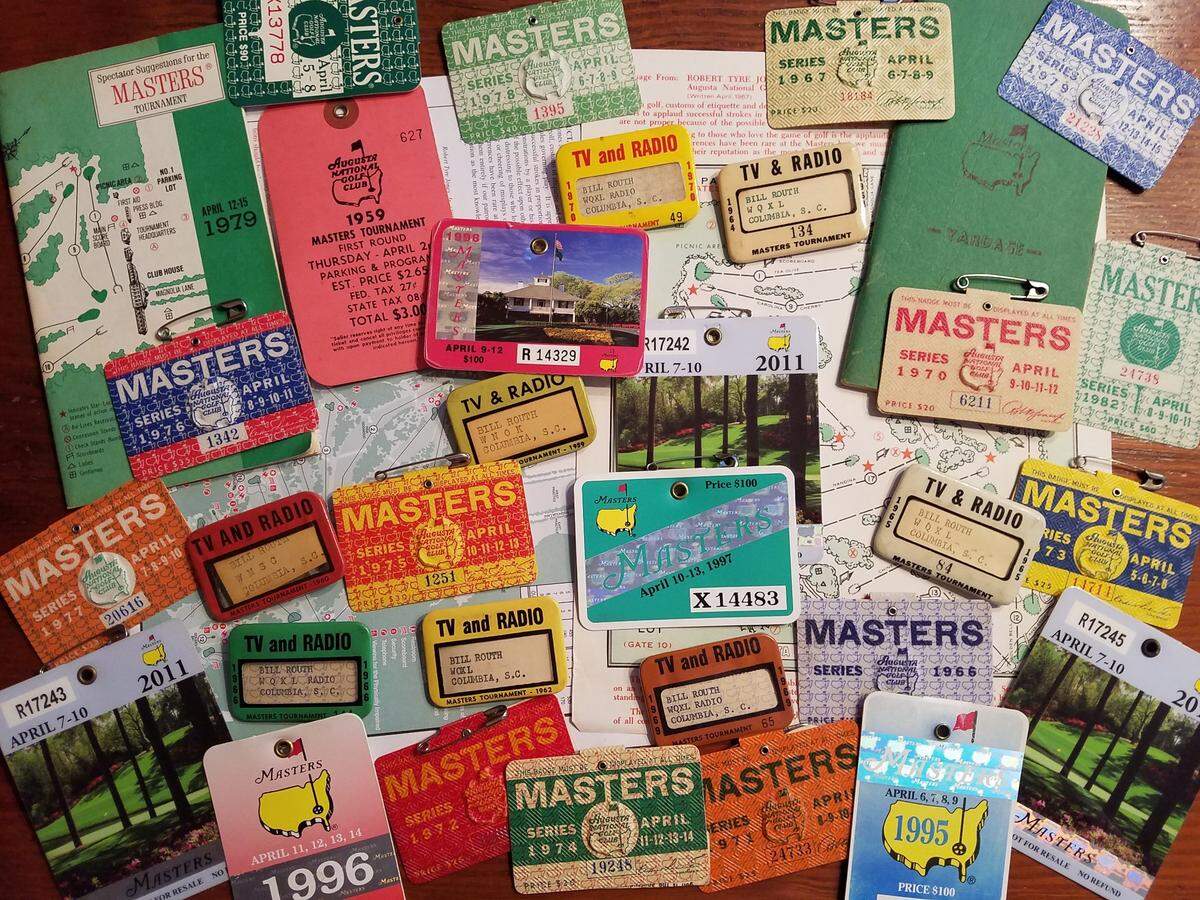
A FAMILY AFFAIR
Bill Routh worked in radio in the mid-1950s and his providing reports on the Masters to Columbia stations began a family tradition that endures all these years later. The media credentials from his early years and later tournament badges — he bought the first ones in 1965 for $15 each — all have a story to tell.
“He got us hooked on the Masters,” says Billy Routh, one of Bill and Shirley Routh’s six children. “We have four badges and deciding who gets to go on which day goes back and forth like a debate in the United Nations. But it always works out.”
Every day at the Masters creates memories that become etched forever in the family lore. There’s the picture of Billy and his hero, Arnold Palmer, and another of Billy and sister Julie Routh Carlton providing the up-close background for Tiger Woods’ receiving congratulations from Lee Elder after his spectacular triumph in 1997.
“I followed (Palmer) many times and getting to meet him after a practice round in 1989 always will be special,” Billy Routh says. “We were there for the dedication of his plaque on the course in 1995 and saw him walk up the 18th fairway for the last time.
“We were beside the 18th green when Tiger won in 1997 and Lee Elder was there to congratulate him. He was headed down the hill to Butler Cabin when the picture was taken.”
Routh can talk about sitting alongside the 13th fairway next to television star and singer Tennessee Ernie Ford.
“Every time somebody came up for an autograph, he asked me to hold his beer,” he says. “When Chi Chi Rodriguez played the hole, Ford yelled at him and he came over. They talked and laughed for a few minutes.”
Then there’s the day he had a ringside seat to watch history unfold.
“We thought there would be a playoff that year (1987) and headed to the 11th hole,” Routh says. “They started (playoffs) on No. 10 in those days, and people have asked why we didn’t go there. We just believed it would go at least a couple of holes.”
Sure enough, Greg Norman and Larry Mize came to No. 11 after Seve Ballesteros had been eliminated with a bogey on No. 10. Norman’s second shot found the green, Mize’s came to rest pin high but off the green, 140 feet from the pin.
“And (Mize) made it,” Routh says. “In addition to that, while we walked back out, a guy asked, ‘Did you see that?’ It was Bill Murray.”
Bill Routh, who passed away in 2015, kept meticulous records on the family attendance, and Billy says: “He would take us when we were old enough to behave. I got to go when I was 10, but I must have done something (wrong) because I didn’t go back until I was 12.
“We all fell in love with the golf course and the tournament. There’s a good memory from every hole and every tournament. We’ll miss it, but hopefully things will be back to normal in April. This time, we’ll be glued to the TV and can’t wait to get back.”
THE PLAYER
Visions of triumph and cheer at the loftiest level are never far away in a high-profile junior golfer’s fantasies, and Bobby Foster is no exception. And what better place to fuel the dream than Augusta National Golf Club at the Masters?
Now a member of the South Carolina Golf Hall of Fame, Foster’s first Masters came in 1959 — “the year Art Wall birdies five of the last six holes to win,” he says — and watching Tommy Bolt left an indelible impression.
“Bolt was such a great shot-maker,” Foster says. “I watched him, then went back and told Melvin Hemphill (famed teaching pro at Forest Lake Club) to show me how to move the ball around like (Bolt).”
Five years later and then a decorated junior golfer, Foster played an exhibition alongside Australian pro Bruce Devlin on Monday of Masters week. The pro shot 65, Foster 70, and Foster says, “He told me to look him up at the Masters if he made the cut.”
Devlin did advance to the weekend and, on his way to the practice tee to warm up for Saturday’s third round, he spotted Foster. They made eye contact, and the pro took the high school junior into the practice area.
“That was a magical day for a 16-year-old,” Foster says, still savoring the memory all these years later. “He shot 66 (to get in contention) and afterward took me into the clubhouse. The next day, he birdied the first two holes, then bogeyed three and four. Arnold Palmer went on to win his last (of four) Masters and Bruce finished fourth.”
Foster developed a friendship with the Nicklaus family through their work with youth and the Fellowship of Christian Athletes, and he treasures the days he walked the course with Barbara Nicklaus.
Nowadays, he generally starts his days at the Masters near the seventh green to watch the golfers use the putting surface’s slope to get their balls near the hole ... or not. Then, it’s over to No. 16 and its breath-taking scenery.
“I’ll miss being there, but (the no-patrons policy) is the right decision,” Foster says. “I’m like everybody else; I’ll be watching on television. It’s the Masters and it’ll be great.”
.JPG "scball_GM284 (1).JPG")
THE MOVING MAN
“Every day at Augusta National is a great day,” Larry Mattox says, no doubt speaking for almost everyone who has attended a Masters and certainly speaking from experience.
He got his first taste of the Master in 1962 and has missed only a handful of rounds since — a couple when his college golf team’s schedule conflicted and one after a death in the family.
“Mostly, it’s 58 (years) times four (rounds), plus some practice rounds,” he says. “I’ve got memories across the board.”
His man-on-the-move strategy enabled him to see Tom Weiskopf make a 13 on the par-3 12th hole or watch Johnny Miller charge into contention in 1975. He can talk forever about this year or that, but topping his experience in 2012’s final round would be almost impossible.
Only historians and aficionados remember that Peter Hanson began that Sunday with a one-stroke lead, and most believed the day would end with Phil Mickelson donning another green jacket.
Instead ...
“I saw (Louis) Oosthuizen make his double-eagle on No. 2,” Mattox says. “We were along the right side about 100 yards up from the green. You can’t see the hole with the back-right pin if you’re closer.”
Oosthuizen’s second shot on the par-5 hit the green, then took the slope and crawled toward the hole before dropping in one of the more famous of Masters moments.
Checking out Mickelson would be his next challenge, and he took up station on the left side of the par-3 fourth hole. Mickelson blocked his tee shot that, Mattox says, “clanked off the grandstand left into the bushes. He’s in a mess. He has no place to (take an unplayable lie) drop and he didn’t want to go back to the tee. He tried to chop it out right-handed.”
The ball squirted only a few feet — to where Mattox stood. “So close,” he says, “that our shadows were over the ball and we had to back up. Phil made triple (bogey) and that took him out of the tournament.”
As usual, however, drama built, and Bubba Watson and Oosthuizen went to a sudden-death playoff. After halving the 18th, they moved to No. 10.
Mattox again: “I went down the right side and Bubba’s tee ball sailed over my head. I was the first one to stop at the ball. If he’s five yards back, he has no shot. The ball stopped perfectly for him.”
Watson, of course, embraces the if-I-have-a-swing-I-have-a-shot theory, and he proved it, slamming a screaming hook out of the trees and onto the green. Soon, he would be donning the green jacket.
“If he’s right-handed, he has no shot,” says Mattox, speaking from the perspective of a one-time scratch golfer. “A right-hander just couldn’t fade the ball like a left-hander like Bubba could hook it from that position.”
So many years, so many rounds, so many memories, Mattox says, “and they never get old.”
This year will obviously be different but no less anticipated.
“I’ll definitely be watching on TV,” Mattox says. “There’s always something unexpected and exciting.”
Next year if the pandemic allows? The streak will live in Mattox’s mind.
“That,” he says, “will be 59th consecutive Masters that I was allowed to attend.”
About this year’s Masters
- The 84th Masters begins Thursday with Jack Nicklaus and Gary Player as honorary starters.
- ESPN’s College GameDay will live from Augusta National on Saturday, Nov. 14. The studio will be staged overlooking Ike’s Pond and the 9th green of the Par 3 course.
- The Par 3 contest, traditionally played Wednesday of Masters week, has been canceled.
Masters 2020 TV details
- Thursday: 1–5:30 p.m., ESPN
- Friday: 1–5:30 p.m., ESPN
- Saturday: 1-5 p.m., CBS
- Sunday: 10 a.m.-3 p.m., CBS