What could sports look like in fall during COVID-19? Lexington Blowfish offer glimpse
No one needs to warn Doug Brash about COVID-19. He has seen it. He knows what it can do.
A physician at the Bamberg Barnwell Emergency Medical Center in Denmark, Brash said he has seen a “significant increase” in COVID-19 patients in the past six weeks, in line with the surging South Carolina case numbers. He has seen the virus attack patients in wildly different ways, from no symptoms to horrible symptoms to everything in between.
But, on Wednesday night, Brash was ready to see something different. Something positive. He wanted to watch his son play baseball — and not from a faraway parking lot or from an internet stream.
From the front row.
Joined by wife Ingrid, Brash was one of 285 spectators to walk through the front gates of Lexington County Baseball Stadium on Wednesday for a Lexington County Blowfish game. It was the first Blowfish game that fans were allowed to attend this season.
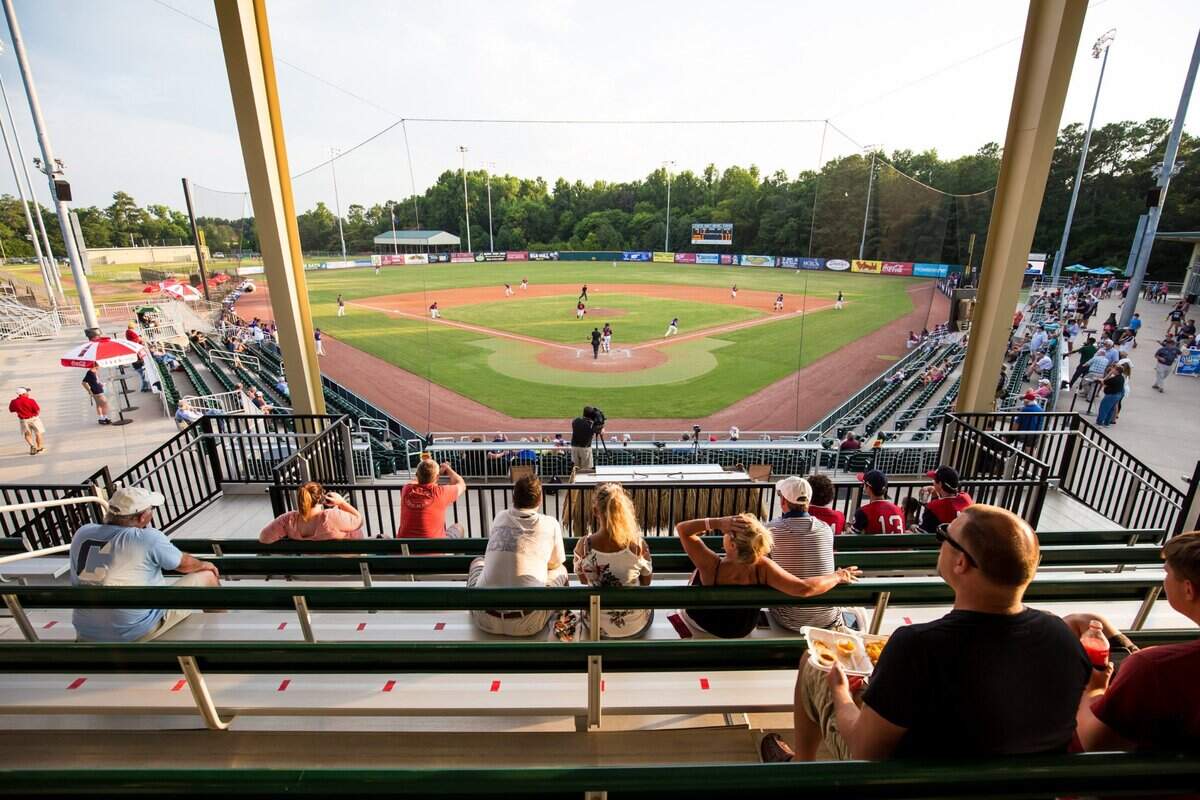
Doug and Ingrid sat directly behind home plate to watch their 19-year-old son, Ryan Brash, play catcher. No one sat near them. The stands hold 2,400 people, and two-thirds of the seats were off-limits, marked off by tape. Families sat in small clusters scattered throughout the facility. Most fans wore masks. A couple of fans wore face shields over their masks. Some put their masks in their pockets when they sat down. Others wore no mask at all.
At a time when coronavirus cases are soaring and questions abound about how to move forward, Wednesday night’s game felt nearly — jarringly — normal: the laughter of children, the smell of hot dogs and chicken fingers, the distinctive “whack” of wooden bats.
“This is good — for people to get out and actually get some sunshine and say hello to your neighbor six feet away,” said Brash from his front-row seat, while wearing an American flag face mask.
“That’s a good thing. People are social animals.”
Brash emphasized the importance of social distancing and mask-wearing, saying that the virus should not be taken lightly. But he also said he felt safe at the ballpark, as long as fans abide by safety guidelines. He expressed optimism that, eventually, the threat of the pandemic will lessen.
“It’s not going to be forever,” Brash said. “We’ll all be back to normal again. It might take a little while, but yeah, eventually we will.”
The return of sports is an important checkpoint on the road to normalcy. Sports have long been a galvanizing force in American culture, especially in times of strife. But the outlook for the wide-scale return of sports this fall remains murky at best.
The Ivy League, Mid-Eastern Athletic Conference and the Patriot League canceled fall athletics. The National Junior College Athletic Association pushed its football season back to spring. Both the Pac-12 and the Big Ten shifted to conference-only football schedules. With positive COVID-19 cases already popping up at football workouts across the country, including Clemson, the safety of a college football season has been called into question.
Even if games are played this fall, will it be safe for fans to attend them? That’s a question with a fluid answer. Of the few sports in action during the pandemic, some, like the PGA Tour, prohibit spectators. Others, like NASCAR, have tested the waters. Bristol Motor Speedway in Tennessee hosted a reported 20,000 fans for Wednesday’s NASCAR All-Star Race.
Though the Blowfish hosted far fewer fans, Wednesday night’s game provided South Carolinians with an initial glance at what sports could look like in the state during the pandemic.
In many ways it was an experiment, designed to prove that sports can be played in front of fans — and done so safely.
‘This is a model’
In the two weeks before Wednesday, the Lexington County Blowfish played in silence. No fans and no noise for five games.
Cam Kirker, a 69-year-old senior usher at the stadium, remembers his phone going off during one of those games.
“My ringtone is a blues riff, and it was really loud,” Kirker said. “So you could hear it bouncing off the outfield walls, and there was no other sound. It was just eerie. It was really weird.”
An empty stadium was never the plan. Team co-owners Bill and Vicki Shanahan wanted to welcome fans during the Coastal Plain League season opener on July 1, based on guidelines from the Lexington County Recreation and Aging Commission, which owns the facility.
But two hours before first pitch, Gov. Henry McMaster was asked during a press conference about the Blowfish hosting spectators and responded: “Spectator sports are not allowed under the existing executive order. Those who violate those lawful orders, there will be consequences of some kind.”
That comment plunged opening night into chaos, prompting the Blowfish to reach out to the governor’s office for clarification. Minutes before the start of the game, Bill Shanahan told fans gathered at the stadium entrance that the Blowfish had been classified as a nonessential business and that no one would be allowed to enter.
In the subsequent weeks, the Shanahans set out to prove the team was mislabeled. During Tuesday’s Lexington County Council meeting, Bill and Vicki Shanahan argued that the Blowfish — a summer team composed of college athletes who play without compensation — should be classified as an amateur youth sports activity. Since June 15, amateur youth sports teams have been allowed to play in South Carolina, with or without spectators, under AccelerateSC guidelines and an executive order from McMaster.
The council agreed with the Shanahans and voted unanimously on a resolution to classify the Blowfish as an amateur youth sports team and to allow the Blowfish to host spectators, with council vice chairman Todd Cullum saying the county stood “shoulder to shoulder” with the Shanahans.
“Play ball,” chairman Scott Whetstone said after reading the full resolution in the council chambers.
The next day, that resolution was enlarged to poster size and displayed proudly at the front entrance of the baseball stadium. And Whetstone attended the game himself, with family, sitting a few rows behind home plate.
Whetstone said that the Blowfish have made a significant contribution to the community since moving to Lexington County in 2015 and that local families benefit from having a safe entertainment outlet.
“I think it’s huge,” Whetstone said. “You have to have socialization. People have to be able to see other people. ... Especially young kids and children. They need that. And this gives a place to do it. And look at the surroundings: people can get plenty of distance in between each other in this facility and still enjoy, still talk to each other and families can sit together. So it’s very important to Lexington County.”
Whetstone commended the Shanahans on their stadium safety guidelines, which he said go “above and beyond.”
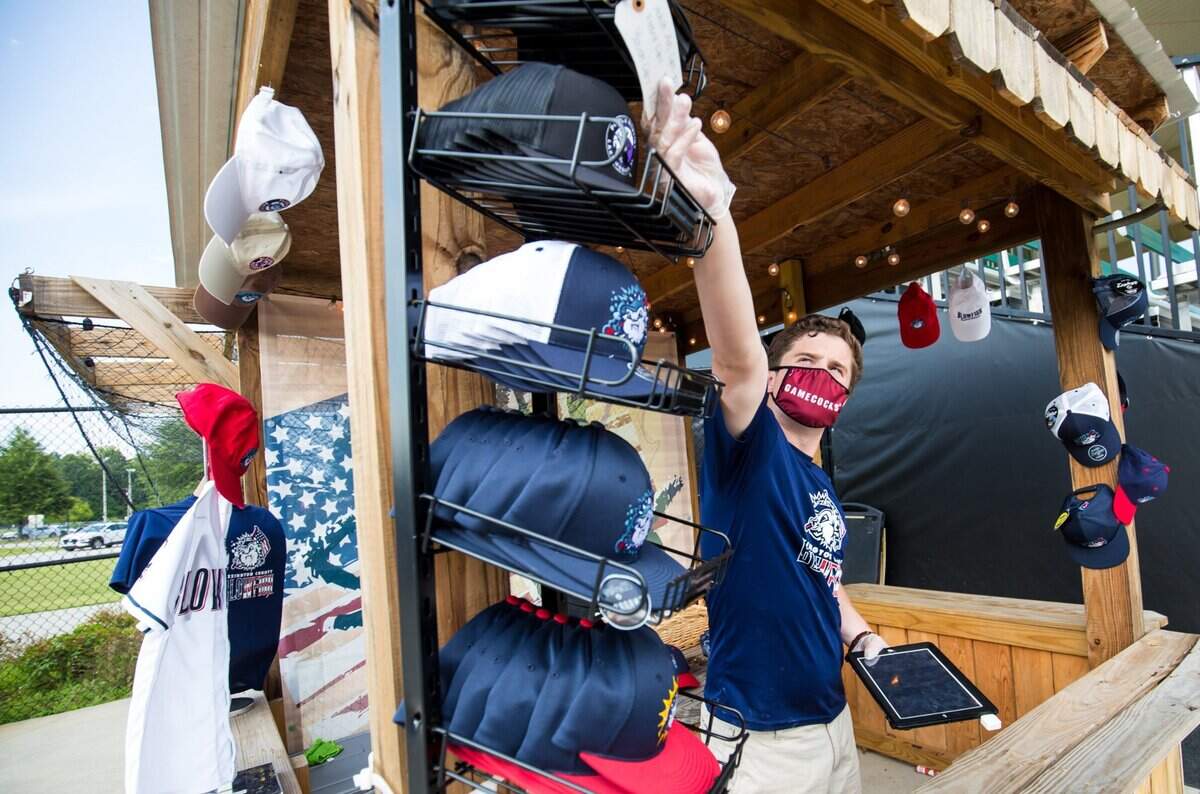
On Wednesday night, every Blowfish employee wore a mask, and concession stand employees wore gloves and stood behind sneeze guards. A multitude of signs and PA announcements advised fans to wear masks and maintain six feet of distance, with markings on the ground to serve as guidance. Every fan had his or her temperature checked before entering the facility and had access to a plethora of hand-sanitizing stations. As fans migrated around the concourse, stadium employees followed closely behind, spraying tables and railings with disinfectant.
Shanahan said he studied the COVID-19 safety guidelines from Disney theme parks when he crafted the Blowfish rules. His attention to detail was clear.
“I’ve been in this game so long — 35 or 36 years — that the old story is expect the unexpected and adjust to the adjustment, and that’s what we had to do,” Shanahan said. “... I’m very pleased. And the fact is people got to enjoy watching a baseball game. And it’s a nice way to start. It’s a beautiful night, people are sitting back and enjoying watching baseball in our beautiful little ballpark.”
Multiple fans said they felt safe in the ballpark and trusted the stadium’s safety measures. Bob Herring was one of the fans who was turned away on July 1 after McMaster’s ruling, and he said he found the decision “frustrating.” On Wednesday, he and his wife were back in their customary seats, wearing face masks and keeping score with every pitch. Many other families snapped back into familiar routines. Skip Broome was able to bring his 14-year-old son back to the same ballpark where he once served as a ball boy. Three young travel ball players took in the action from seats just below the press box.
Could South Carolinians soon see similar scenes at other stadiums across the state, even amid a pandemic?
Whetstone thinks so.
“This is a model,” Whetstone said. “This is a way to see how to do it and to let the kids get out there and play and figure out the socialization. Most of these schools in the area, they have big enough facilities where they can do the same thing. They can socialize everybody in a good area. You take a River Bluff or a Lexington or even a Pelion, they’ve got big stadiums.
“You cut the capacity back, and you let kids go play.”
The weeks ahead
A 62-year-old Army veteran who served three tours in the Middle East, Rick Wise knows what it’s like to be away from baseball for a summer. Wise is a lifelong fan of the sport, so much so that he used to watch tapes of old Braves games while deployed overseas.
Because of those experiences, Wise doesn’t take the game for granted. Time near a baseball field is precious to him. That’s why he was among the fans who tried to enter Lexington County Baseball Stadium on July 1 and why he came back Wednesday night. Wearing a USC face mask, the Gamecocks alum stood at a table on the third-base concourse, drinking a Coke and eating a hot dog. His wife, who is immunocompromised and at high-risk for complications from COVID-19, stayed home.
There was no hint of fear in Wise, who said he trusted Shanahan and the rules the Blowfish put in place. Even still, with COVID-19 cases continuing to rise around the state, Wise said he’s not sure if he would feel safe attending other, larger sporting events. And he wasn’t the only fan to express that sentiment.
“The venue here is big enough, two hundred people spread over a ballpark, that’s easily done,” Wise said. “But when you’re looking at Carolina football and those things, to get the numbers of people that you would expect there and how you would be able to do all that, it’s just a difficult decision.
“My son and his girlfriend just recently went to Universal Studios, and there were signs on the roller coasters that said, ‘Do not scream. Screaming spreads COVID.’ I’m not sure I could sit at a Carolina game and be quiet. It’ll be very abnormal to do that.”
While the Lexington County Blowfish could serve as a model for other sports in the area, it’s necessary to recognize that one team’s protocols might not translate to another and that one size doesn’t fit all. In normal times, both South Carolina and Clemson can host upwards of 80,000 fans at their respective football stadiums, compared with 2,400 for the Blowfish. Earlier in the summer, both schools acknowledged plans to limit capacity and to social distance at games, but it’s unclear how rising COVID-19 cases and the evolving national discussion could affect those plans.
And, of course, fan capacity is a moot point if the athletes themselves aren’t able to stay healthy.
For the Blowfish, all players were tested for COVID-19 before the start of the season. Outfielder Brady Allen, who plays college ball for the Gamecocks, said that each member of the Blowfish has his temperature checked every day and that players wear masks in the locker room.
“If one of us gets it, the league might shut down,” Allen said. “We’re taking it very seriously.”
Playing the first few games of the season in total silence was “a little weird,” Allen said, adding that the team was excited to see fans back in the stands on Wednesday. However, even Allen expressed some skepticism about seeing spectators at Gamecocks games.
“I don’t want to say anything to get my own hopes up,” Allen said. “I would love to see that work and if everyone wears a mask and limited seating and good space between everyone, I think it could work, and I hope it does because I love playing in front of fans. Them cheering for us really pumps us up and gives us motivation.”
For now, the Blowfish will remain one of the few live sporting options for South Carolinians this summer as the team plays a truncated schedule through Aug. 15. With the Shanahans’ commitment to safety, the Blowfish organization has an opportunity to set a positive example and show that sports, with some modifications, can work during a pandemic.
“I think people are very careful,” said Patrick Montgomery, a season-ticket holder who also runs a smoothie stand on the stadium concourse. “The natural inclination is to shake hands and hug people that you’ve seen over the years because the season-ticket holders, they’ve really become close. You look forward to coming here. Opening night is like a family reunion.
“And this year has been very difficult. You can’t hug. You can’t shake hands. It’s kind of muted from years past. But I think as we get rolling, people will be more comfortable.”