
Flood victim’s death sparks questions about Fort Jackson dam
The rubble of a broken dam spread across the soggy ground at Fort Jackson early on the morning of Oct. 4, the result of a storm that weakened the structure and caused it to wash away.
About 2 miles downstream, Bob McCarty was dead in his car.
Rising water had engulfed his vehicle before 7 a.m., trapping him inside and killing the 78-year-old Army veteran, according to the Richland County Coroner’s Office. Authorities found his body later that day.
McCarty’s widow, Lois, said it’s obvious to her the broken dam at Semmes Lake played a role in her husband’s death.
“I feel like it contributed,” she said, comparing the flood that killed her husband with “a tsunami and a raging river.”
No one yet knows the full story of Bob McCarty’s death or what impact the Semmes Lake dam failure played, if any, in the tragic events of Oct. 4.
But plenty of questions remain, seven months after the historic flood.
Richland County Coroner Gary Watts is among those who say the broken Fort Jackson dam can’t be dismissed as a possible reason for McCarty’s death and the death of a woman that same morning nearby.
“To me, it sounds like that’s exactly what happened,” Watts said.
View TIMELINE in a separate window
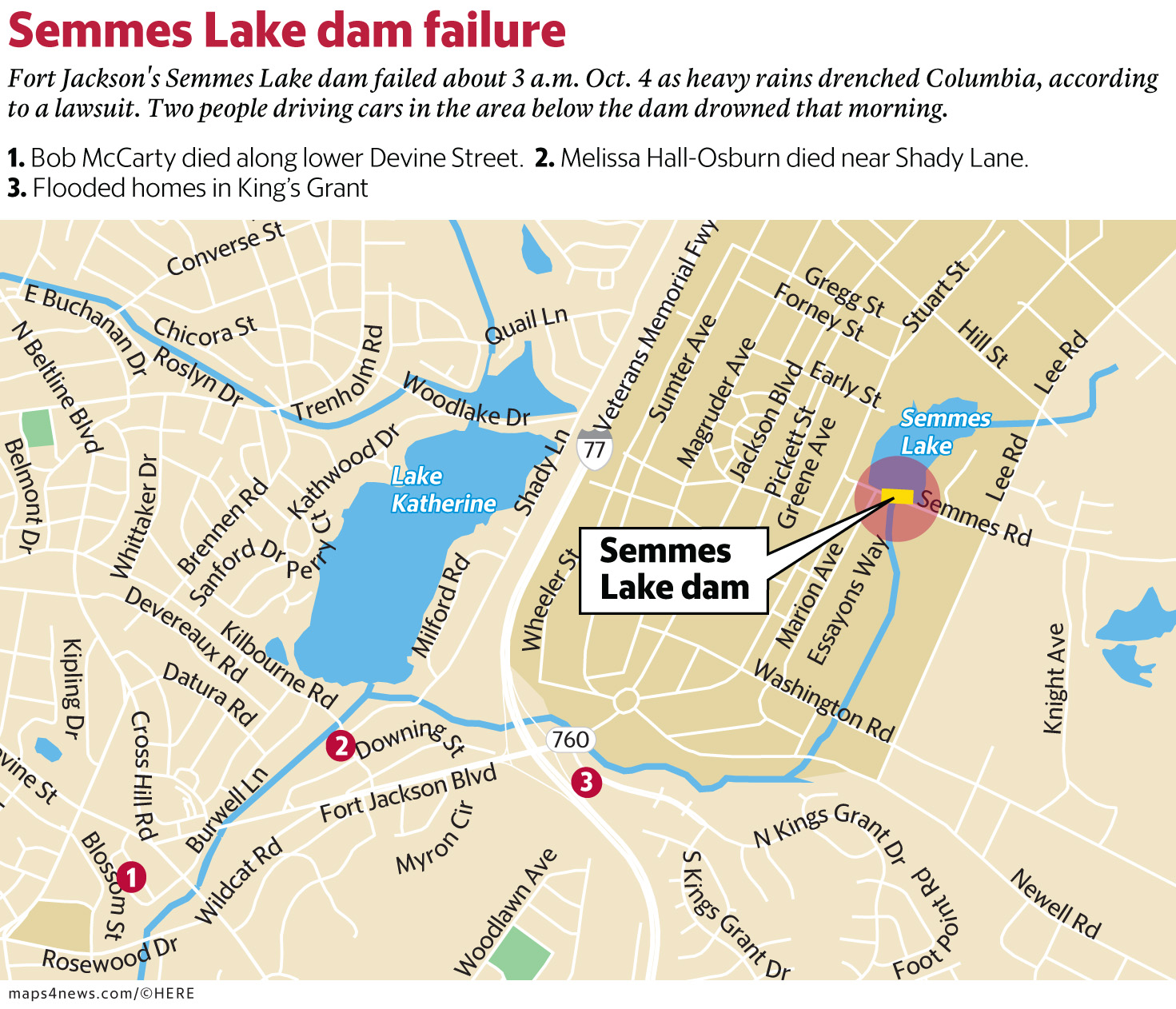
Both victims died in the lower Devine Street area below the Semmes Lake dam. High water in the area came from numerous sources, including water pouring directly down Gills Creek from far upstream. But the failure of the Semmes Lake dam became a focal point last week.
About 25 residents of the King’s Grant neighborhood filed a federal lawsuit Monday, saying Army officials didn’t fix the dam when they knew the structure was a “serious hazard.” Water released when the dam broke flooded their homes, causing up to $20 million in property damage, the suit said.
Although the King’s Grant lawsuit is a property damage case, it provides a timeline that could be useful in determining how – and if – the Semmes Lake dam added to flooding along the section of Devine Street where McCarty died. Of the dams known to have broken the morning of Oct. 4, the one at Semmes Lake is closest to the King’s Grant and Devine Street areas.
The lawsuit says the 76-year-old earthen dam failed about 3 a.m.
Between 4 a.m. and 5 a.m., flood waters began rising and pouring into homes in King’s Grant, a neighborhood along Wildcat Creek near Fort Jackson, the suit said. Water covered the first floor of many houses, rising up to 9 feet at the peak of the flood, records show.
By 8 a.m., water levels had subsided in King’s Grant – but not before McCarty and another person, Melissa Hall-Osburn, had died, according to the lawsuit and the coroner’s office.
Both McCarty and Hall-Osburn, 35, were found in their cars below King’s Grant, not far from where Wildcat Creek runs into Gills Creek. Hall-Osburn died near Shady Lane between 5:20 a.m. and 6 a.m. while McCarty’s estimated time of death was 6:30 a.m. to 7 a.m., according to the coroner’s office. McCarty’s body was found on lower Devine Street near a grocery store and a title loan building, Watts said.
Hall-Osburn’s husband, identified in an obituary as Terrance Osburn, could not be reached. He has had a difficult time since her death and is not ready to talk publicly about the tragedy the family suffered, a relative told The State newspaper. A mother of two who worked at a local answering service, Hall-Osburn drowned near her home after leaving for work that morning, records show.
Lois McCarty, a neighborhood leader in the Cedar Terrace community, has plenty to say about the possible reasons her husband died.
Bob McCarty had worked for the state Housing Authority for years until retiring in 2005. He was a hardworking, duty-bound person who deserved a better fate than to be killed in a flood, she said. She’s upset at what she said is an apparent lack of maintenance by the military of dams on Fort Jackson.
“Why weren’t they maintained?” Lois McCarty asked. “It wasn’t like the United States was going to be less broke if they fixed those dams. That is something vital.”
Records obtained late last year by The State newspaper show the Semmes Lake dam had been noted in a 2013 inspection as hazardous. Problems found in the 2013 inspection might have led to its failure during the flood, according to an inspector’s email obtained by the newspaper.
Court records show as much as 208 million gallons of water poured out of 29-acre Semmes Lake toward Wildcat Creek, which drains into Gills Creek upstream from where Bob McCarty died on lower Devine Street.
Federal military officials have declined to answer questions about what steps, if any, the fort took to make repairs to the Semmes Lake dam. The U.S. Army Corps of Engineers has also refused to release records detailing inspections of dams on the fort. Fort Jackson officials declined comment Friday.
Boulevard of death
The area where Bob McCarty’s body was found is part of what typically is one of the busiest roads in Columbia, lower Devine Street as it approaches Rosewood Drive extension. The four-laned road, which is lined with fast food restaurants and retail businesses, runs through low-lying property and across the main channel of Gills Creek.
On the day of the storm, record high flood levels occurred at a bridge on Devine Street about a mile downstream of where Wildcat Creek drains into Gills Creek. Water covered Devine Street for hours.
Peak stream flows reached nearly 20 feet at the Gills Creek bridge Oct. 4, according to the U.S. Geological Survey. That’s more than twice the level of the highest flow recorded at that spot since at least 1965, the survey said in a report released shortly after the October storm.
What isn’t known yet is how much water from the broken Semmes Lake dam made its way down Wildcat Creek and into Gills Creek at the time Bob McCarty was driving through.
Experts say that even without the Semmes Lake dam break, Gills Creek likely would still have been swollen from heavy rain. At least two dams off the Army base, including a state-regulated dam at Cary Lake, also broke Oct. 4. But the exact times of those failures remain unknown.
Federal scientist John Shelton said water from the failed Semmes Lake dam – as well as water from other dam failures on Gills Creek – might have contributed to the flood at Devine Street at some point during the storm.
“A lot of the flooding at Gills Creek was, potentially, due to all the dam failures,” said Shelton, a U.S. Geological Survey researcher who wrote a report about the flood. “That put out a quantity of water at the (Gills Creek) channel that the channel was not prepared to handle.”
The Devine Street area was among the worst hit in Columbia during the October storm, which over several days dropped more than a foot and a half of rain in the Gills Creek watershed, which runs through the city. The flood caused property damage across the city and resulted in the deaths of nine people in the area. The only two deaths near Semmes Lake were those of McCarty and Hall-Osburn, who died about a mile away from the Army dam.
While many of the events surrounding the flood are still being sorted out, more lawsuits are expected against the federal government over failed dams at Fort Jackson. The suit filed last week by owners of about a dozen King’s Grant houses focuses on damage to homes inside the gated, high-end community next to the fort. But scores of homes and businesses that flooded last October lie below King’s Grant.
Columbia lawyers Pete Strom, who filed the case, and Jones Andrews say the broken dam at Semmes Lake will be a point of legal disputes for some time.
“All this water that came down ... is consistent with the dam failure at Semmes,” Andrews said. “But there are questions we are still trying to get answered.”
Camden tragedy
Lois McCarty has spoken with attorneys about her husband’s death, but proving whether a dam failure wrongfully killed someone can be a challenge.
Semmes Lake failed during a historic rain that likely would have flooded the area anyway, experts say. It’s easier, geologists say, to show the effects of a dam break on people and property downstream if a rupture occurs on a dry day when no other water sources could be blamed for problems downstream.
Still, wrongful death cases from failed dams are filed from time to time, both nationally and in South Carolina.
Some residents of Camden filed suit after four children were swept away in a flood 26 years ago. The children died as adults tried to push a car out of rising flood waters below a dam. Another surge of water from the broken dam hit the car, washing over the vehicle and drowning the children, said West Columbia lawyer Desa Ballard, who handled the case.
Kendall Mills and the city of Camden, which owned the dam, were named in the suit. Attorneys for both sides eventually settled the case for an undisclosed amount, she said.
“You can’t imagine how I relived this case when the floods happened last October,” Ballard said.
For Lois McCarty, the circumstances of her husband’s death will remain in her mind for the rest of her life. Her husband, whom she described as a person who liked helping others, died on his way back from dropping her off at the Columbia Metropolitan Airport.
At first hesitant because of the rain to fly to Missouri to see her daughter, Lois McCarty said she was told by officials at the airport that flights were still running the morning of Oct. 4.
So she and her husband agreed she would catch the plane. After leaving his wife at the airport about 6 a.m. on Oct. 4, Bob McCarty maneuvered his car through the pounding rain as he drove from West Columbia to their home in the Cedar Terrace area off Garner’s Ferry Road.
He managed to avoid problems returning from the airport until he reached the Devine Street area just up from Garner’s Ferry.
Lois McCarty said she learned about her husband’s death the night of Oct. 4, long after her plane touched down in Missouri. She had become concerned because she could not reach him and called police in Columbia. But she had no luck finding out what happened. Hours later, her daughter received a call confirming that Bob McCarty had been killed.
If the Fort Jackson dam contributed to her husband’s death, Lois McCarty said it would prove to be a bitter irony. Bob McCarty spent 23 years in the Army, serving stints in both Korea and Vietnam, she said.
Today, Lois McCarty is doing better since the death of her husband. She has a support system of neighbors who have helped her through the loss.
But it’s hard sometimes to be alone, she said.
“I miss Bob a lot,’’ she said. “My God, I never would have thought Bob would go this way. It has just been a torturous and upsetting experience.”
Broken dams
At least seven dams failed in Columbia’s Gills Creek watershed as a result of historic rains and flooding last October. But it’s unclear the time that some of them burst. Those dams include:
▪ Pine Tree Lake dam. This unregulated dam burst Oct. 4. There are conflicting reports about the time of the failure.
▪ Cary Lake dam. This state-regulated dam broke Oct. 4. Anecdotal reports indicate it broke around dawn, but an exact time has not been determined.
▪ Semmes Lake dam. This Army dam broke Oct. 4. A lawsuit says the failure was at 3 a.m.
▪ Lower Legion Lake dike. This Army structure broke Oct 4. A lawsuit says it failed on the morning of Oct. 4.
▪ Upper Rockyford Lake dam. This state-regulated dam broke Oct. 5. The time of failure appears to be late afternoon, according to an interview conducted by The State newspaper that day.
▪ Lower Rockyford Lake dam. This state-regulated dam failed Oct. 6. The time of the failure is unclear.
Note: The Beaverdam in northeast Richland County suffered a partial breach as a result of the storm but never broke. Also, a small dam with conflicting names, located behind North Trenholm Baptist Church, suffered a breach.
Sources: Gills Creek Watershed Association, Fort Jackson, Federal Emergency Management Agency dam task force, S.C. Department of Health and Environmental Control
Early morning flooding on Oct. 4
▪ 3 a.m. Semmes Lake dam breaks at Fort Jackson
▪ 4 a.m.-5 a.m. Homes begin to flood in King’s Grant neighborhood
▪ 5:20 a.m. to 6 a.m. Melissa Hall-Osburn dies as high water floods her car near Shady Lane
▪ 6:30 to 7 a.m. Bob McCarty dies as high water floods his car
▪ 8 a.m. Water recedes at King’s Grant
Sources: May 9 federal lawsuit by King’s Grant residents and Richland County Coroner’s Office
This story was originally published May 14, 2016 at 6:45 PM with the headline "Flood victim’s death sparks questions about Fort Jackson dam."