
70 years later, Rock Hill man remembers World War II battle for Iwo Jima
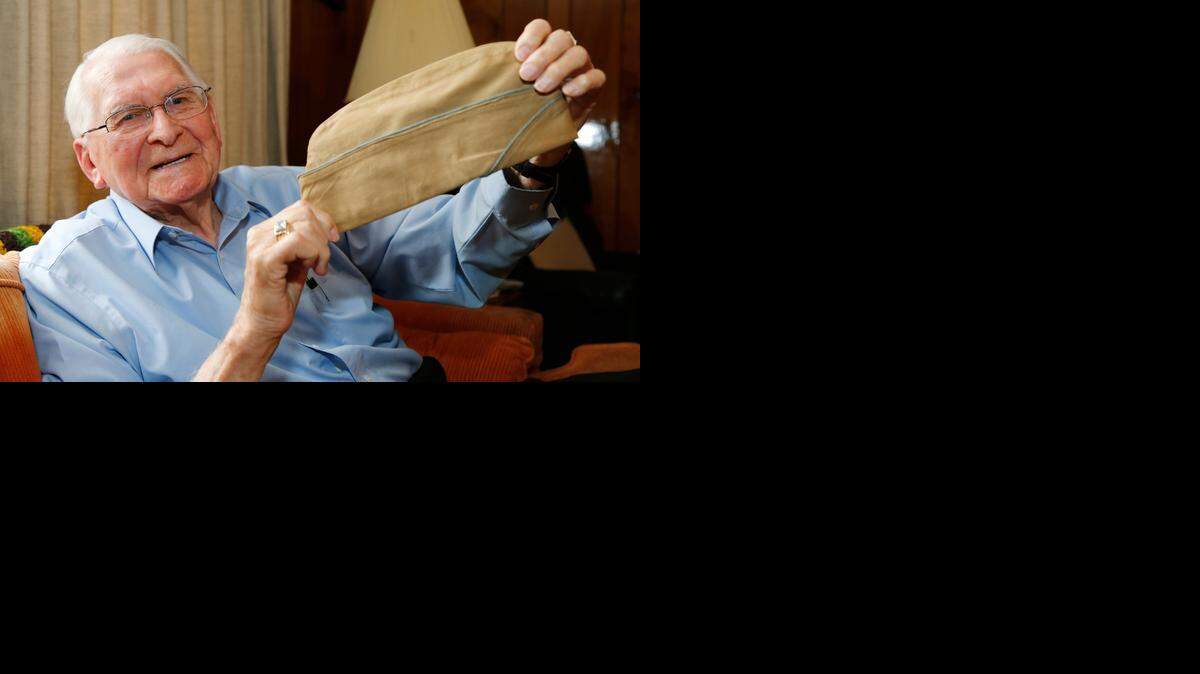
Seventy years ago, Raburn Miller was ordered onto a boat in the Pacific Ocean with 7,000 other soldiers. It was the height of World War II, and Miller had spent the previous three years in the Pacific theater going where the Army instructed him, including the fighting at Guadalcanal.
After nearly a week on the boat, Miller and the other soldiers discovered they were bound for Iwo Jima, where U.S. Marines had landed just weeks before and thousands of soldiers had already died. Miller, part of the 147th infantry, would be relieving the Marines.
“They said we were going to Iwo Jima. I figured then, I had been (there) over three-and-a-half years. That might be the last of me,” said Miller, now 99 and living in Rock Hill.
The Battle of Iwo Jima began Feb. 19, 1945, and continued until March 26 – 70 years ago Thursday. The Marines – 70,000 of them – were the first into battle, taking on the estimated 18,000 Japanese soldiers on the island. After 36 days, 7,000 Marines were killed and 20,000 were wounded. Only 216 Japanese soldiers were captured by March 26; more than 16,000 Japanese soldiers were killed in the fighting.
The 147th infantry, along with Miller, came in during the final days of the battle to help the Marines. In the two months following the Marines’ departure from Iwo Jima, the Army forces killed 1,602 more Japanese soldiers and captured 867 more.
As Miller sat on the boat growing closer to Iwo Jima, he was well aware of the danger he faced. The Japanese had a system of underground tunnels, as well as foxholes and pillboxes. Mount Suribachi, a volcanic mountain on Iwo Jima, was a concern for the soldiers.
The Japanese were on Mount Suribachi, “and they could shoot down, and if you were trying to dig a foxhole in the sand, it’d just get bigger and bigger before it would get deep enough to get away from the bullets,” Miller said.
He stayed on Iwo Jima for three months as a machine gun leader stationed at headquarters. During his time on the island, most of the fighting happened at night, when Miller was restricted to headquarters. That didn’t stop him from trying to get in on the “action,” he said.
“I asked to go out on night patrol,” he said. “I was young and wanted to see some action.”
Miller was prized for his resourcefulness. He used dynamite to blow through rock to reach fresh water, and he devised a system for keeping flies away from the tents used as a mess hall.
At night, he wrote letters to his mother by a makeshift lamp – a bottle he had filled with kerosene, using part of an old shirt as a wick.
Like many soldiers serving in the Pacific, Miller contracted malaria. He was treated with a medication that yellowed his skin, he says. Miller’s daughter, Frances Tinkler, recalls that even when she was a child, Miller would still have night sweats that would turn his sheets yellow. Other than the side effects from the medication, Miller says he made a full recovery.
Of all his time in the Pacific, Miller remembers July 4, 1945, most vividly. Miller was scheduled to depart for home on leave the following day. He walked up to Mount Suribachi, the site where five U.S. Marines and a U.S. Navy Corpsman raised the United States flag on Feb. 23, 1945. The flag raising was made famous in a Pulitzer Prize-winning photograph and as the basis for the Marine Corps War Memorial in Washington.
The flag had been flying over Iwo Jima for 131 days, waving over one of the deadliest battles in military history.
“I walked up there where that flag was raised, and it was kind of rough looking,” Miller said. “It wasn’t pretty at all.”
Miller returned home the following day. While he was home, an atomic bomb was dropped on Hiroshima, Japan, on Aug. 6, 1945, and then, three days later, Nagasaki. Miller was never called to return to battle. The war officially ended on Sept. 2, 1945.
“I felt pretty good,” Miller said. “I was lucky I made it.”
Miller, who turned 99 earlier this month, remains independent. After the war he married the love of his life, Hazel, who passed away 12 years ago but still lives vividly in Miller’s sharp memory. He is the oldest member of his church, Northside Baptist in Rock Hill, and enjoys driving his bright orange Volkswagen.
He even flies through the grocery store in a motorized cart, said Tinkler.
“If I go fast, I can get things done quicker,” Miller said.
Until recent years, Miller didn’t often talk about Iwo Jima or the rest of his time serving the country during World War II, Tinkler said. As he grew older, he opened up about his experiences.
“I’m so proud of him. He went through a lot. He is so proud of serving his country,” she said.
This story was originally published March 25, 2015 at 12:56 AM with the headline "70 years later, Rock Hill man remembers World War II battle for Iwo Jima."