
Report: Poor children lag behind despite 4K
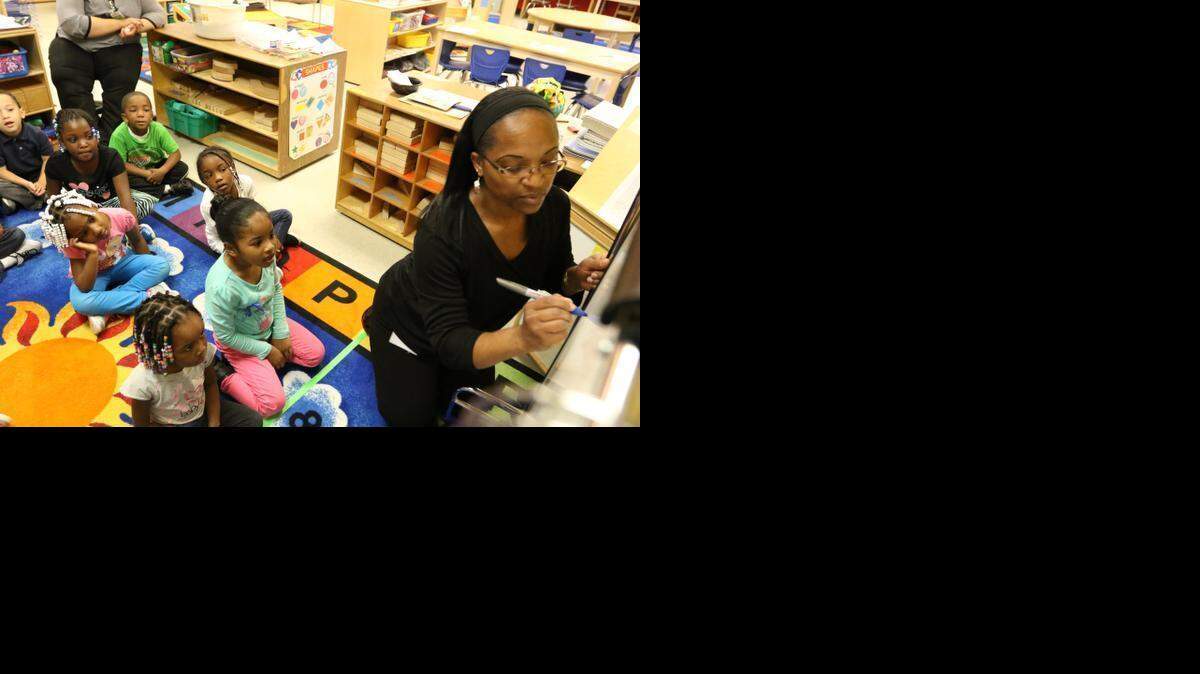
Sitting on her mother’s lap, McKenzie Jackson lists the Carolinas, the Gulf states and ends with a drawn-out pronunciation of “Arkansas.”
At their Hopkins home Wednesday, Alisha Jackson was quizzing her daughter on what she has learned in 4-year-old kindergarten at Gadsden Elementary School. McKenzie attends that program for free, thanks to the state’s 4K program for low-income children.
The state’s free 4K program has been a life-changer, Alisha Jackson says. Saving $150 a week on child care, she said, helps her take her daughter on trips so she can “experience more things in life.” McKenzie’s early start in school also means she will not be farther behind next year, her mother says.
But a new study has some education advocates questioning whether the state’s decade-old, $65 million-a-year free 4K program for impoverished children is succeeding.
The study for the S.C. Education Oversight Committee compared how poor children who enrolled in 4K during the program’s first four years performed later on standardized tests.
The study found:
▪ Poor children in poor districts who enrolled in 4K were more likely to pass end-of-year exams in math and reading than poor children in those districts who did not attend 4K.
▪ But, even after attending 4K, the success rate of those impoverished students was no better than that of poor children in wealthier districts that do not have the state’s free 4K program.
▪ Success rates of students in the K4 program varied dramatically from school district to school district. Students in some districts did well, with almost 90 percent passing the state’s third-grade math test. But performance was dismal in others, with less than 1 in 10 passing that test.
▪ Poor children who enrolled in 4K had “consistently lower” achievement levels on state tests than did all students statewide.
Despite “modest academic gains,” the state’s 4K program is “not closing the (academic achievement) gap” between impoverished students and other S.C. students, Oversight Committee executive director Melanie Barton told a state Senate panel Wednesday.
“(W)e remain concerned that we are not succeeding with this at-risk population of young people,” she said.
Court-ordered reforms
The dilemma of how to close the achievement gap – the gap between the performance of children statewide and poor children on the state’s standardized tests – has been at the heart of South Carolina’s education debate for two decades.
The 4K program was created in 2006 in response to a judge’s order that South Carolina must do more for preschool-aged children in poor, rural school districts. Those districts sued the state in 1993 for more state support.
The 4K study also comes during a push for new reforms, ordered by the state Supreme Court. In October, that court ruled the state’s public education system was unconstitutional.
The K4 review has left some supporters disappointed.
While the program “has been helpful, it’s not a panacea,” said state Sen. John Matthews, D-Orangeburg. “We have not seen the gains that we thought we were going to see.”
The study sheds light on just how much worse off poor children in poor districts are than their peers in wealthier districts, Matthews said. Those poor students tend to fail more often because, he said, “Most of them live in poor homes, then you send them to poor schools in a poor district.”
‘Do we need to do more?’
The report also comes on the heels of a dramatic expansion of the 4K program.
During the last two years, state lawmakers more than doubled the number of children served by the 4K program to 12,500. They also more than tripled the program’s budget to $65 million, not including about $10 million left over from last year.
Now, however, the program’s quality must be improved before lawmakers expand it again, as some want to do, Barton says.
Teachers in the 4K program need more training, Barton said. Elementary teachers also must change the way they instruct, building on what students learn in 4K instead of repeating that instruction in lower elementary grades. Lawmakers also should set higher standards for the private day care centers and public schools that take part in the 4K program, rewarding programs that raise students’ success rates.
But not all policy advocates see 4K as the best use of state dollars.
The 4K program will not leave students better off if they attend failing schools with failing leaders, said Ellen Weaver, president of the Jim DeMint-backed Palmetto Promise Institute, a conservative think tank.
“It’s a mistake to put all of this money into developing a (prekindergarten) program ... if we're putting these kids into systems and schools that are consistently under-performing,” Weaver said.
Advocates say the 4K program is succeeding.
Dan Wuori of S.C. First Steps, which oversees part of the program, said gains by 4K students have been “substantial,” given how far behind children in extreme poverty are when they enter the classroom.
While poor 4K participants still lag behind children statewide, they are bridging the achievement gap, he said, by outperforming poor children in high-poverty districts that do not have 4K.
For example, nearly 73 percent of poor children who had gone to 4K passed the state’s standardized reading test at the end of the third grade. That compares to 67 percent of poor children in poor districts who did not go to K4.
And, while the success rate of students who had taken K4 lagged the statewide average by 6 percentage points, the success rate of poor students in poor districts who did not go to 4K was even lower, lagging the statewide average by 12 percentage points.
Still, Wuori added, “If the question is, ‘Do we need to do more than just 4K to really talk about closing the achievement gap,’ then the answer is yes.”
4K outcomes vary among districts
Barton said the gains poor children in 4K make are good but “modest.” Children in the state’s highest-poverty districts are, on average, only performing at the same levels of poor children statewide, she said.
The impact of 4K on poor children also varies widely from district to district, signaling a need for more accountability in some programs, she said.
Some school districts saw 4K successes.
For example, two-thirds of the poor children in the Clarendon 2 school district who did not enroll in 4K passed the state’s third-grade math test. But participating in 4K increased the passage rate of poor children in that district to 88 percent, based on an analysis by The State newspaper.
Other districts saw no difference in results.
In the Berkeley school district, 1 in 3 poor children failed the state’s math test at the end of the third grade whether they had gone to 4K or not.
Some districts’ 4K programs seemingly hurt participants.
In the Florence 4 district, only 8 percent of 4K participants passed the same third-grade math test, less than the 15 percent who passed without attending 4K in the four years that the study reviewed.
Successful districts are innovating outside the classroom, finding ways to reach parents and families in their communities, Barton said.
One district helps parents find family doctors, for example. In another district, grocery stores are putting up signs helping parents use shopping to practice identifying objects, words and colors.
State Sen. Wes Hayes, R-York, who chairs a Senate panel that oversees K-12 spending, agrees with Barton that the program now must focus on quality.
High-quality 4K can make a “huge difference” for students, Hayes said. But, he added, “Just simply having a program with poor quality may not, in the long term, do much good.”
State Rep. Rita Allison, R-Spartanburg, who chairs education committees in the House, said the 4K report proves that improving education is “not all about money. You can continue to spend the money, but you've got to delve into where the problems are and solve them.”
Education reforms in the budget
Improving 4K students’ academic success is more pressing now than ever, education advocates say.
Starting in the 2017 school year, third graders who fail the state’s standardized test for reading face being held back a grade for reading-intensive instruction.
The retention plan is part of a new law that requires a statewide focus on literacy.
In last year’s budget, Republican Gov. Nikki Haley pushed lawmakers to spend $30 million on reading coaches for all elementary schools and more money for summer reading camps.
But state Sen. Vincent Sheheen, D-Kershaw, a longtime advocate of expanding the free 4K program to all S.C. children, said House budget writers already are undercutting programs aimed at ensuring third graders are reading on grade level.
In her proposal for the state’s fiscal year that starts July 1, Haley recommended spending an additional $13 million for more reading coaches and summer reading camps. However, the House approved only about half that amount.
That House action is “more of the same” by a state government that fails yearly to fund public education at levels recommended by state law, Sheheen said.
‘We are saving a life’
South Carolina has about 42,000 4-year-olds who, like McKenzie Jackson in Hopkins, meet federal definitions for living in poverty – qualifying for Medicaid or free or reduced-price lunches.
The state’s 4K program now serves about 30 percent of those children in 60 school districts, up from 34 districts in 2012. Richland 1’s Gadsden Elementary, where McKenzie attends 4K, was included in the state’s expansion.
Principal Monica Owens-Carter said leadership, resources and reaching families early on have helped Gadsden Elementary narrow the achievement gap.
Ninety-seven percent of Gadsden’s students live in poverty, but the school received a “good” rating on last year’s state report card, an accomplishment shared by only six other schools with similar poverty rates. (More than 160 schools like Gadsden scored average or below on that report card; only one scored “excellent.”)
The state’s 4K dollars allowed Gadsden to use federal money for technology and other 4K upgrades, Owens-Carter said. A Montessori program for 3-year-olds also helps children early, Owens-Carter said.
“Oftentimes, if our kids don't come to the school, they sit at home on the couch,” she said. “When we are opening our doors to the 4-year-olds and the 3-year-olds, I think, at that moment in time, we are saving a life.”
Is 4K succeeding?
A new study found:
▪ Poor children in poor districts who enrolled in 4K were more likely to pass end-of-year exams in math and reading than poor children in those districts who did not attend 4K.
▪ Even after attending 4K, the success rate of impoverished students was no better than poor children in wealthier districts that do not have the state’s free 4K program.
▪ Success rates between students in the 4K program varied dramatically. Students in some school districts performed well, with almost 90 percent of students passing a state test. But results were dismal in others, with less than 10 percent passing that test.
▪ Poor children who enrolled in 4K had “consistently lower” achievement levels on state tests than did all students statewide.
Report: South Carolina’s free 4K program
The S.C. Education Oversight Committee says South Carolina’s free 4K program for children who live in poverty must be improved. Why? A recent study found 4K increased a poor child’s chances of passing standardized tests. But poor children who took 4K had “consistently lower” achievement levels than students statewide and performed about the same as poor children in wealthier districts. A look at the number of S.C. students who passed third-grade tests in reading and math, averaged, over the course of the study:
All S.C. students
Reading: 79%
Math: 74%
Poor children who took 4K in high-poverty districts
Reading: 73%
Math: 65%
Poor children in high-poverty districts who qualified for but did not take 4K
Reading: 67%
Math: 60%
Poor children in wealthier districts
Reading: 72%
Math: 66%
SOURCE: S.C. Education Oversight Committee
This story was originally published March 21, 2015 at 8:55 PM with the headline "Report: Poor children lag behind despite 4K."