
Clemson University President Barker reflects on 14-year tenure
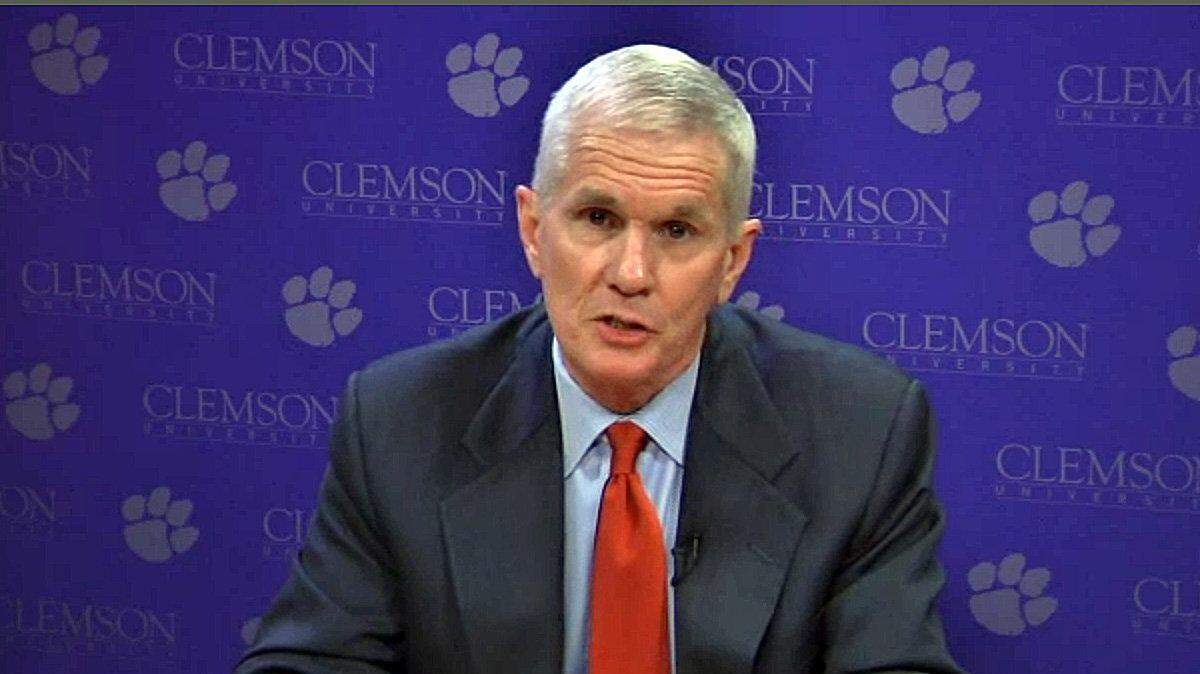
The first half of James F. Barker’s tenure as president of Clemson University was marked by an era of progress in higher education across the state, spurred by such legislative actions as creation of lottery-funded scholarships, endowed professorships and funding for economic development activities, Barker said Wednesday.
Since the Great Recession, however, the relationship between higher education and the General Assembly has frayed to the point where the colleges and universities are more often seen by lawmakers as part of the problem rather than the solution to the state’s economic well-being, he said.
“The answer is education, but there’s not that same kind of communication going on,” Barker said in a meeting with reporters and editors at The Greenville News.
Barker, 65, said he expects to leave office in early January, when Jim Clements, the president of West Virginia University who was named last week as his successor, takes office.
Reflecting on his 14 years leading Clemson, Barker said he’s optimistic about the future of the institution and the state, but hopes to see a return to better relations between the school and the Legislature.
“I’d like to see tomorrow look a little bit like it looked yesterday,” he said. “I hate to say that because it never makes any sense because conditions are different. But that attitude of collaboration and communication I think would make a huge difference right now.”
Part of the change in the relationship has to do with a change in the nature and character of the General Assembly, with the departure of many longtime stalwarts such as former House Speaker David Wilkins, now chairman of Clemson’s Board of Trustees, and Sen. Verne Smith of Greer, Barker said.
“I think we’re finding leaders now who want to point the finger at something else,” he said. “And often times it’s easy for that to be at higher education.”
Accusations of “lack of accountability” are often heard on the floors of the Statehouse in reference to higher education – which Barker finds incredulous.
He notes, for example, that every purchase the university makes is posted on the Internet, for anyone to see.
“That’s accountability. Serious accountability,” he said. “It was called for and we produced it. Now every university in the state is doing that. But yet there’s still these (people saying) ‘you’re not being accountable enough.’ I’m not sure what that means.”
The tuition increases that followed budget cuts fueled the fire, Barker said.
Tuition and fees for full-time state residents at Clemson rose by 19.5 percent between the 2008-09 academic year and 2012-13, from $10,608 to $12,674, according to CHE. It had jumped by 53 percent the five years prior to that, from $6,934 in 2003-04, CHE figures show. This year it's $13,054.
The rift between lawmakers in Columbia and the state’s institutions of higher education goes back even before the recession, to the eight years of Mark Sanford’s governorship, state Sen. Larry Martin says.
But he said, “Most of us in the House and Senate understand that higher education plays a huge role, not only today but also down the road in our future in economic development.”
The burden of high student loan debt could have a crippling effect on the economy unless the state begins to increase funding to higher education and reduce the load on students, the Pickens Republican said.
While other states have begun restoring funding to higher education since the economy has improved, South Carolina hasn’t done much, he said.
Barker said when he was a Clemson student in the late 1960s, state support accounted for 70 percent of the university’s budget. When he took office in 1999, it was 40 percent.
During the worst years of the recession, it got down to 8-9 percent and is now at about 10 percent, he said.
Martin said he hopes to increase the state’s support of Clemson and other colleges and universities next year.
“What has happened is we’re being forced to choose and make some choices that we’d rather not make on funding,” he said. “Could we have done more? Certainly. Should we do more, particularly with the revenue that we have this year? I hope so.”
Competition with USC
As the Nov. 30 football game with the University of South Carolina approaches, the rivalry between the two schools is at the top of many people’s minds.
Barker, too, said he hopes to see the Tigers come out on top of the Gamecocks this year – “especially after having lost four in a row.”
“I do like to see teams in the state be successful,” he said, sidestepping a question about whether he pulls against the Gamecocks when they’re not playing Clemson. “But I do think that this competition and our focus on sports, and somehow we measure the quality of universities by that is a dangerous thing.”
In the bigger picture, he said he’s had a good relationship with USC during the past 14 years, and he hopes to see that continue with his successor.
“I think there’s been good communication and good collaboration across that period of time. I’d like to see it strengthened. I think it can be,” he said.
“We should compete less and collaborate more.”
The Barker era
While much of the latter part of Barker’s tenure has been marked by struggles with budget cuts, it is his push to get Clemson recognized as a Top 20 public university that many will remember.
As he leaves office, the university is ranked No. 21 in U.S. News & World Report – just a hundredth of a point from the elusive goal – and has been in the top 25 for the past six years.
One of Barker’s regrets, he says only half jokingly, is that he didn’t aim for the top 25 instead – which still represented a jump of more than 25 places.
He took some criticism for making such a high-profile push for a ranking in a magazine, but he says it was the results that the push would yield for students he was most interested in.
“We looked at a lot of ways we could measure ourselves, but we really thought that U.S. News had a great set of criteria that if you weren’t paying attention to those criteria something was wrong,” Barker said.
“But we said, let’s don’t chase a rating and a ranking. Let’s focus on our students and maybe the rankings will take care of themselves. If we do the right things for them, then that should be the driver.”
Some of the things the university put in place to reach those goals were part of a long-range plan Barker had when he interviewed for the president’s job.
“They said, ‘what’s your five-year plan?’ I said I don’t have a five-year plan,” Barker said. “They said, ‘what have you got? I said I’ve got a 10-year plan. It’s going to take us that long to reach this vision I’m about to tell you. They were startled by that.”
Along the way, Clemson broadened its reach, creating the International Center for Automotive Research and moving master’s level business programs to downtown Greenville.
It developed programs in the Charleston area to do energy and ecological research and expanded study abroad programs.
Several initiatives of the Barker era have attracted national attention, such as Call Me Mister, a program that works to encourage minority students to go into the teaching profession. It has been replicated at 25 universities in seven states, Barker said.
A program called Bridge to Clemson program helped open the doors to local students who otherwise wouldn’t have made the cut in the increasingly competitive environment for acceptance.
About 600 students every year transfer to the university after completing their freshman year at Tri-County Technical College and meeting certain requirements through the program, and their graduation rate is the same as for students who started at Clemson, Barker said.
A graduate research program that uses the creative inquiry method leads to innovative ideas developed by small groups of students working on multiple-semester projects with a single faculty member.
And an on-campus internship program is providing opportunities for students to gain experience while at the same time helping Clemson save money, Barker said.
Higher quality students
Also during Barker’s time, the quality of students at Clemson has risen. The average SAT score now is 1246.
Part of that is because the Life and Palmetto Fellows scholarships are keeping many of the state’s best students in the state, he said.
“We’re starting to push Chapel Hill and Virginia and some other schools in a state not necessarily known for high SATs. And the reason is we’re getting the best and brightest students.”
Clemson expects 19,000 applications for 3,000 seats this year, which raises the bar for entrance, Barker said. But the notion that the university has shut out its own isn’t true, he said. Clemson admitted 90 percent of the students from South Carolina who applied last year, either to the Bridge program or directly to Clemson, he said.
Other oft-heard criticism is that Clemson is “getting too big for its britches” and straying from its roots as a land-grant college by trying to become an elite institution. Barker said 16 of the top 25 universities in the country are land-grant schools.
“All those arguments are hollow and smoke screens,” he said. “The real issue is quality. What are we going to do about raising the quality of higher education in South Carolina.”
Enterprise Act
Another area that Barker hopes to see Clemson move forward – with cooperation from the Legislature – is in gaining more flexibility in managing economic development projects with private companies.
He said he went to Munich earlier this year to talk with BMW executives about potential partnerships and saw clearly that the regulatory system governing higher education here is holding the university back from being able to respond to the needs of businesses.
“We’ve got to find a way to be more nimble and to be accountable,” Barker said. “Certainly we’ve got to be accountable. We’ve got to add some flexibility to our portfolio or we’re not going to be able to serve a company like BMW is at the pace they want to see the changes made.
“So we need to find the right balance. And we can only do this by talking to each other as opposed to pointing fingers.”
Some progress, from Clemson’s perspective, was made in that direction during the 2013 legislative session when the Senate passed a bill called the Clemson Enterprise Act. It would allow the university to move some of its operations, like business partnerships, research and auxiliary programs such as athletics, into a separate unit, free from restrictions that tie things up in “redundant” requirements, Barker said.
The House failed to act on the bill by the time the session ended, but Barker hopes to see it move forward when the House convenes in January.
Back to the classroom
He won’t be there to lobby for the bill, however. That job will fall to Clements.
“There can only be one president,” Barker said.
He will be happy to return to the School of Architecture as a professor and watch from the sidelines, he said.
He has kept his foot in the classroom during his presidency, teaching one course each spring. He has found himself “stimulated” by the interaction with students who seem smarter each year.
Many people might consider the president’s job the most important one on campus, but Barker said being a faculty member clearly tops that.
“You can talk about policies and sort of broad impacts, but when you’re talking about changing people’s lives or making meaningful differences, those smaller size groups of students that you interact with there, that’s what I’m really looking forward to doing,” he said.
He said he feels healthy, after having quintuple bypass surgery in January, and isn’t through giving of himself to Clemson.
It’s a debt he doesn’t think he will ever be able to repay.
When Barker came to Clemson as a student, his father had died a year earlier, and no one in his family had ever gone to college before. He felt a little unsure about how it was going to go.
Until he got there.
“I walked on that campus, and I promise you, the sense was, you’re gonna be OK,” he said. “For the first time since my dad died, it was like, you’re gonna be alright.
“And so when you have that kind of debt and you get a chance to repay it ... but then I never could fill up that bucket.”
After he got married, Barker and his wife Marcia lived in married student housing.
“To move from that little bitty metal prefab building to the President’s Home is just inconceivable,” he said. “So that’s what’s been a key driver in trying to contribute something and make sure it’s in a little better shape than when it started.”
This story was originally published November 20, 2013 at 10:39 PM with the headline "Clemson University President Barker reflects on 14-year tenure."