
New Holocaust book tells story of Columbia survivors
Editor’s Note: Today marks the end of Holocaust Remembrance Day 2022. The following is chapter 1 from the forthcoming graphic novel, “We Survived The Holocaust: The Bluma & Felix Goldberg Story” by Frank W. Baker with illustrations by Tim Ogline. It details the harrowing, true story of two young Polish Jews during World War II. The Goldbergs settled in Columbia, S.C. after the war, becoming beloved members of the community.
Present Day
It’s January. The Goldberg family is departing for the cemetery where their parents are buried. Before they leave the house, Esther, the youngest, puts her hands on the Mezuzah, mounted at the front door, and brings her hand to her mouth.
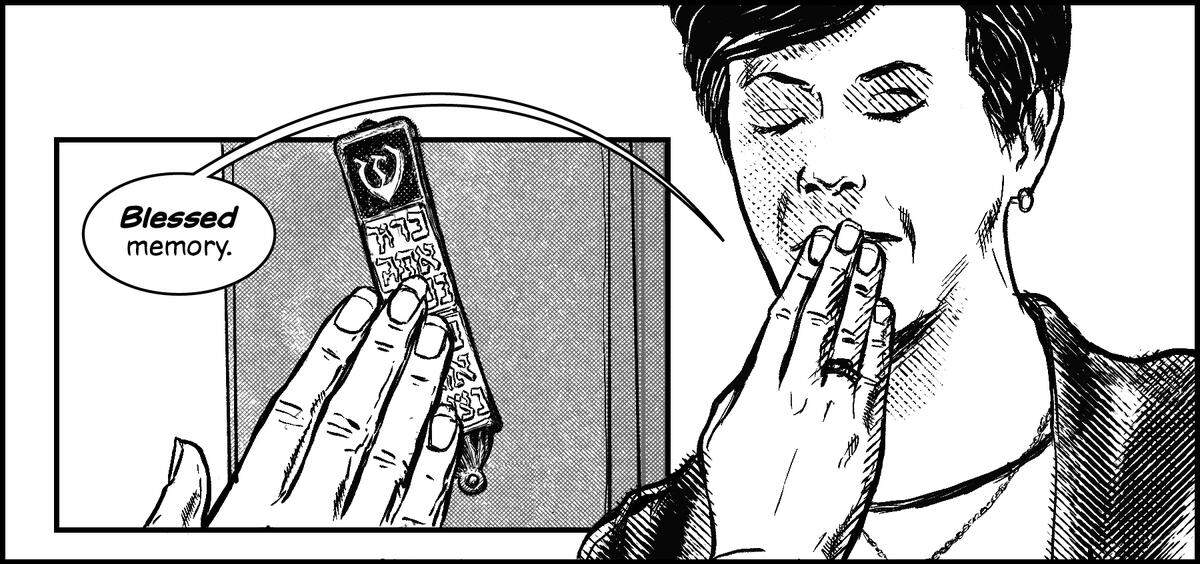
“Are you OK”, her brother Karl asks?
“No,” she replies. Henry, the oldest, says, “I understand.”
They get into the car for the long ride; they pass The Tile Center (on Two North Road in Columbia), the business their late father ran with their mother, Bluma. Felix started the company when they emigrated to Columbia after the war.
Upon arriving at the cemetery, Esther, Karl and Henry all pick up small rocks. As they walk to the area where their parents are buried, each of them quietly puts a rock on top of the headstone. (It’s a Jewish ritual which one does as a sign of paying respect.) They are contemplative. Esther pulls out a tissue from her purse and begins to dab her eyes. She looks up and says: “Do you want to say it?” Karl responds with a nod in the positive.
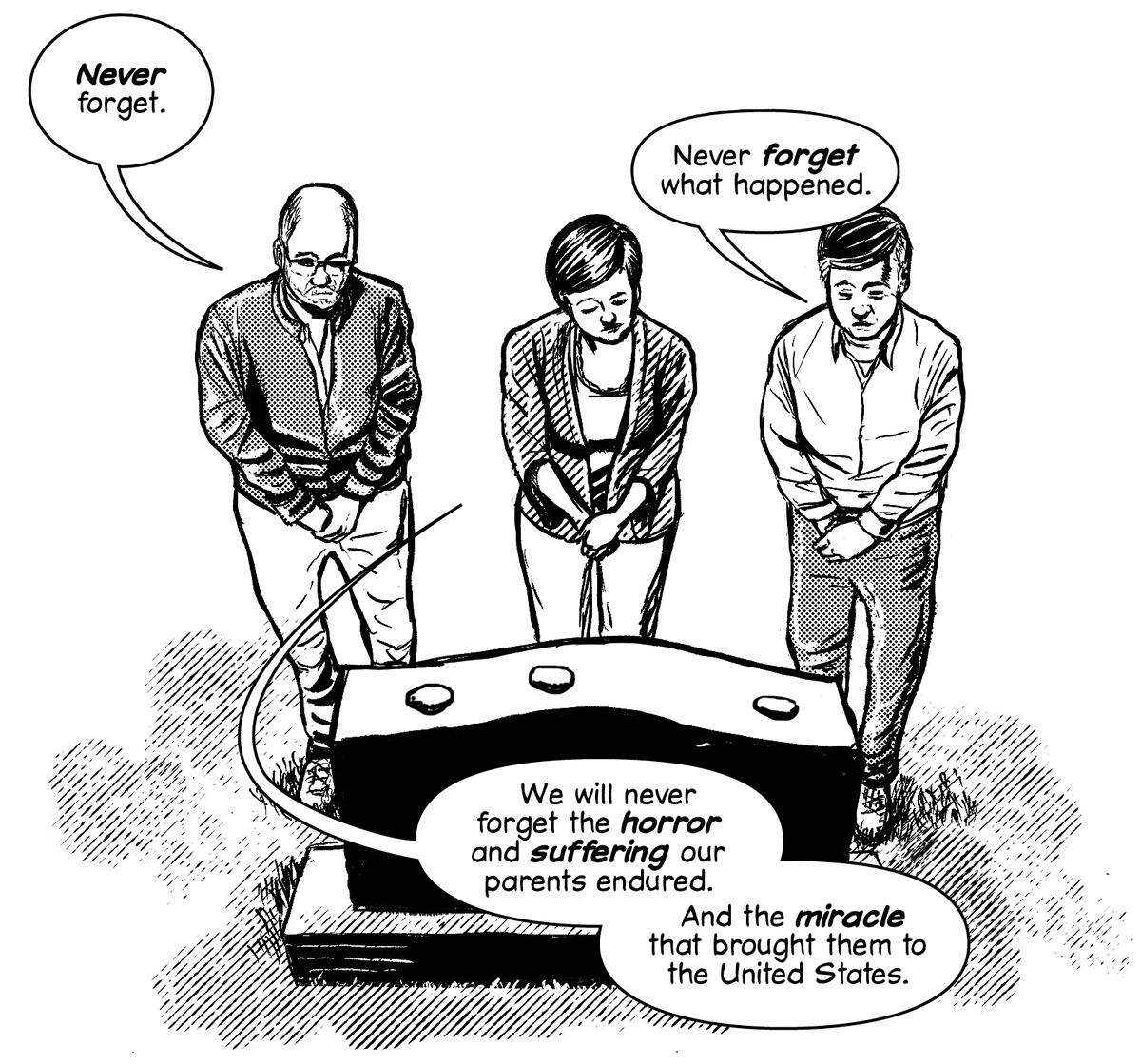
He pulls out of his pocket a small piece of paper with some writing on it: it is the Kaddish — a traditional Jewish prayer recited in memory and honor of those who have passed away.
Before departing, Henry recalls quietly, “Let us not forget: They survived Hitler’s Final Solution. It was a miracle. No one could possibly comprehend what they went through.”
Flashback
In the beginning of this story we find two children born in Poland. Little did they, or their families, know about events that were closing in around them. Things were happening around them that they did not control. They were caught up in Adolf Hitler’s “Final Solution” — the Nazi plan to eradicate the entire Jewish population.
The Beginning
The boy, Felix Goldberg, was born in a small town outside of Kalisz, Poland in 1917. Bluma Tishgarten, the girl, is born 9 years later, 190 miles away, in the town of Pinczow. Their parents were happy as both children were born into growing families. Felix had four siblings; Bluma had three sisters and a brother. They were Jewish and they grew up as typical children: they went to school, they played games with friends and they did chores for their parents.
Life for both children was fairly normal for families. Bluma loved to go skiing with her family and in the summers, swam in the lake near her home. Felix played soccer and on Saturday afternoons he would go to soccer matches with his cousin in the stadium in Kalisz.
Both families continued their long-standing Jewish traditions: observing the Jewish Sabbath (sundown Friday-sundown Saturday). On Friday night, Bluma’s family lit the Sabbath candles and said their weekly prayers. Every Saturday morning, Felix and his siblings attended Cheder (the name for school where Jewish children learn Hebrew language and religious customs).
But by the time both Felix and Bluma were teenagers, it was clear things were anything but normal in Poland. Their families were aware of the pogroms of the past — violent riots which drove Jews away and, in many cases, killed many. Now, their world was about to be turned upside down. Their parents had heard rumors that Jews in other cities and towns were being harassed and treated poorly by Adolf Hitler and his Nazi Party.
Some reports indicated Jews were being killed, but the Goldbergs and Tishgartens were skeptical. “This couldn’t happen to us,” they thought.
The Nazis were a German political party that grew into a movement that blamed Jews for many of their problems. The Nazi plan was to eliminate the Jewish way of life — to limit their movements, take away their jobs and destroy anything and everything Jewish — including publications. Books written by Jewish writers had been burned in public displays years earlier.
Jews were considered “enemies of the state,” and an active propaganda campaign began to convince Germans (and others) that Jews were bad and needed to be controlled. Violence against Jews was widely encouraged and as a result many Jews suffered under the hands of German troops as well as German and Polish citizens.
Slowly the rumors became fact as the war came to Felix and Bluma’s hometowns. Little did they know, their lives were about to change forever.
Felix (young man): “Father, why are you removing the Mezuzah from the door?”
Father: “Son, it is now dangerous for our family to be identified as Jews. By taking it down, those who are not from here will not know that we are Jews. I want to protect my family and we need to keep a low profile.”
Quickly things began to change for Jews. People who were previously their life-long friends and neighbors were suddenly angry enemies. They were not allowed to go to school or play with non-Jewish friends. Jewish owned businesses were boycotted and then forced to close.
And Jews were required to wear a label, a yellow star, that made it clear who they were to Nazis and Poles.
And then, the German army invaded Poland and the Soviet Union. The year was 1939. World War II had officially started. From the air, German planes rained bombs down on homes, theaters, schools and businesses. Thousands of German troops crossed the border and began destroying everything in their path.
When they arrived in Pinczow, the first thing they did was to burn it to the ground, leaving Bluma and her family homeless. She was just 13 years old at the time. Her closest sister, Cela, was 16. The family escaped to an uncle’s house on the outskirts of town.
Bluma (to her father): “Daddy, are we safe? I’m afraid. “
Father: “Sweetheart, we are for now. I don’t know about tomorrow. I just know we must be vigilant. We might soon have to move away from here because it’s getting increasingly dangerous for all of us to survive.”
But the Nazis came looking for them, because their mission was to destroy their way of life AND kill all of the Jews.
Read the next installment in Friday’s paper.
This story was originally published April 28, 2022 at 5:00 AM.