
Chapter 2 of new Holocaust book: Children captured by Nazis
Editor’s Note: The State Media Co. is running the first four chapters of the forthcoming graphic novel, “We Survived The Holocaust: The Bluma & Felix Goldberg Story” by Frank W. Baker with illustrations by Tim Ogline. It details the harrowing, true story of two young Polish Jews during World War II. After the war, the Goldbergs settled in Columbia, S.C., becoming beloved members of the community. Today is chapter 2. Visit www.thestate.com for chapter 1.
Chapter Two: CAPTURE
1939-1940
As part of the Nazi effort, signs were erected around Polish cities and towns where Jews lived. These signs read “Jews Forbidden” in all areas where their movements were restricted. Other signs read “Do Not Help Jews — To Do So Means Immediate Death.”
Signs and posters were part of a massive propaganda campaign designed to convey the idea that the Jews were the source of Germany’s problems and that they must be eliminated.
For the time being, the Tishgartens and their friends were allowed to remain in town, but their access to school and stores was restricted. They had a curfew which meant they had to be off the streets by 6 p.m. each night. And they had to wear that yellow Jewish star on their clothing so as to be easily identifiable.
Bluma and Cela Tishgarten were just teenagers; their parents had to carefully think about what the family would have to do if and when the situation got worse. One day it did. On a morning they would long remember, their mother heard gunshots. She carefully peered out the window to see Nazis forcing their neighbors from their homes at gunpoint. Frightened, she called to her two daughters.
Mother: “Girls, come here NOW. I need you to listen to me carefully. The Nazis are here, and they will kill us if we don’t act quickly. Take this (she stuffs into their pockets) Money and jewelry. It’s all I have. It will help you survive. You must GO now. Run out the back door into the woods and hide. Do not come back”
Bluma: “But Momma where will you go?”
Mother: “Your father and I will try to get away, but you must go now. (shouting) SAVE YOURSELVES. I love you. GO!”
She literally shoves them out of the house. (They never saw their mother again.)
Crying and scared, the girls ran out the back door into the woods. They immediately saw their neighbors trying to escape as well. But, rather than join them, Bluma and Cela decided to run in a different direction, away from their neighbors.
Cela: (running, looking back at her sister who lags slightly); “Hurry Bluma, we must run faster, away from danger.”
Bluma: (huffing, a bit out of breath, visibly shaken): “I have never been so frightened in my life. Where are we going to go?”
Cela: “I have an idea; I will show you.”
It was getting dark, so they made a makeshift shed from found materials and they spent their first night like this. They would constantly be “on the move” trying to hide and find food. For weeks, they would sneak into a town and beg people to give them food. That’s how they survived until ...
Constantly running and hiding from the Nazis, moving at night from town to town, hoping someone would give them some food, became exhausting.
Cela: “Bluma, all of this running and hiding is bound to get us caught and perhaps killed.”
Bluma: “What do you think we should do?”
Later that same day, they had the answer. Off in the distance they could hear a voice blaring from a loudspeaker: it was a message from the Nazis: “Jews, give yourselves up now and you will not be harmed. We will take care of you. Come into town tomorrow.”
Cela: “Bluma, I’m thinking that now might be the time to surrender. Do you agree?”
Bluma (reluctantly) “I don’t know. I’m not sure. But as long as I’m with you sister, I’ll feel safe.”
The next day, they decide to give themselves up. With their hands raised high, they slowly exited the woods. As they entered the town, they were immediately seen by the Nazis who escorted them at gunpoint to a large truck filled with other people. The truck drove them to a train station where they were ordered into the “cattle car” jammed with many others. The train began to move.
Bluma (to sister): “I can hardly breathe.”
Cela: “Me either. Perhaps we can try to move to that small opening near the door.” (They slowly maneuver to get to that spot.)
Bluma: “Can you breathe?”
Cela: “Not very well. Let’s huddle together to stay warm.”
---
At this moment, Felix Goldberg was just 19-years-old and was desperate to survive. He decided that fighting for the Polish Army would be the smartest move. For a short while he rode horseback with other Poles fighting the Germans. But they were soon overtaken and he was captured.
During his first capture he was sent to a ghetto whose conditions were tolerable. Eventually he was released and was allowed to travel, so he took advantage of the opportunity.
Felix recalls: “Everybody had to wear that (Jewish Star) because of being Jewish. But I took a chance and took that emblem off, and I was riding (the passenger train) without it. But I was recognized. I looked very much Semitic.
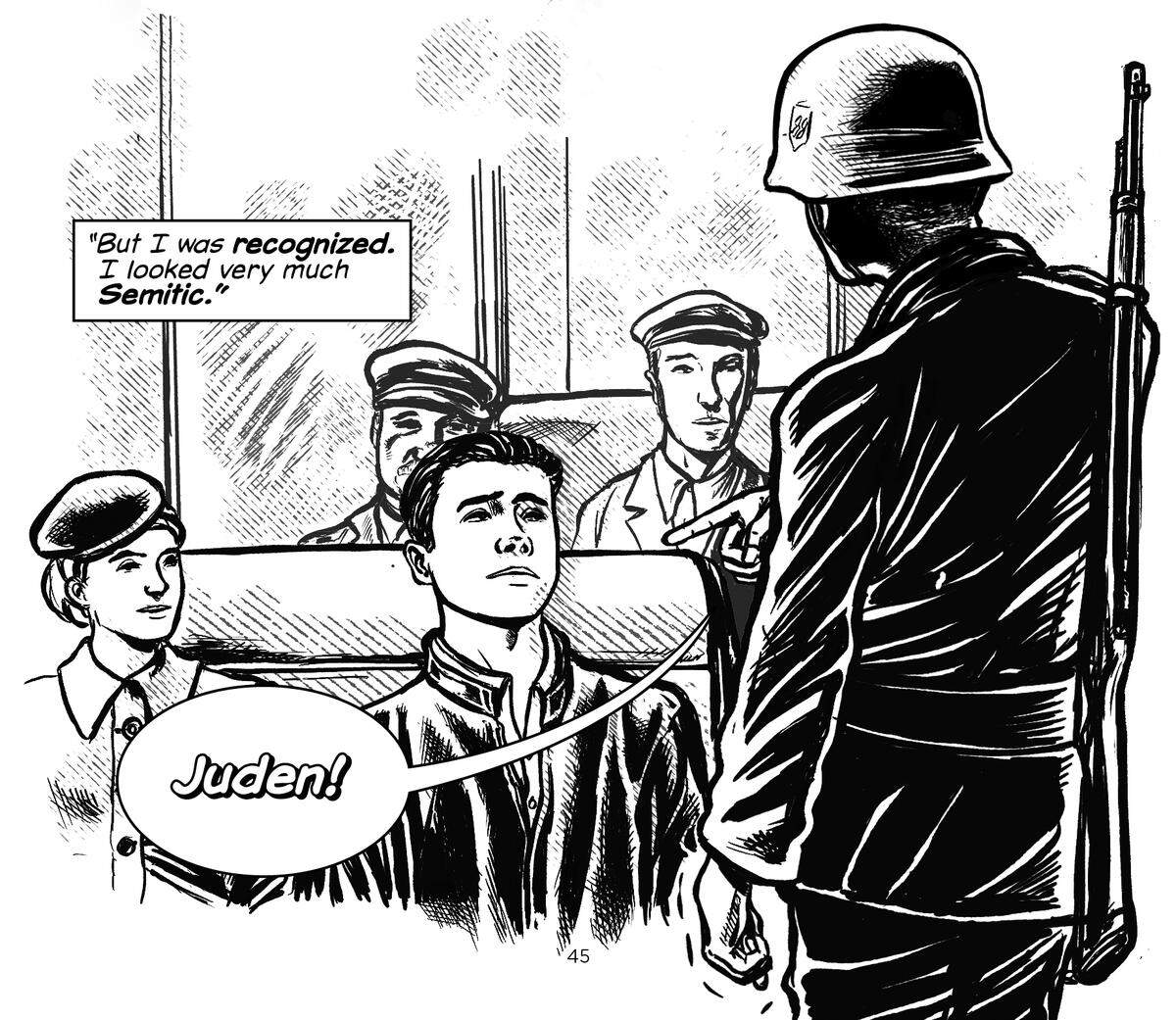
“And so they took me off the train and waited for the next train. But in the meantime, an SS man worked me over pretty good, socked my face, knocked out two of my teeth”, and declared: “You will go back to the Warsaw ghetto.” But Felix thought, “I don’t want to go back to the Warsaw ghetto. “
The Nazis put him on another train, but this time he was on a “cattle car” jammed with hundreds of other prisoners.
Man (to Felix): “Where do you think this train is taking us?”
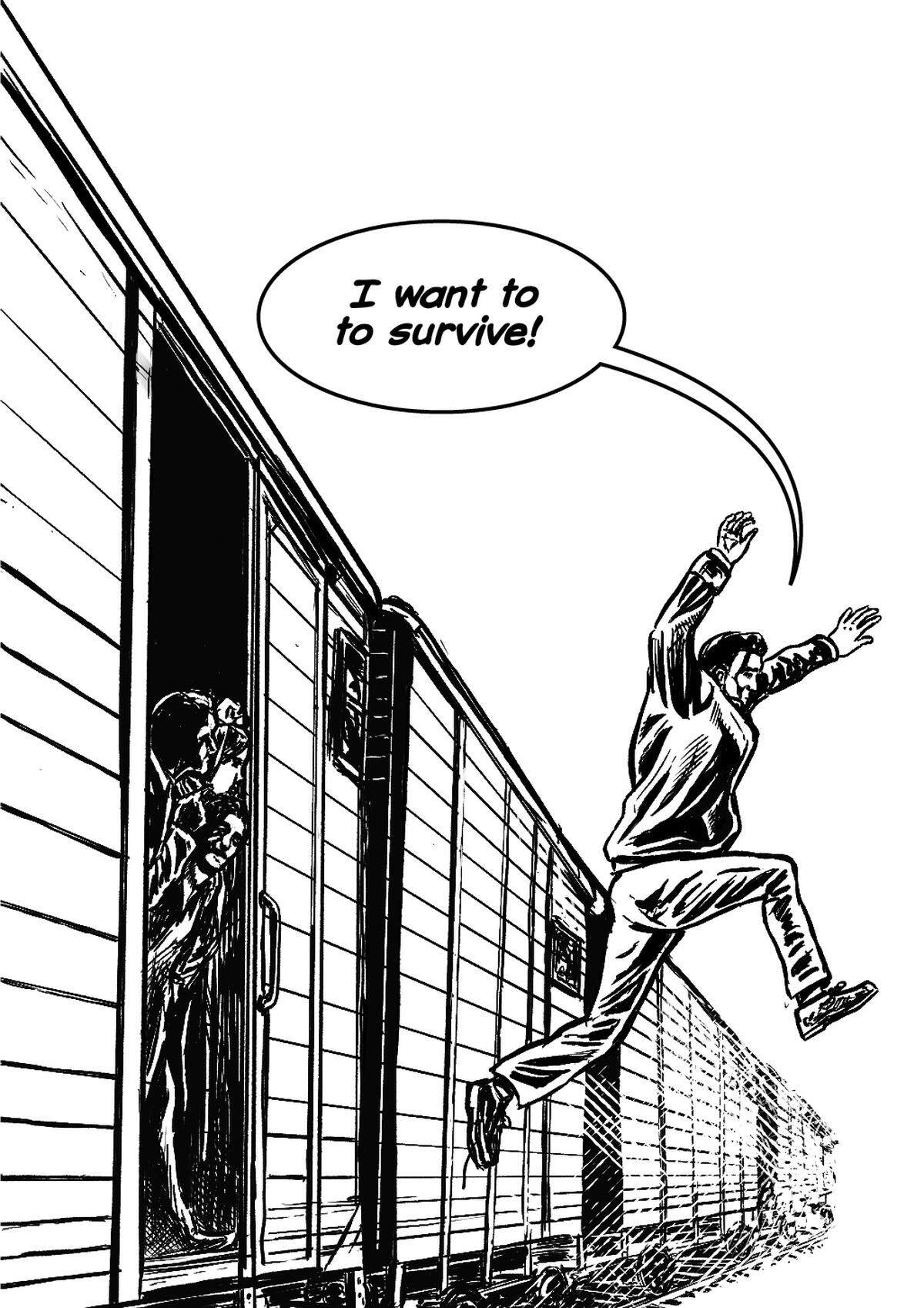
Felix:” I don’t know but I don’t plan to stay much longer. This train will certainly take us to our deaths. I want to survive.”
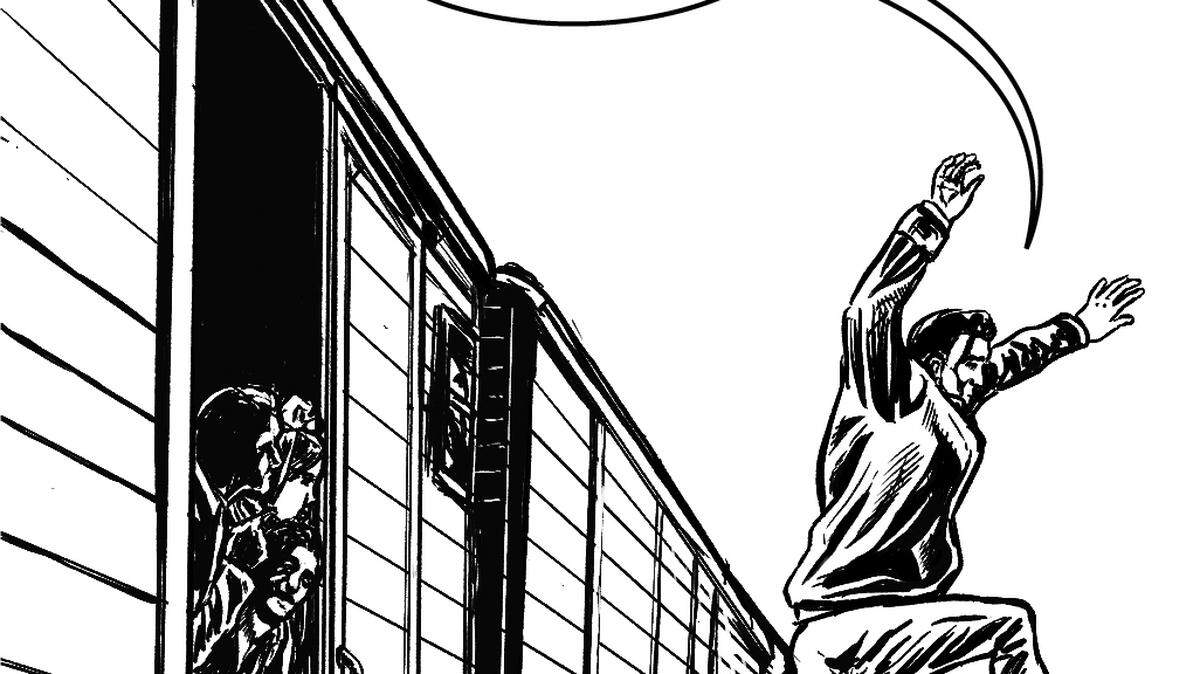
Felix slowly opened the train door just enough for him to get through it and finally jumps from the moving train, rolling several times on the ground before stopping, getting up and quickly moving into a wooded area.
Eventually, after wandering and hiding in the woods Felix was recaptured and put on a transport for Auschwitz.
Life in ‘the camps’ was horrific for Jewish prisoners. They were awakened at 4 in the morning. They marched in formation out of the barracks and were forced to stand in the freezing weather. The Nazis counted every prisoner to make sure no one had escaped. Breakfast, if you can call it that, consisted only of coffee and some soup and nothing else, not even bread. They could see smoke rising from the chimney of a nearby building, but Felix said no one, at the time, knew what the chimney was for.
With these harsh conditions in the camps, only the strong survived, the weak were not so lucky. Felix was assigned to the Jawarzno Coal Mine. The workers were forced to march for 2 hours to the mine each morning. He was assigned to the coal mine elevator, which carried coal and fellow Jews up and down. The work was dangerous and often the walls of the mine collapsed, killing Jews in the process. Now, in addition to carrying coal, Felix carried out the bodies. The Nazis directed him to put the bodies in the back of a truck, which made its way to the crematoria (furnaces).
In order to survive, Felix had to take many chances and said “If you wanted to live, you take risks”— he sometimes stole bread and wine from guards. He had to keep whatever he took in a secret hiding place as his life and survival depended on it.
One night, upon returning to Auschwitz, they discovered that a large part of the camp had been targeted and destroyed by the Russians who had bombed the camp by air.
Overcrowding became a huge problem for the Nazis so they began to put Jews on transports and send them to other camps. This meant Felix was on the move again. This time the destination was Buchenwald, the infamous concentration camp.
Read the final installment in Sunday’s paper.
This story was originally published April 29, 2022 at 5:00 AM.