
Chapter 3 of Holocaust book: Couple survives death camps
Editor’s Note: The State Media Co. is running the first four chapters of the forthcoming graphic novel, “We Survived The Holocaust: The Bluma & Felix Goldberg Story” by Frank W. Baker with illustrations by Tim Ogline. It details the harrowing, true story of two young Polish Jews during World War II. After the war, the Goldbergs settled in Columbia, S.C., becoming well-known members of the community. Read the first two chapters at www.thestate.com.
Chapter Three: Every Day A Miracle Just to Survive
1943-1944
Bluma and Cela Tishgarten (two sisters) have managed to stay as healthy as possible while being moved around by the Nazis. At this point, they are slave laborers and not threatened because the Germans need them to work in factories to help build machines, equipment and other products for the Nazi war effort.
One of their jobs is at a munitions factory, where they make bullets. The process involves hot, melted metal and Bluma gets burned on one of her arms. The conditions are terrible and they are required to work long hours. One day, she could hardly keep her eyes open to stay awake.
Bluma recalls: “I felt so tired that I closed my eyes and nodded off, standing, for just a minute. There was this gray-headed man, a supervisor, who when he approached, made everybody shake with fear. All of a sudden he slaps me (on my face) awake and tells me to ‘get back to work.’ I was really frightened, but that’s all that ever happened to me, thank God. I never closed my eyes again at work.”
At night, exhausted, she falls asleep on a wooden bunk in the barracks, jammed with hundreds of other women. As she drifted off to sleep, she worried about her family. Had her parents and siblings survived? If so, where could they be? Would she be reunited with them? She prayed that day would come.
Nazi: (inside barracks at 5 a.m.) “Everybody wake up. You have five minutes to be outside. HURRY HURRY HURRY.”
Bluma to sister: “What do you think is happening?
Cela: “ I don’t know, but I have a bad feeling.”
The two women join many others as they march to the train station.
Cela: (directed to Nazi) “Where are we going?
Nazi: “Be quiet, and get on the train.”
It is after midnight and it is obvious they are being moved to another location, but they do not know where. They are directed to their new barracks, which consists of nothing but wood slats on the floor. It is winter and it is bitterly cold. Blankets are in short supply. It is so crowded they can hardly move. These are perfect conditions for the spreading of diseases. Illness spreads quickly and not everyone is strong enough to survive.
In the morning, they march in formation and an SS guard calls out each name and the women answer, “here.” Their breakfast now consists of watery soup and a piece of bread. After breakfast, they are marched to a location in the woods.
The sisters find themselves, this time, at a make-shift factory. They see planes, lots of them, sitting on the ground. Bluma wonders what work they will have to do here.
The women are ordered to get in line, where they wait for instructions. When it’s Bluma’s turn at the front of the line, the supervisor asks if she knows how to paint. And she says, “Yes, of course.”
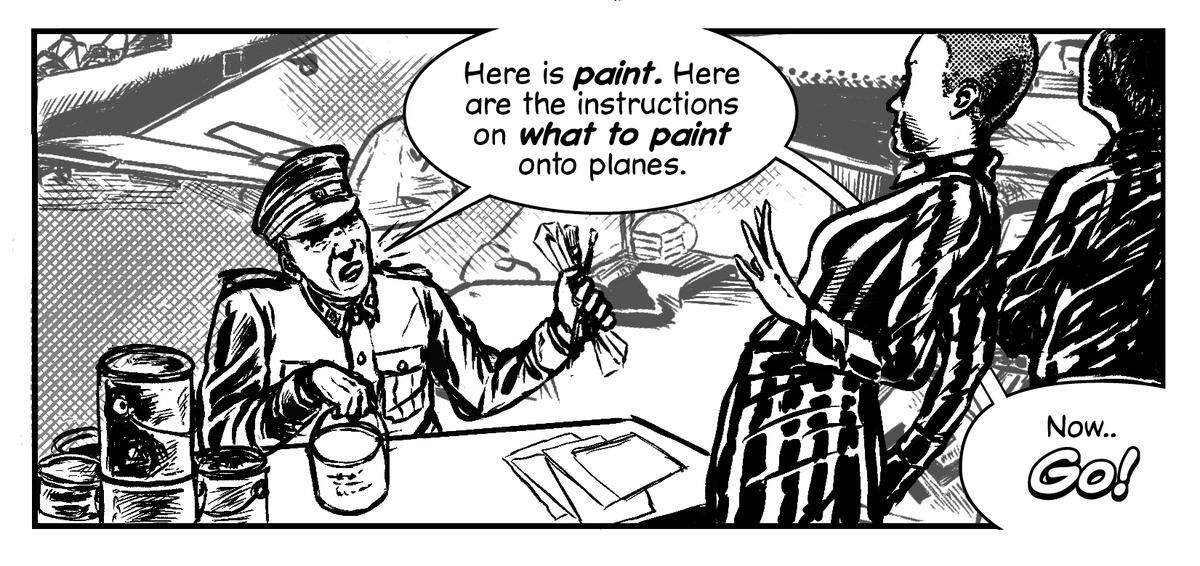
So, he directs her to read the instructions on a piece of paper and points her in the direction where a plane sits on the ground. She spends all day, like the others, painting Nazi swastikas and numbers on planes. The work continues for weeks and at the end of each day the women are marched a long distance from the woods back to the camp. Eventually, it begins to take its toll.
One day Cela, Bluma’s sister, gets a fever and is very weak: It’s the result of having contracted typhus — a disease caused by lice — which spreads in close quarters. Since the barracks were overcrowded, many others also got sick.
Cela (sickly to sister): “I am so tired and weak I fear I won’t live much longer. Please can you get some medicine for me or more food?”
Bluma: “Yes of course. I will try.”
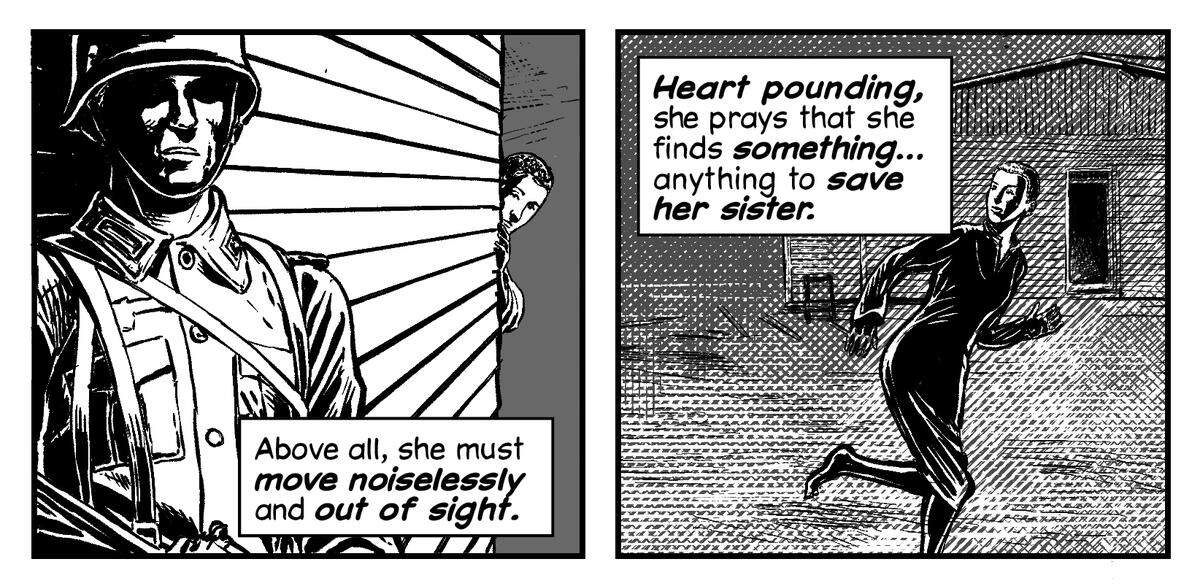
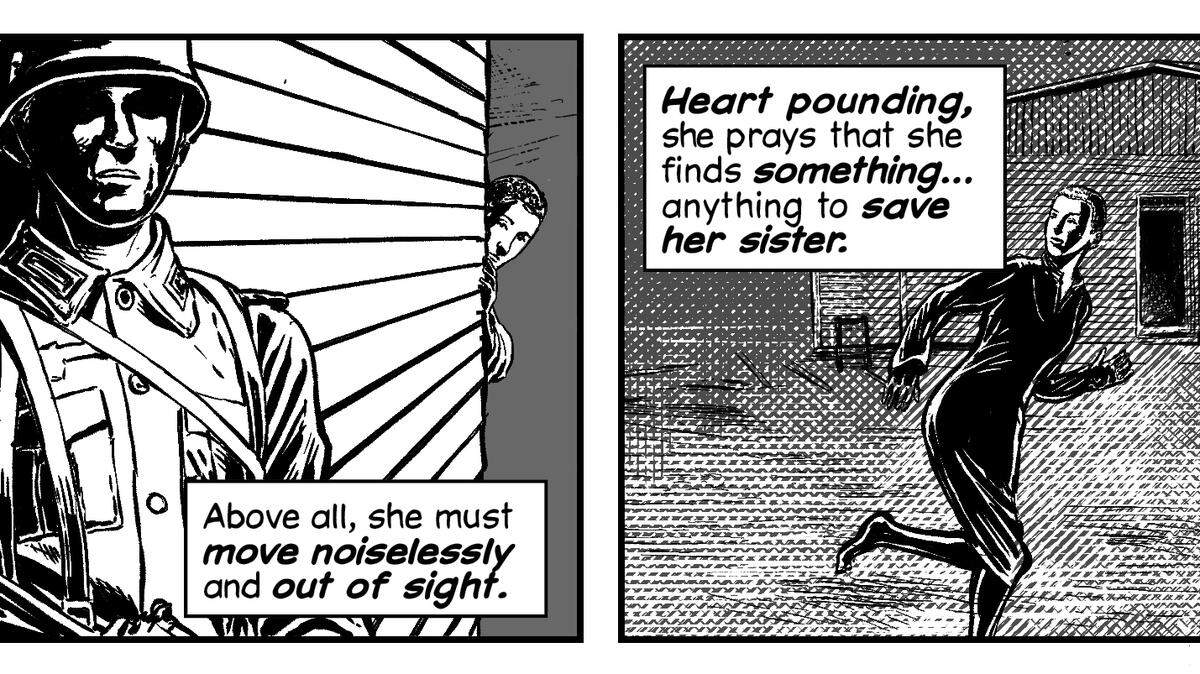
Bluma knows that to leave the barracks at night is a huge risk. What if she gets caught? What might happen then? She decides she will do anything for her sister who has looked out for her throughout their long ordeal together.
She waits until nightfall, where she quietly sneaks out of the barracks and enters the empty kitchen. The lights are off. She steals an apple and puts it in her pocket. Carefully, she looks around and times her movements so that she is not spotted by the Nazi guards as she makes her way ever so silently back to the barracks.
Bluma: “Here, (removing apple from pocket) I got you an apple. Eat slowly and try to save some.”
Cela: “God bless you, dear sister.”
At one point, Bluma also got sick and then it was Cela’s chance to return the favor. The sisters always looked out for one another.
---
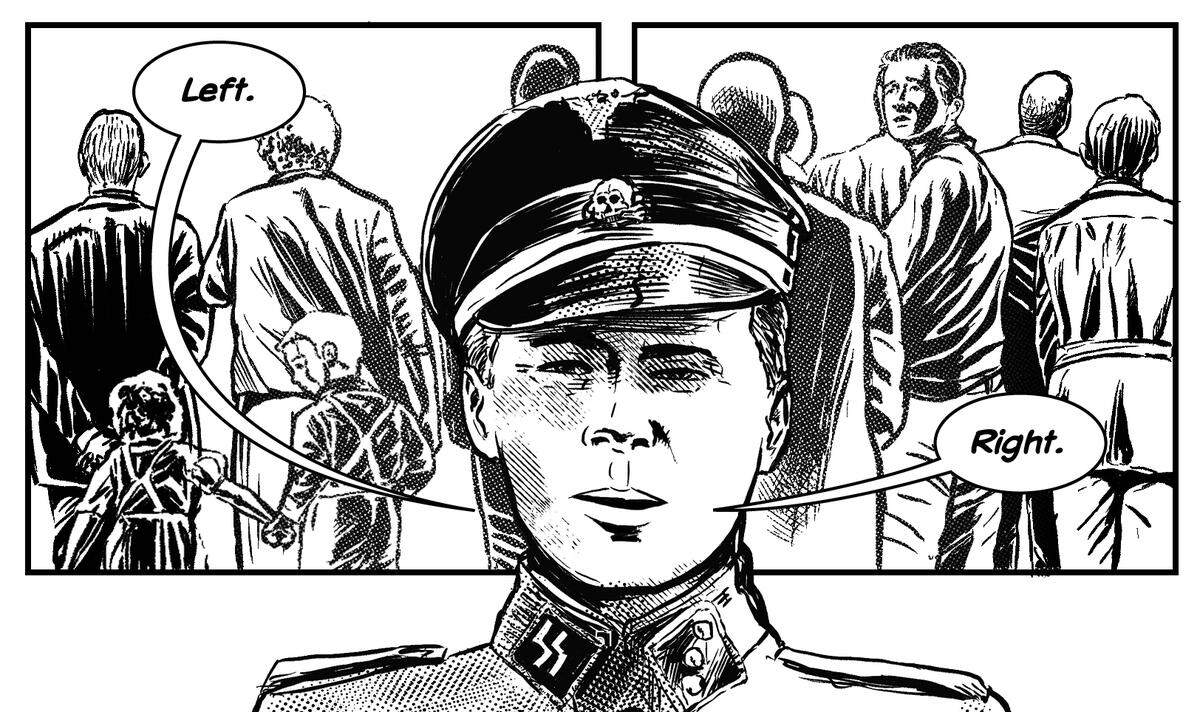
Every day in the camps was a fight for survival. One day Felix Goldberg found himself in a long line. He didn’t know why. But in the front of that line was a Nazi officer who towered over everyone else. The man was the infamous Dr. Josef Mengele. Felix quietly inquired, “What’s happening?” and the answer he got was, “Pray you get assigned to the right.”
Mengele was known as the “angel of death.” On this day, the Nazi doctor was separating the weak from the strong. Those judged to be strong were sent off to work; the weak went to their deaths.
It was Felix’s turn to be examined by Mengele. He was rightfully apprehensive as to what he should expect. Mengle instructed Felix to pull up his shirt. He felt Felix’s arms and saw that he was strong and fit. “You, go to the right.” This meant Felix would survive another day.
Read the final installment in Sunday’s paper.
This story was originally published April 30, 2022 at 5:00 AM.